There are easier ways to make a blue dial.
Moritz Grossmann could have painted one. Lacquered one. Galvanised one. Given it a sunburst finish and allowed the colour itself to do most of the talking.
Instead, for a watch celebrating the 200th anniversary of Moritz Grossmann’s birth, the Glashütte manufacture chose a process involving silver powder, salt, tartar, water, a tiny brush, a remarkably steady hand and the sort of patience that modern manufacturing has spent the past century trying to eliminate.
Then it made the dial turquoise.
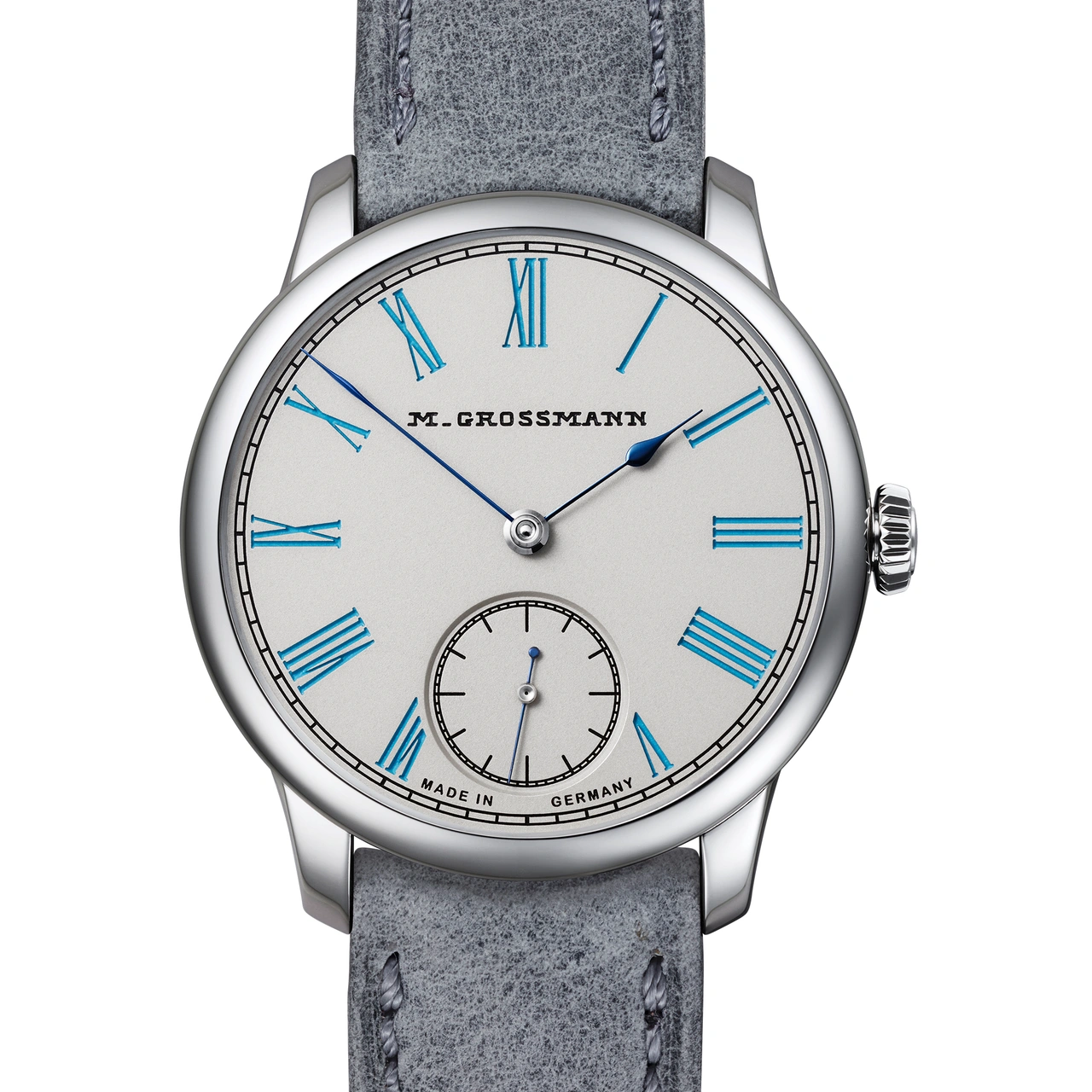
The result is the Moritz Grossmann TEFNUT 36 Silver-Plated by Friction Turquoise Blue, a 12-piece limited edition that might initially appear to be a classical dress watch in an unusually vivid colour. Look closer and it becomes something far more interesting – a demonstration of how an almost forgotten 19th-century craft can create something that looks unmistakably contemporary.
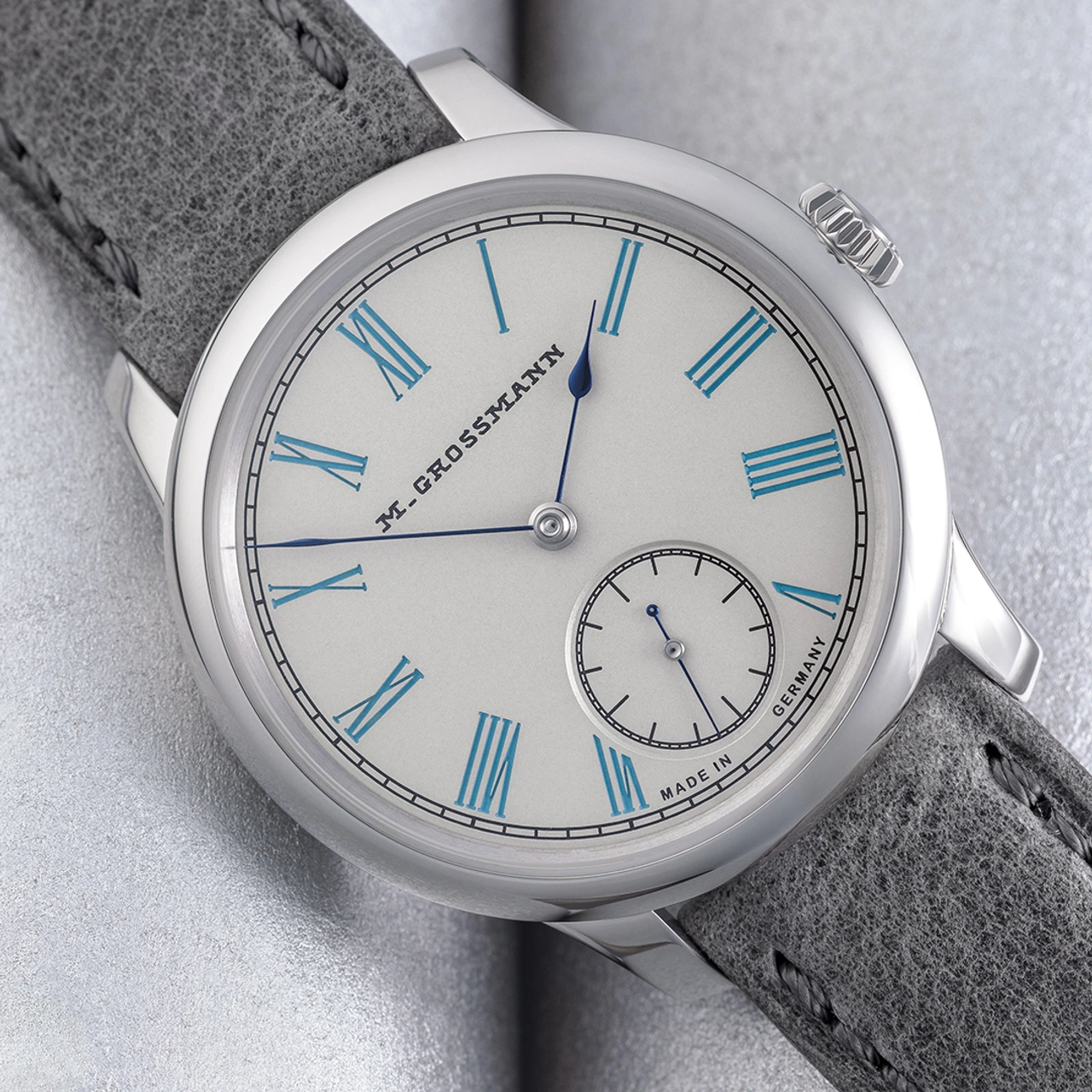
Turquoise blue makes an immediate impression, particularly inside a watch as restrained as the TEFNUT. But concentrating solely on the colour misses what makes this dial remarkable.
Underneath that blue-green surface is a dial finished using silver-plating by friction, an old technique also known as silver-plating by grit. It is not simply a decorative coating.
Silver powder, salt, tartar and water are successively picked up with a small brush and physically rubbed into the dial surface. Again and again the brush moves across the metal as the material is gradually worked into it. The watchmaker has to judge the quantity, pressure and progress by eye and feel. Too much material is wrong. Too little is wrong. The final grain needs to be sufficiently fine and even that the resulting surface takes on the distinctive soft character the technique is known for.
There is no convenient button marked ‘silver plate’. And there is very little room for error. Moritz Grossmann revived this traditional process within its own workshops, where only a small number of specialists have acquired the skill to perform it properly. That alone makes the dial unusual. What happens next makes this particular version extraordinary.
Once the friction-silvered surface has been completed and gently polished, colour is introduced.
Moritz Grossmann describes it as a blue tinged with green. In practical terms, that means the dial sits somewhere in the fascinating territory between turquoise, blue and teal, but its exact appearance is almost impossible to pin down.
That is because the underlying silver-plated grain remains part of what you are seeing.
Light does not simply bounce off a flat coating. It interacts with the finely textured surface beneath it, creating small changes in gloss, shadow and saturation. Move your wrist and the dial moves with you. One moment the blue dominates. At another angle the green begins to emerge. Under softer light, the entire dial can become quieter and more muted.
It is the sort of surface that explains why serious watch enthusiasts still care so much about traditional dial making. A computer can specify the colour. A manufacturing line can reproduce it. Neither necessarily gives it life.
Here, the imperfection and complexity of a handmade surface are precisely what make the colour work.
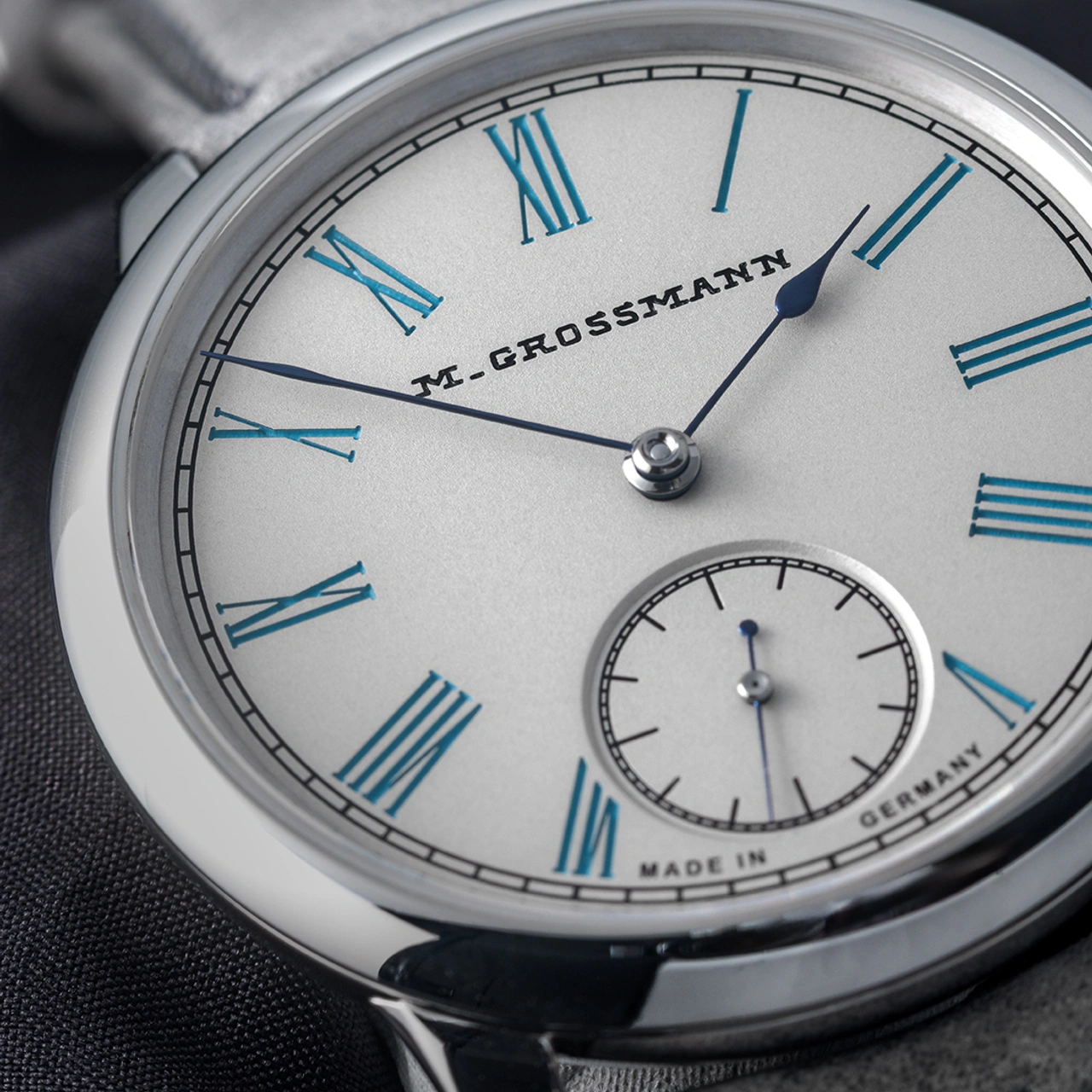
Against all that colour, Moritz Grossmann exercises remarkable restraint.
The engraved Roman numerals are lacquered blue rather than contrasting aggressively against the dial. Black is reserved for the historic ‘M. Grossmann’ signature dating from 1875, along with the minute track, subsidiary seconds scale and Made in Germany inscription.
Even the method used to achieve those markings reveals something about how seriously the manufacture approaches the dial. The lacquers are applied and kiln-fired before the friction-silvering process begins, then protected so that the numerous stages required to finish the surrounding surface do not damage them. The hands deserve equally close attention.
Moritz Grossmann is one of the increasingly rare manufactures that produces its hands in-house. They are shaped through numerous operations, gently rounded, given extraordinarily fine tips and finally heat-treated until the steel takes on its characteristic blue tone.
These are not off-the-shelf components chosen to match the dial. They belong to the same world of handwork as the dial itself.
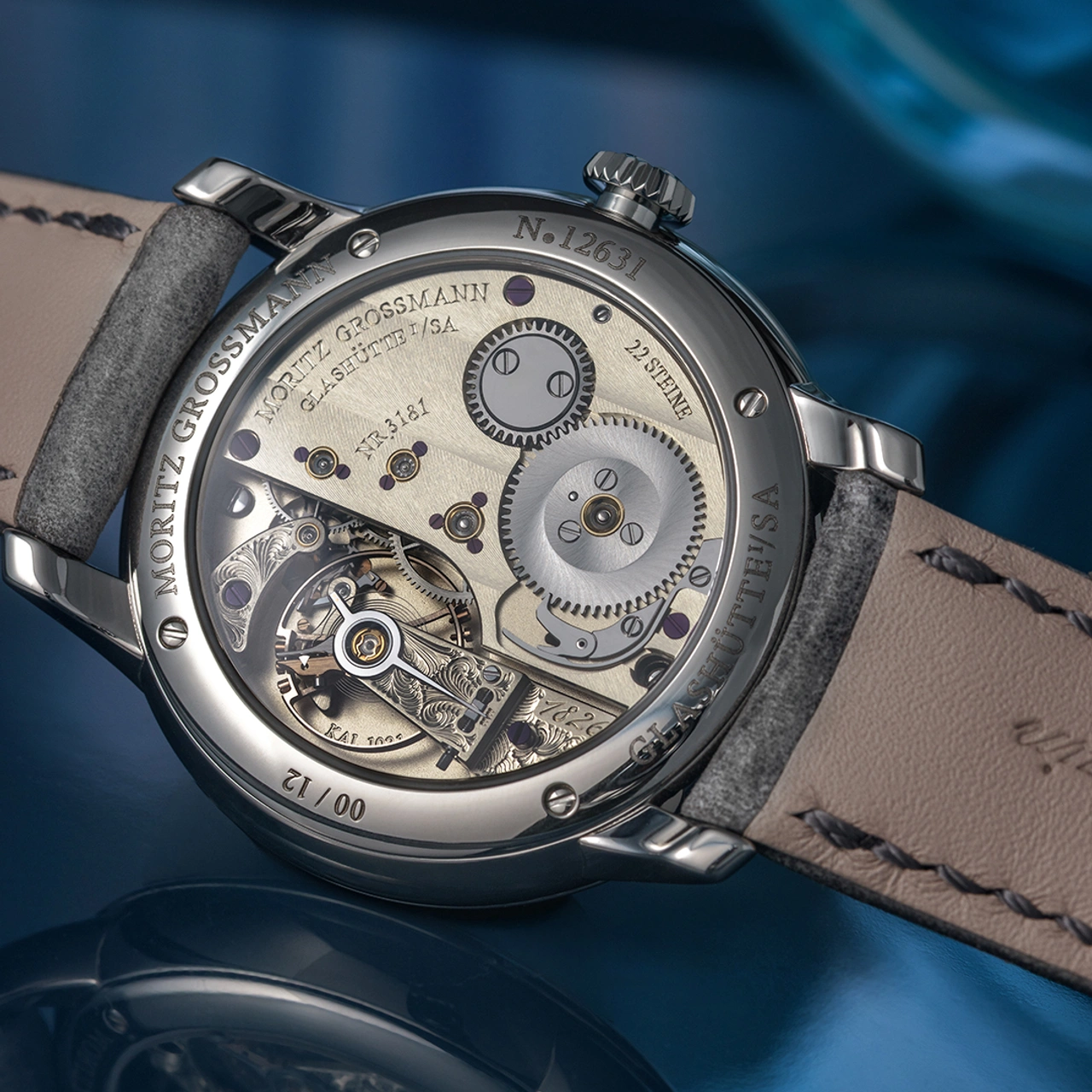
The TEFNUT measures 36 mm across and only 8.5 mm thick.
Those dimensions are important.
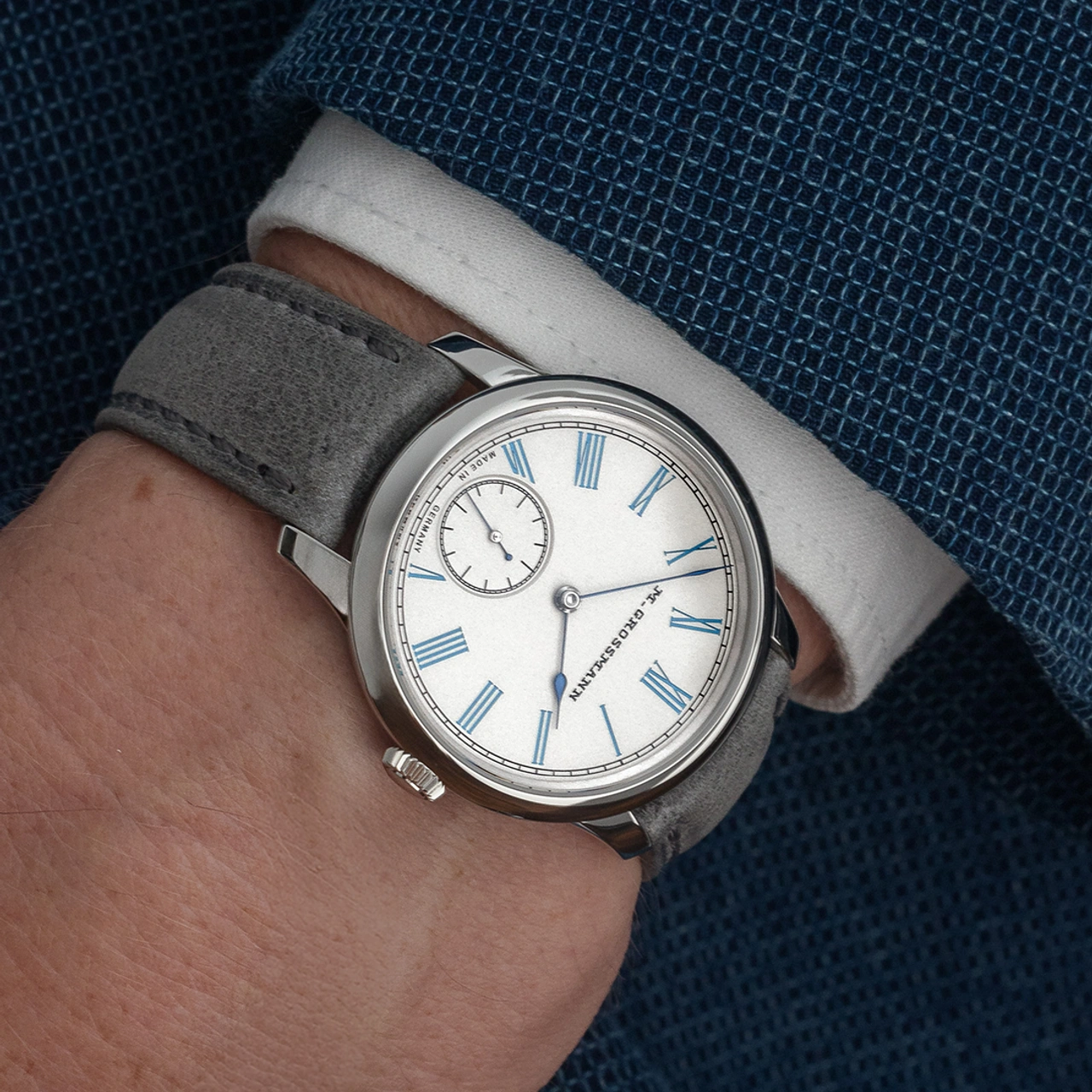
A dial this unusual could easily have become an exercise in spectacle. Increase the case to 40 or 42 mm and suddenly that turquoise expanse dominates everything. Moritz Grossmann instead keeps the proportions firmly within the language of a classical Glashütte dress watch.
The stainless steel case is slim and uncomplicated. Fine lugs extend from its sides, while the crown carries the characteristic Grossmann cross groove. A hand-stitched grey kudu leather strap introduces just enough texture without competing with the dial.
The result is a watch where the colour can be adventurous because almost everything surrounding it is controlled.
It is also a reminder that 36 mm is not a compromise size. On a watch this thin and with this much dial presence, it can be beautifully proportioned.
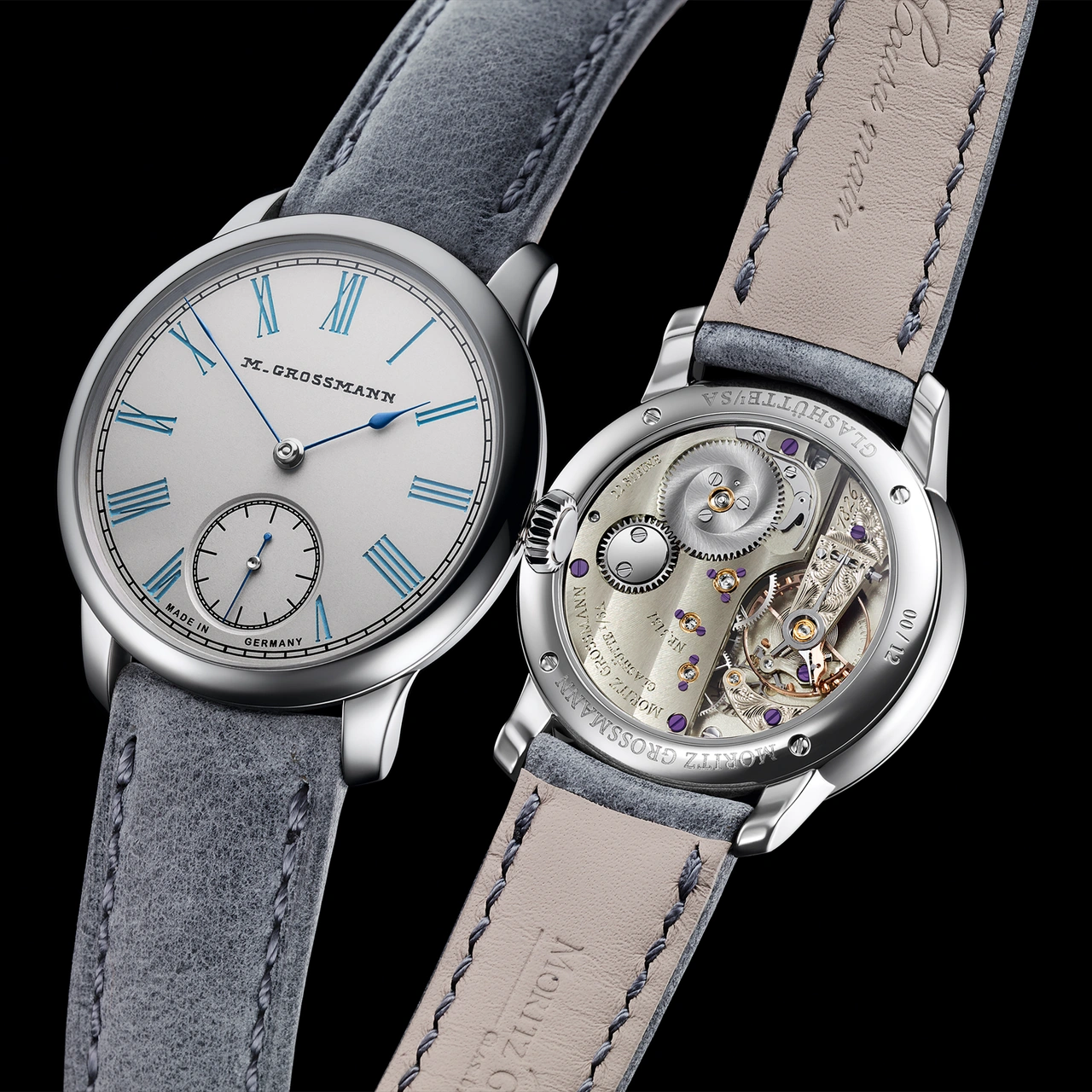
There is a point at which calling the reverse of a Moritz Grossmann watch a ‘caseback’ begins to feel inadequate.
Through the sapphire display back sits the manufacture’s calibre 102.1, a hand-wound movement measuring 26 mm in diameter and an extraordinarily slim 3.45 mm in height.
Its architecture is unmistakably rooted in Glashütte.
A traditional three-fifths plate dominates the view, accompanied by raised gold chatons secured with pan-head screws. The movement contains 188 individual components and 22 jewels, with three jewels set into screwed gold chatons.
Look towards the balance and the details become even more obsessive.
The shock-resistant Grossmann balance uses four inertia screws and two poising screws. Regulation is carried out through the manufacture’s own micrometer screw system. The escapement uses an 18-tooth escape wheel, while ARCAP is used for the train wheels. The mainspring barrel runs in bilateral jewel bearings to improve power management as torque declines.
And because this is an anniversary watch, the hand-engraved floral balance cock carries one particularly significant detail.
Carl Moritz Grossmann was far more than a watchmaker.
Born in 1826, he became a scientist, writer and technical thinker, and was instrumental in the establishment of the German School of Watchmaking in Glashütte. He was deeply interested in the technological possibilities of his era rather than simply preserving what had come before.
That makes this particular anniversary watch unusually appropriate. The TEFNUT 36 Silver-Plated by Friction Turquoise Blue does not celebrate Grossmann by making a watch that looks as if it came directly from 1875.
It takes a 19th-century technique and asks what it can look like now. Traditional silver-plating by friction provides the texture. Hand engraving, heat-blued hands and classical Glashütte movement architecture provide the craft. Then a vivid turquoise-blue dial completely changes the character of the finished watch.
That relationship between old technique and new expression may be the most fitting tribute Moritz Grossmann could have made to its namesake.
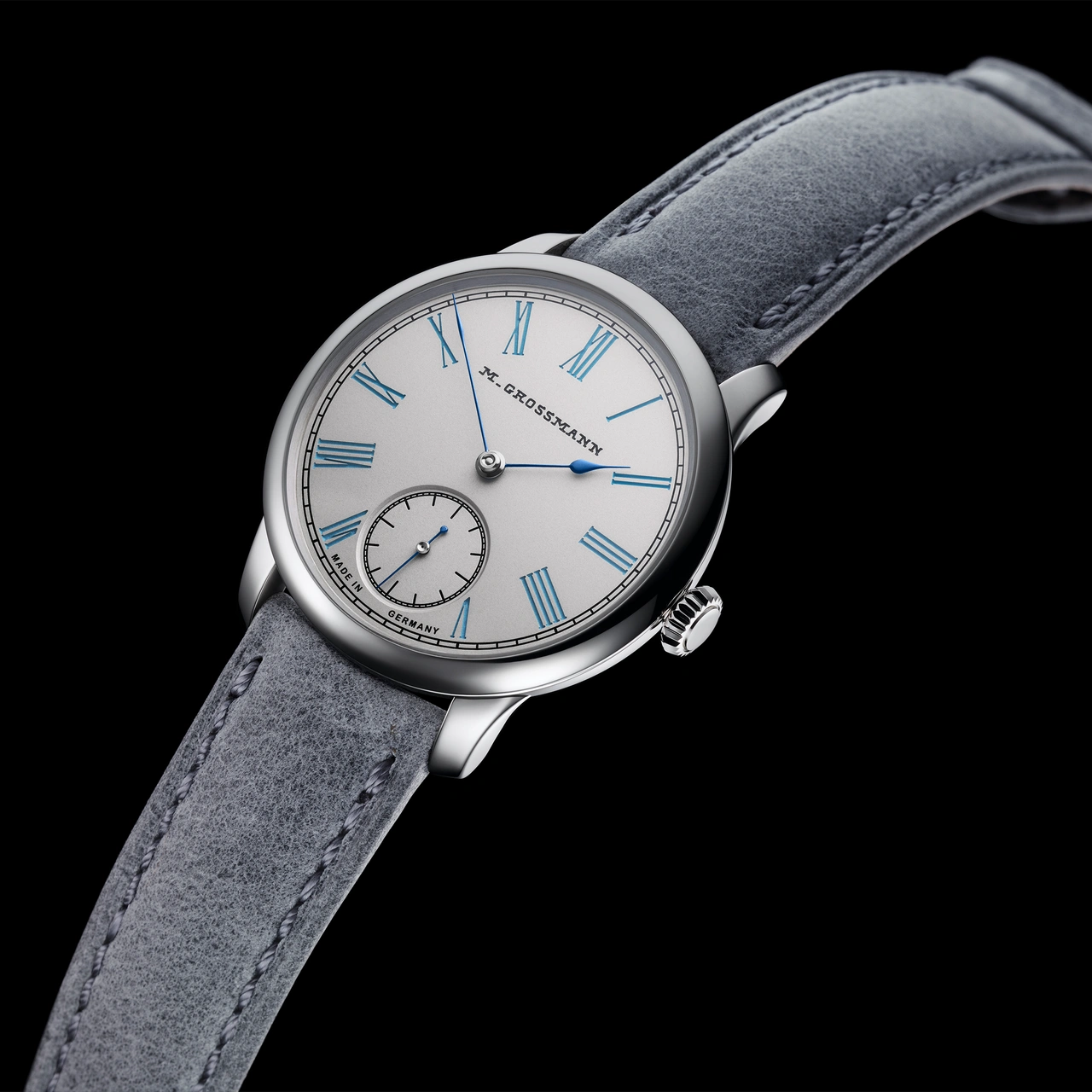
There will be just 12 examples of the Moritz Grossmann TEFNUT 36 Silver-Plated by Friction Turquoise Blue, reference MG-004153.
That number places it firmly within collector territory, but rarity is arguably not the most interesting thing about it.
The appeal lies in what those 12 watches contain.
A dial whose texture has been worked into existence by hand. Hands manufactured and annealed within the same manufacture. A traditionally constructed movement just 3.45 mm thick. Hand engraving visible through the back. And a turquoise colour that appears almost deliberately rebellious against the seriousness of all that Glashütte craftsmanship.