There is a very specific type of luxury that only exists when no one else in the room knows what you have on your wrist. While the modern watch world is often dominated by oversized, aggressively skeletonized statement pieces and rainbow-gem-set bezels designed to catch eyes from across the table, independent watchmaker Lang & Heyne is taking a decidedly quieter approach to celebrate its 25th anniversary. The Friedrich III Power Reserve in 950 platinum is a watch that completely ignores the modern impulse to flex. It doesn’t scream for attention, and it certainly doesn’t rely on flashy gimmicks. Instead, it asks you to lean in, slow down, and look closer.
At a passing glance, it is simply a beautifully ordered, highly classical timepiece. The 39.2mm case sits perfectly within traditional dress watch proportions, the dial layout is impeccably clean, and absolutely nothing about the design begs to be noticed. But the moment you actually pick the watch up off the table, the sheer density of the platinum gives the game away. It is incredibly heavy, substantial, and deeply luxurious, yet it entirely lacks the immediate, recognizable warmth and flash of yellow or rose gold. To the untrained eye, it could easily be mistaken for stainless steel. That is entirely the point. Platinum is the ultimate insider’s metal, saving its physical weight and subtle, cool luster exclusively for the person wearing it. It anchors the watch to your wrist in a way that constantly reminds you of its inherent value, without ever broadcasting that value to a stranger.
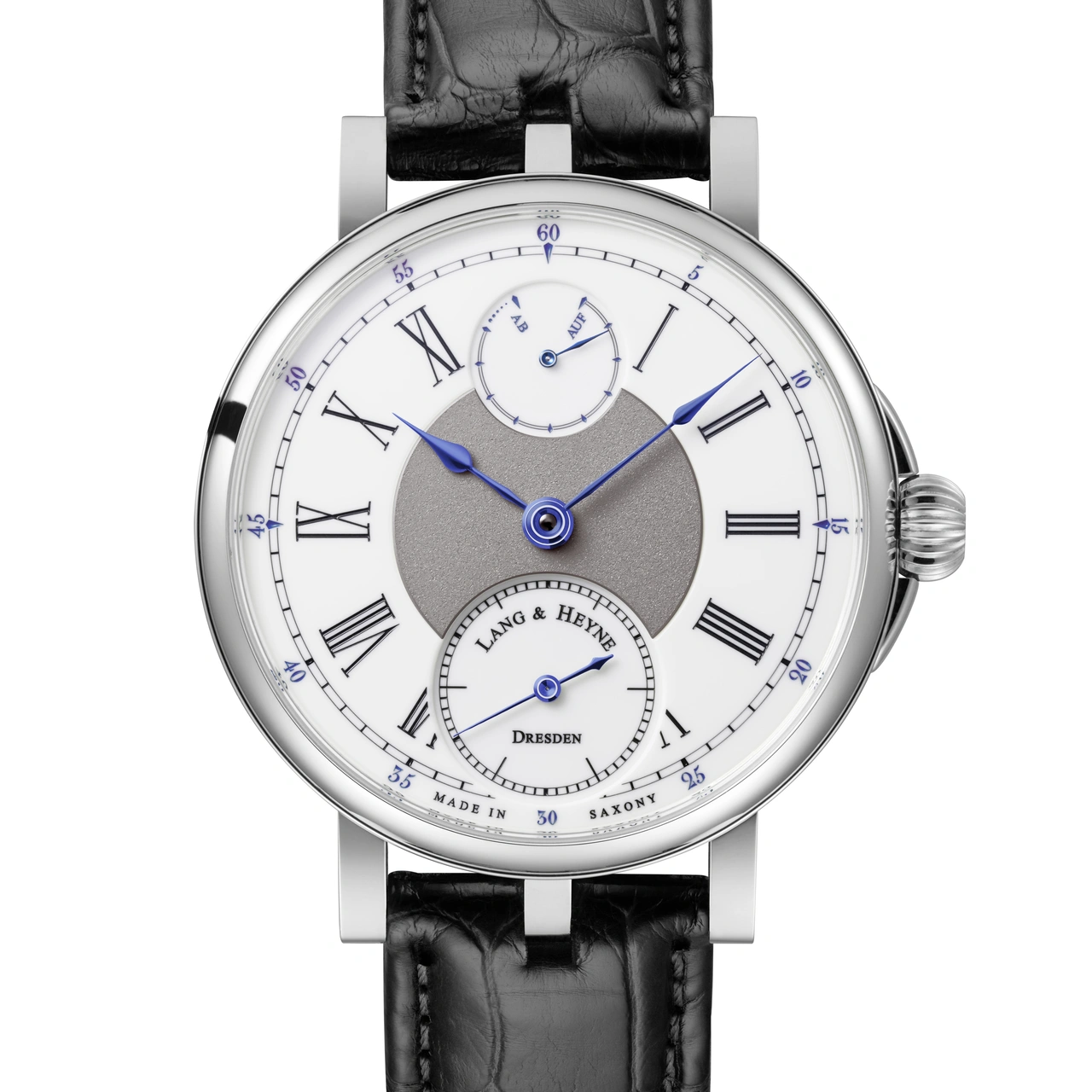
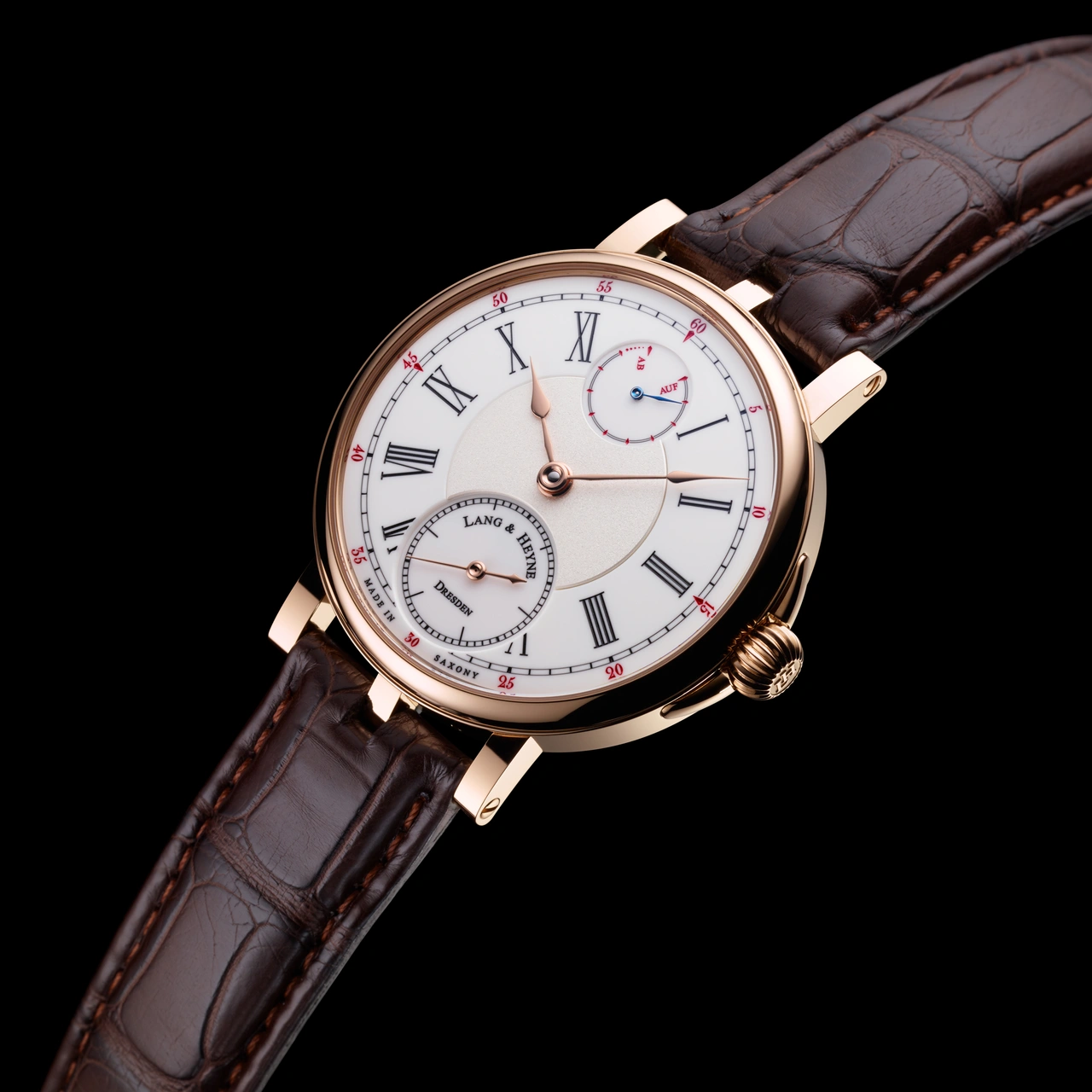
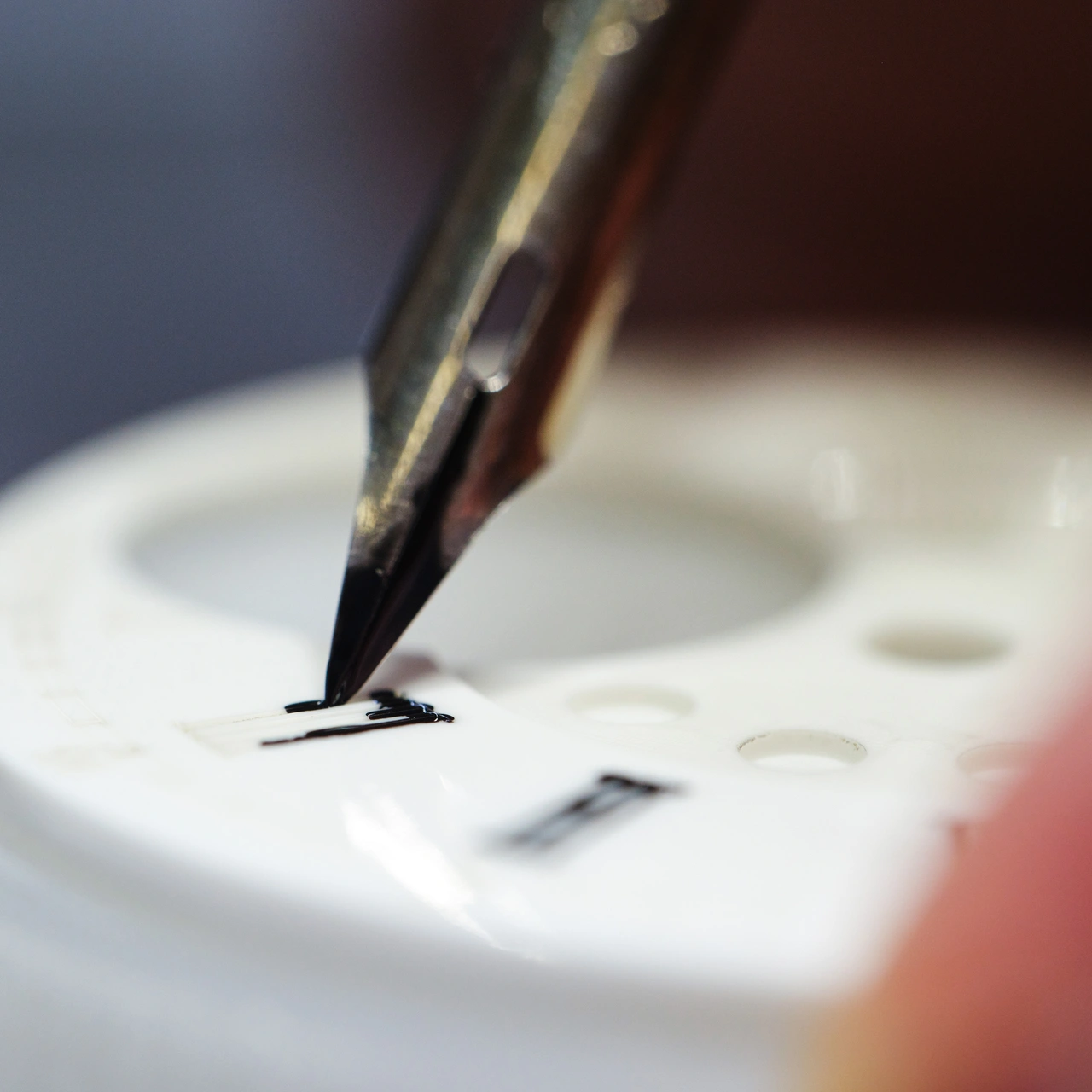
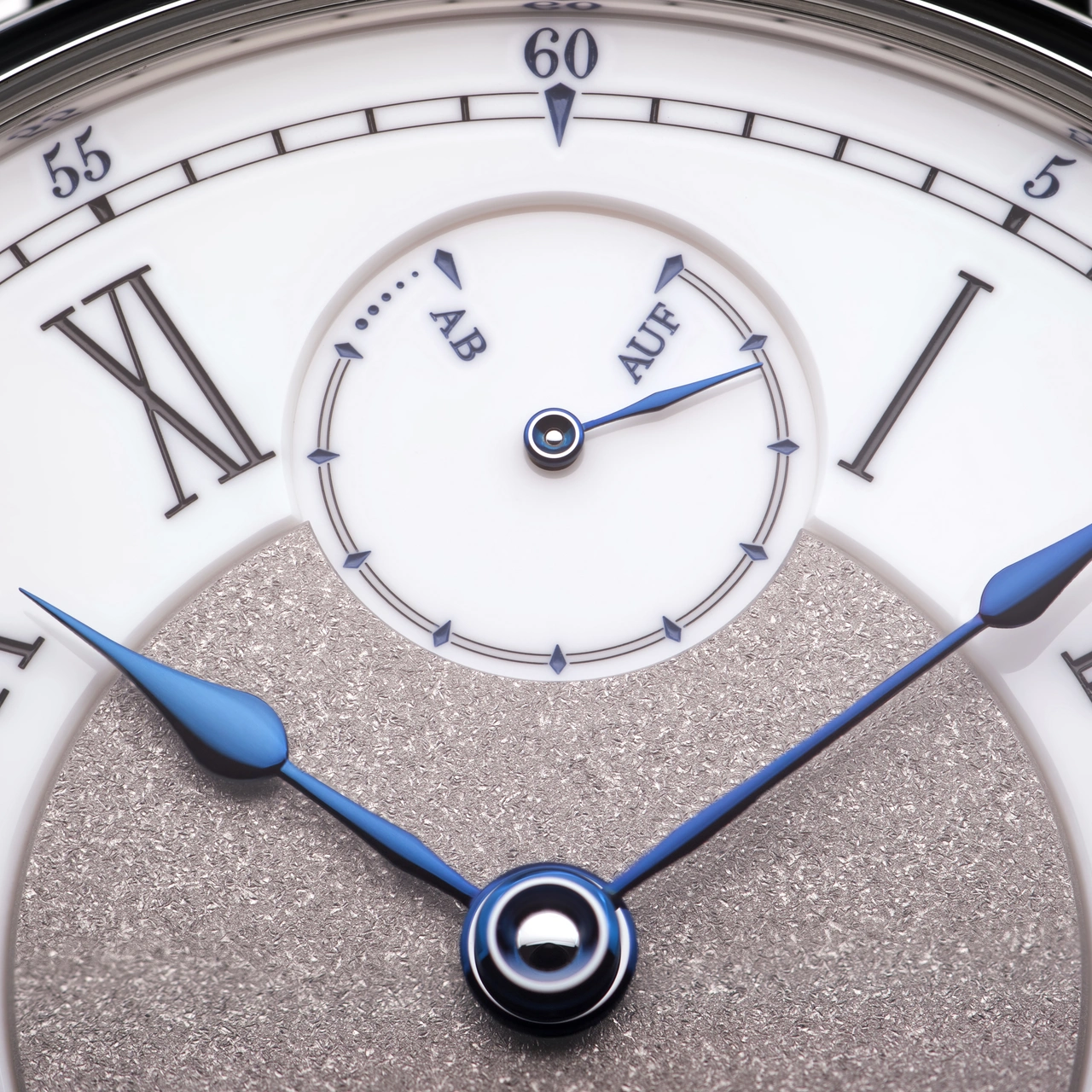
That exact same sense of quiet, uncompromising perfection carries directly over to the dial. When you hear the word “ceramic” in modern watchmaking, you immediately picture rugged dive watch bezels or high-tech, scratch-resistant sports chronographs. You rarely associate it with classical Saxon watchmaking. But here, Lang & Heyne deploys the material almost invisibly, using modern manufacturing to achieve a hyper-traditional aesthetic. The dial is actually constructed in three distinct parts, meticulously flat-polished to create a flawlessly clean surface that mimics the glassy depth of traditional enamel, but with razor-sharp tolerances that vintage techniques could never achieve.
To break up that glossy surface, the oversized seconds sub-dial is given a frosted, givré finish, providing a beautiful textural contrast. The deep, classical Roman numerals aren’t simply painted on; they are engraved directly into the raw ceramic and then carefully filled with lacquer. It is a brilliant, entirely stealthy way to use cutting-edge material science to achieve a look that feels hundreds of years old. The ceramic isn’t there to serve as a marketing talking point about durability. It is there because it provides a perfectly stable, ultra-defined canvas for the rest of the dial’s architecture.
And that architecture feels incredibly grounded. The cool, silvery tone of the platinum case locks in the dial’s stark geometry, while the new power reserve indicator positioned at the top of the dial provides a much-needed visual counterweight to the massive, off-center seconds display down below. The original Friedrich III has always been a watch that thrived on a sort of mild, charming asymmetry. By adding the power reserve up top, and pairing the layout with newly designed, broad spade hands that assert themselves beautifully against the white ceramic, the whole composition suddenly clicks into perfect balance.
Crucially, that power reserve indicator isn’t just there to fill negative space on the dial. On an automatic watch, a power reserve is somewhat redundant. But on a manual-wind watch, tracking the energy of your mainspring is a genuinely useful, tactile part of the ownership experience. It frames the Friedrich III as a precision mechanical instrument rather than just a passive object of luxury. Lang & Heyne deliberately draws a line back to vintage marine chronometers, where operators needed to know exactly how much tension was left in the barrel to maintain precision. By tracking the power curve, you know exactly when the watch needs winding, helping you keep the mechanical heartbeat running in its optimal torque range for the best possible chronometry. It creates a daily dialogue between the wearer and the machine.
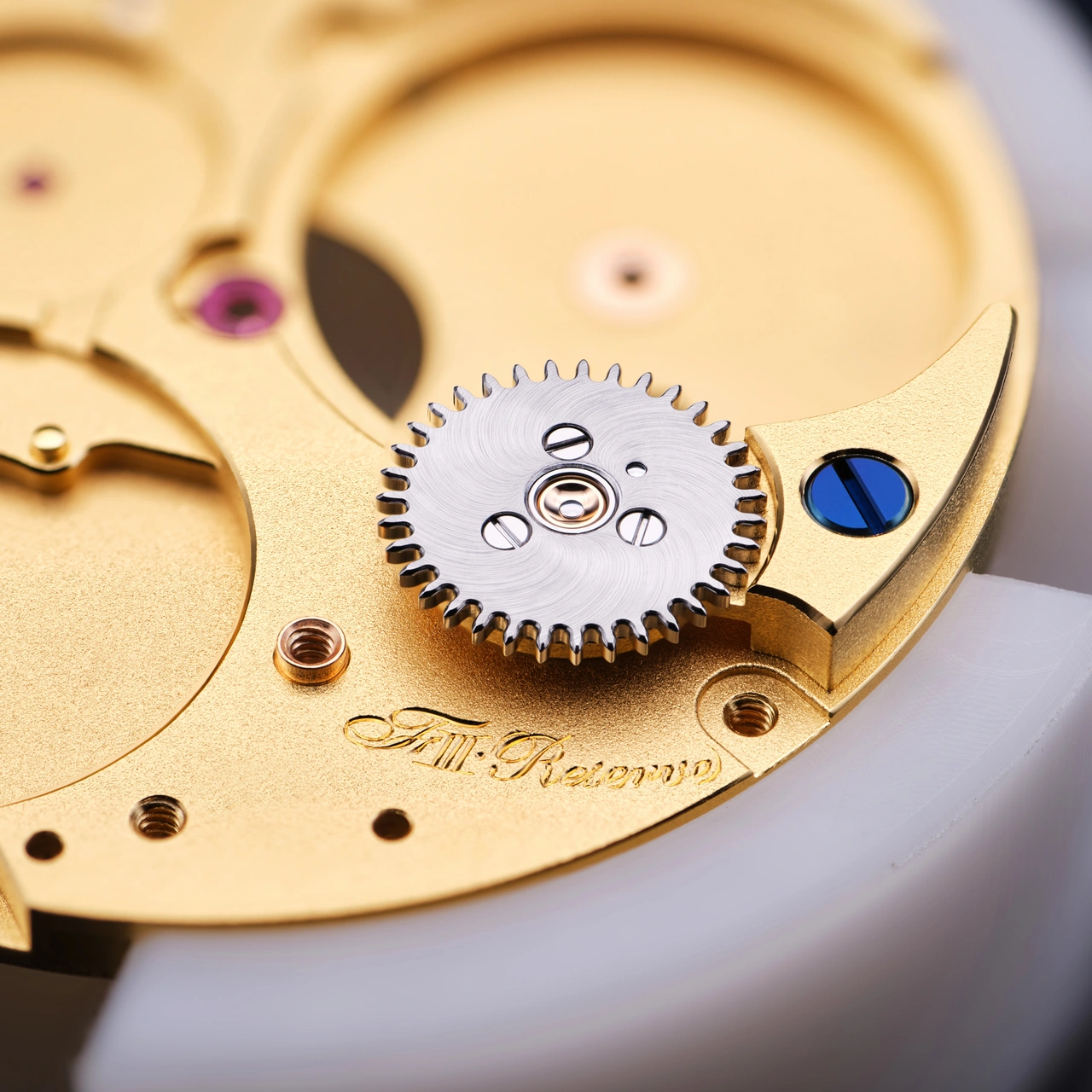
The heavy lifting for that specific complication happens completely out of sight. To drive the power reserve indicator, the new hand-wound Caliber VI-II utilizes a clever, purpose-built differential gear train. Designing a power reserve is mechanically tricky because the system has to account for two completely opposite forces at the exact same time: the sudden input of energy when you turn the crown to wind the mainspring, and the slow, gradual release of that energy as the escapement ticks away. The differential essentially acts as a mechanical calculator, interpreting both the winding and the unwinding to determine the net energy remaining, and then translating that math into the physical position of the hand on the dial.
What makes Lang & Heyne’s approach so impressive is the sheer efficiency of the engineering. They managed to track this complex push-and-pull of energy using just two crown-toothed wheels. Good mechanical design isn’t about adding as many parts as possible to look complicated; it’s about solving a problem with as much elegance and simplicity as possible. Because of that highly efficient differential system, the Caliber VI-II remains incredibly slim, measuring just 4.9mm thick and 33.5mm across. It ensures the 39.2mm platinum case never has to bulge or distort to accommodate the new mechanics.
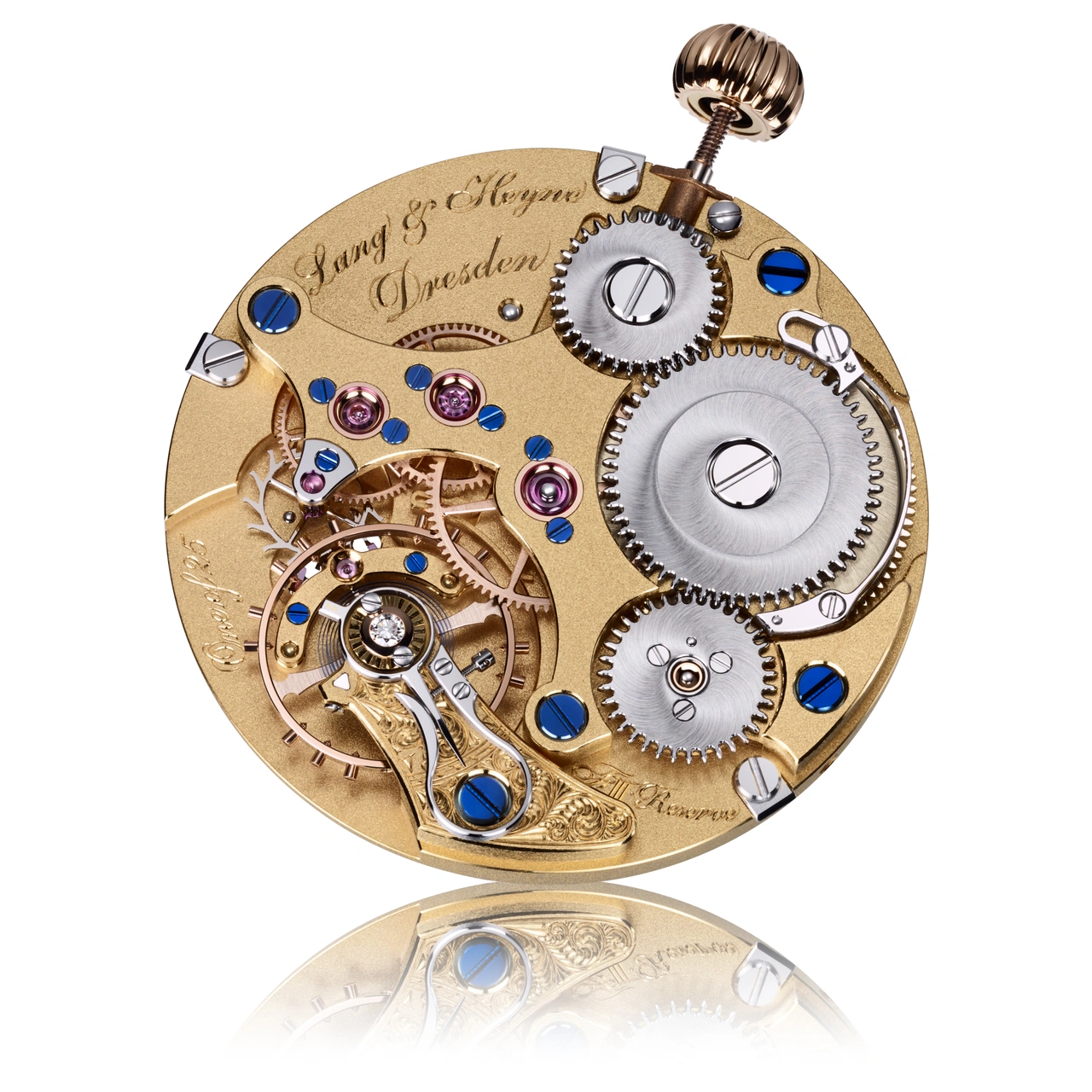
While the front of the watch is an exercise in total restraint, the moment you flip the case over, all that visual discipline goes straight out the window. Traditional German watchmaking is famous for the three-quarter plate—a massive bridge that covers nearly all the moving parts, leaving only the balance wheel exposed. It’s historically accurate, but visually restrictive. Lang & Heyne completely rejects this norm. They leave the architecture of the Caliber VI-II wide open.
Through the sapphire caseback, the gear train, bridges, massive ruby jewels sitting in gold chatons, and beautifully polished screws are all proudly exposed, creating a stunning sense of mechanical depth. When you open up a movement like this, there is nowhere to hide poor finishing. Every single edge is meticulously beveled and polished by hand. The undeniable centerpiece is the deeply hand-engraved balance cock, a touch of pure, irreplaceable human craftsmanship that ensures no two watches are exactly identical. Below it, the large balance wheel beats away at a leisurely, traditional 18,000 vibrations per hour (2.5 Hz). It is a slow, rhythmic heartbeat that feels entirely appropriate for a watch steeped in this much history, delivering a highly respectable 55 hours of power reserve.
Named after Friedrich III, the Margrave of Meissen, the watch is deeply rooted in the history of the House of Wettin and the region of Saxony. It is a part of the world that has been obsessed with precision engineering, decorative arts, and uncompromising craftsmanship for centuries. This specific watch, limited to a total of just 25 pieces split between platinum and rose gold, is a distillation of that exact cultural heritage. It embodies a distinctly Saxon approach to luxury, where precision and mechanical integrity always come before spectacle.
Over the last 25 years, Lang & Heyne has grown from a tiny startup into a fully realized, independent manufacture. They employ dedicated watchmakers, CNC specialists, and finishers, yet they have fiercely protected their low production volume. They didn’t build the Friedrich III Power Reserve as an excuse to slap a giant “25th Anniversary” logo on a dial and throw a massive industry party. They built it to quietly, methodically prove exactly what they do best, and to offer a handful of collectors a piece of watchmaking that doesn’t care if the rest of the world understands it or not.