There is an understandable temptation, when looking at a familiar watch in a new colour, to treat it as a cosmetic update. Change the dial, change the strap, perhaps alter the finishing of a bridge or two, and another edition joins the collection. The Armin Strom Dual Time GMT Resonance Manufacture Edition Blue resists that kind of quick assessment. Blue is certainly the most immediately obvious difference, but the interesting part is what the colour does to a movement that was already architecturally unusual.
This is, after all, not a conventional GMT watch with an additional hand circling the same dial once every 24 hours. The Dual Time GMT Resonance presents two separate time displays, two regulating organs and two independent trains, brought into relationship through one of the most intriguing physical phenomena used in contemporary mechanical watchmaking. The new Manufacture Edition Blue takes that already complex arrangement and gives it a stronger visual hierarchy. Areas that could previously disappear into the intricacy of the mechanism now become easier to read. Polished edges become brighter, white dials appear crisper and the oscillating balances seem almost suspended above the deep blue mainplate beneath them.
That makes this edition worth looking at as a complete watch rather than simply another colour variation. Armin Strom has long occupied an interesting position among modern independents. The manufacture is technically ambitious, but it rarely seems interested in complexity purely for the sake of creating a longer list of complications. Much of its best work is concerned with the mechanics of timekeeping itself. Resonance sits very naturally within that philosophy.
A travel watch built around resonance
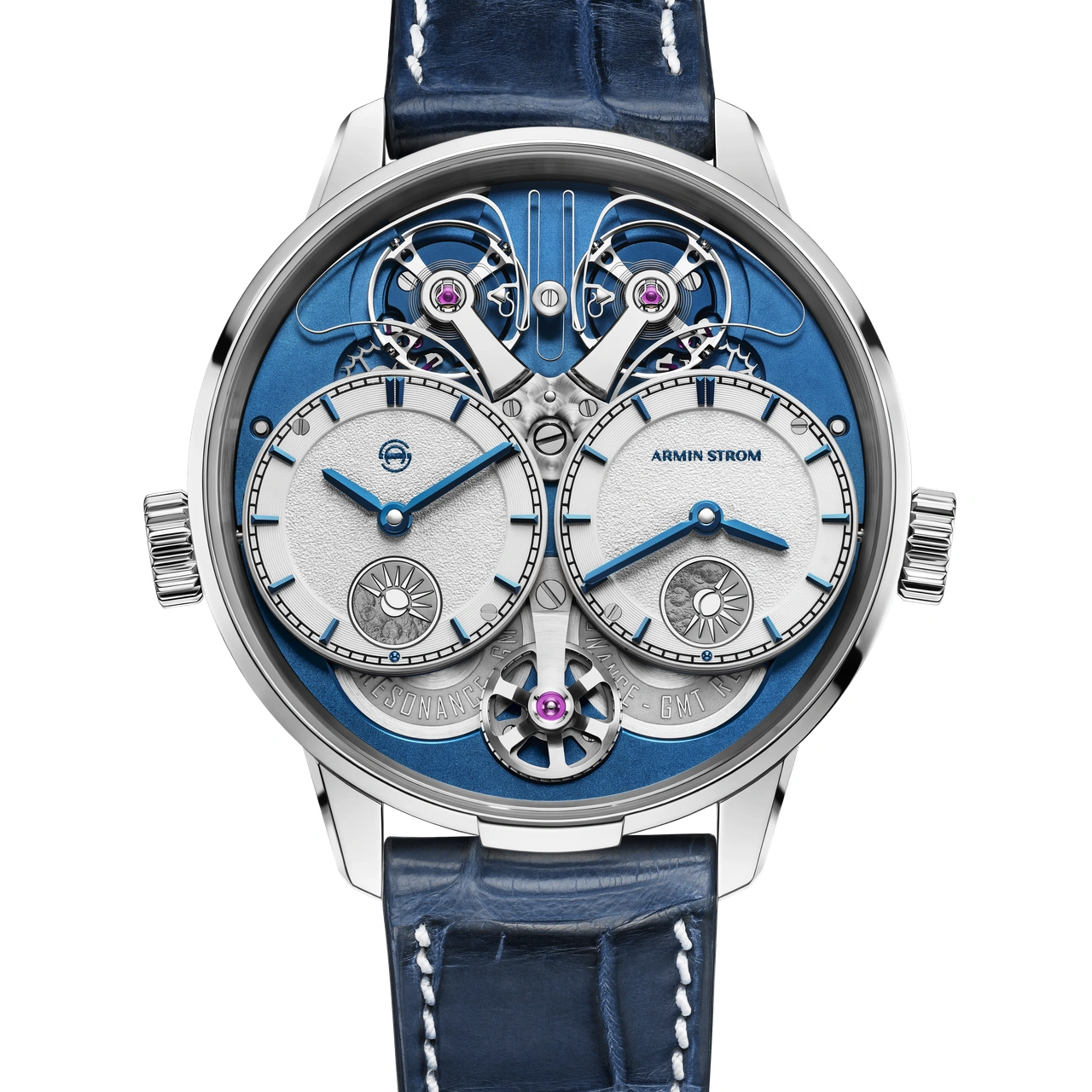
The calibre ARF22 is the reason the Dual Time GMT Resonance exists. Entirely designed, developed and produced by Armin Strom, it contains two independent regulating systems connected by the manufacture’s patented resonance clutch. Each regulating system drives its own display of hours and minutes, with a separate day/night indication accompanying each time zone.
The result is fundamentally different from the usual approach to a travel watch. Instead of one movement displaying local time and an additional reference time, the ARF22 presents two time displays with equal importance. There is no obvious “main” dial and secondary GMT indication. Whether someone is keeping track of Brisbane and Geneva, Sydney and London, or simply home and destination time, both zones are given their own hands, their own dial and their own day/night display.
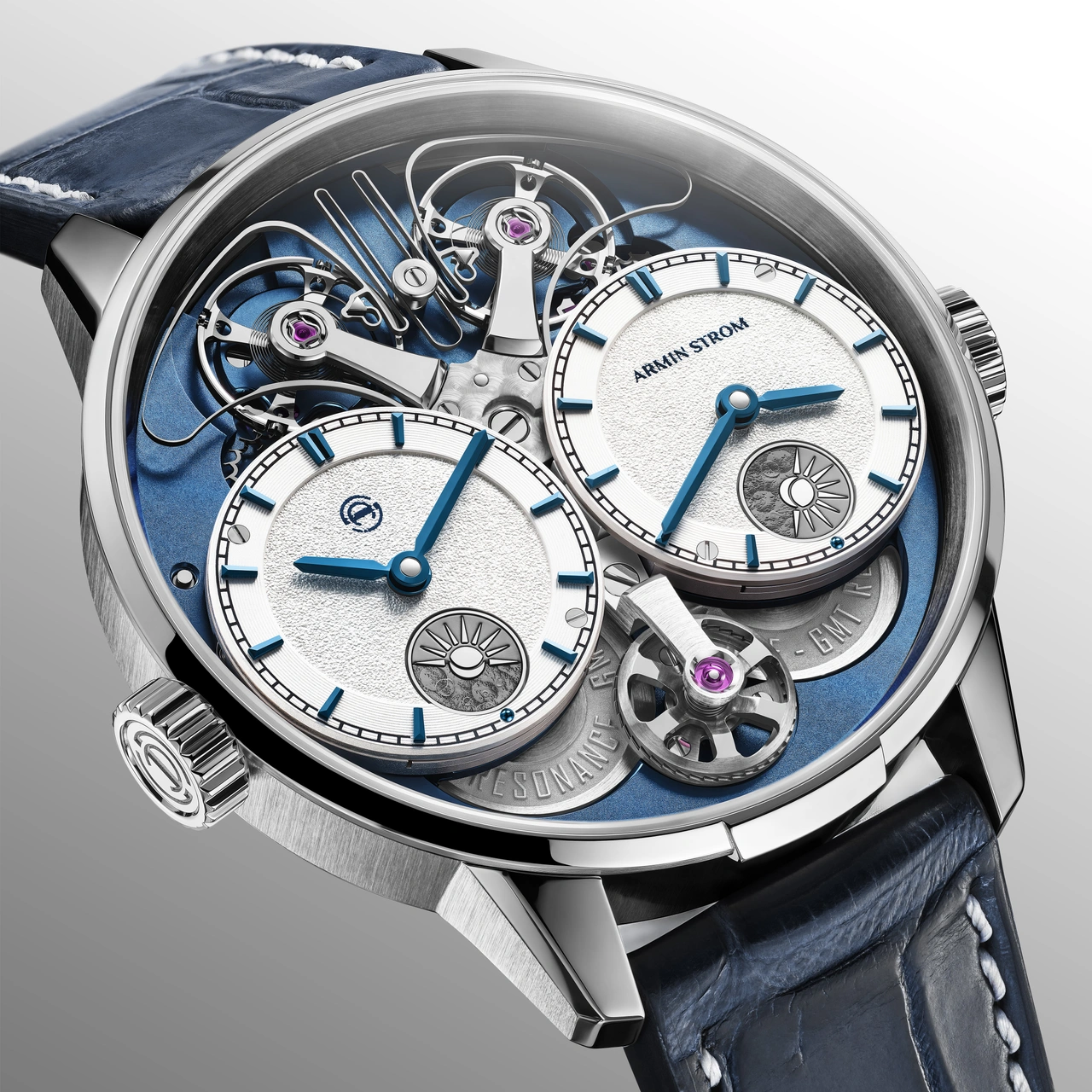
That symmetry suits the mechanics underneath. Two regulating organs are visibly operating beside one another, and the resonance clutch allows them to interact until their oscillations become synchronised. Resonance has fascinated watchmakers for centuries because it is a physical effect rather than a conventional complication that simply adds another indication. Two oscillators influence one another through the transmission of tiny vibrations, eventually settling into a shared rhythm.
Armin Strom’s solution is especially compelling because it makes the interaction direct and visible. The patented clutch spring mechanically links the two systems, permitting the balances to exchange energy. In practical terms, the system is intended to improve chronometric stability, with disturbances affecting one oscillator being compensated for by the relationship between the pair. From an enthusiast’s perspective, however, there is another attraction. It is possible to actually watch the principle operating.
Mechanical watches often hide their most interesting work. A perpetual calendar can look wonderfully restrained from the front even though hundreds of components are calculating the lengths of months beneath the dial. With the Dual Time GMT Resonance, the complication itself becomes a large part of the visual identity. The twin balances are there, in motion, almost asking the owner to stop reading the time for a moment and watch the movement instead.
Why the blue changes more than expected
Blue watches are hardly unusual. Blue dials, blue bezels and blue straps have become staples across almost every section of the market. Armin Strom has used the colour differently here. Rather than simply applying blue to the easiest visible surface, the manufacture has given the underlying mainplate a deep blue PVD treatment and extended the same treatment to the gear-train bridges visible from the reverse.
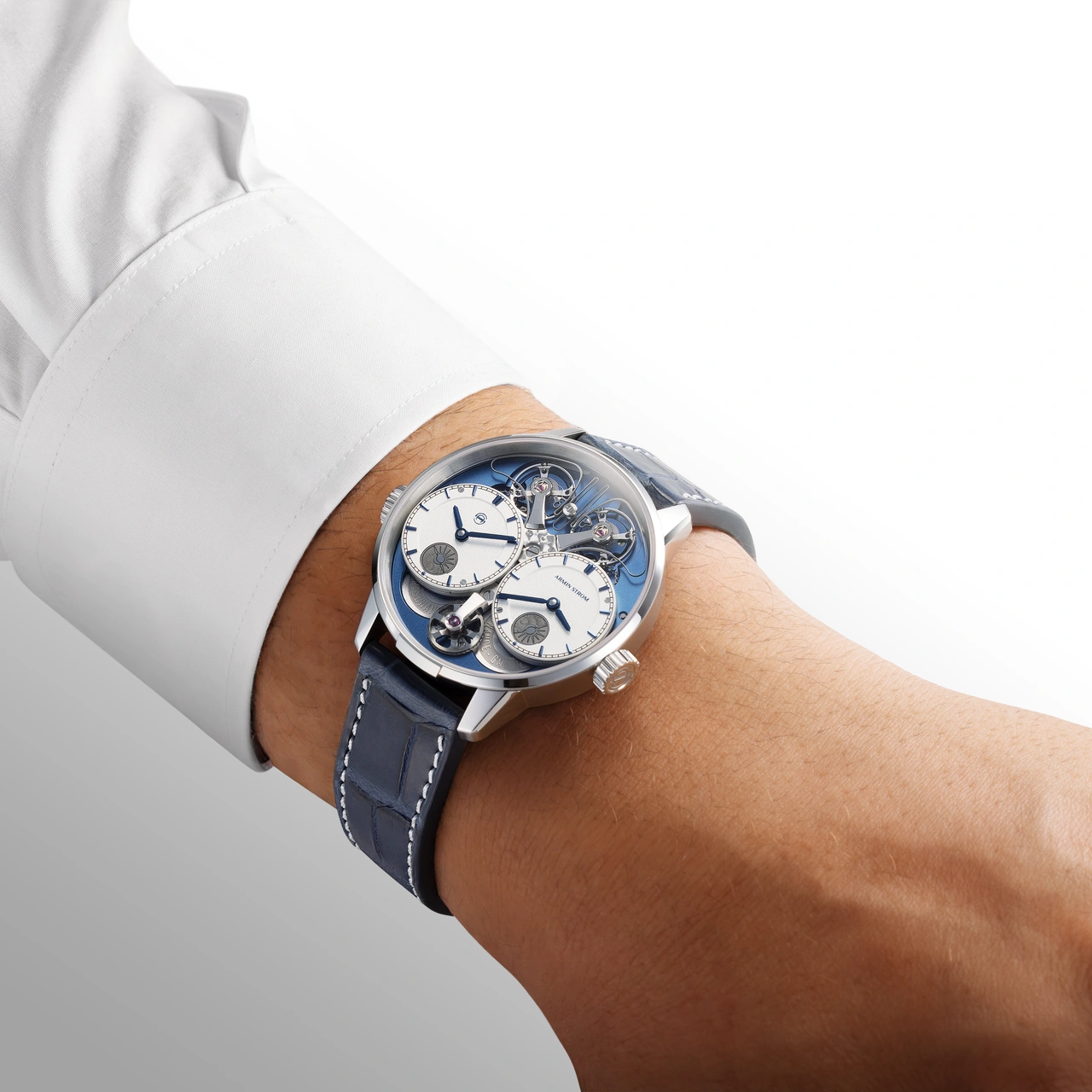
It changes the character of the watch substantially. Against the blue mainplate sit two white grenage dials, each surrounded by a white azurage chapter ring. Grenage finishing provides a fine, slightly granular texture rather than a reflective gloss, so the dials have a softness that works particularly well against the saturated colour surrounding them. They appear almost like two traditional pocket-watch dials placed over a considerably more modern mechanical structure.
There is an appealing tension in that combination. The colour palette itself is classical. Blue hands and indexes against white dials have appeared throughout traditional watchmaking for generations. Yet the architecture around those dials is unmistakably contemporary. The wearer sees wheels, balances, bridges and the resonance system itself occupying the spaces where a conventional watch would have an uninterrupted dial.
The applied indexes are blue PVD-coated and polished, as are the facetted hands. It would have been easy for so much blue to become monotonous, but variations in texture prevent that. Polished surfaces reflect light differently from the matt depth of the mainplate, while the white grenage and azurage provide a contrasting neutral foundation. Depending on the viewing angle, one part of the movement comes forward while another recedes.
This is where the new colour becomes more than decoration. The darker mainplate makes polished bevels considerably easier to appreciate. A bright chamfer around the edge of a bridge is inherently subtle when surrounded by similarly coloured metal. Place that same polished edge against deep blue PVD and its geometry becomes far more obvious. The finishing starts to define the structure of the movement.
Two small details that deserve attention
The day/night indicators could easily have been treated as straightforward functional elements, but they are among the more charming details of the watch. Each dial incorporates a polished and blackened stainless steel disc depicting a sun and crescent moon. The moon receives an engraved crater-like surface, adding a tiny amount of texture to a component that many brands would simply print.
These indicators are useful because two independent time zones can quickly become confusing when they are separated by many hours. Yet their execution also demonstrates the kind of detail that gives independent watchmaking its appeal. Nothing about the cratered moon is necessary for the watch to function. It is there because someone decided that a component only a few millimetres across should be interesting when viewed closely.
That attitude is reflected throughout the ARF22. The calibre consists of 231 components and 40 jewels, running at 3.5 Hz, or 25,200 vibrations per hour, with a 42-hour power reserve. Those specifications are respectable, but they are not the part that makes the movement memorable. The fascination comes from how clearly the construction has been considered as both engineering and visual composition.
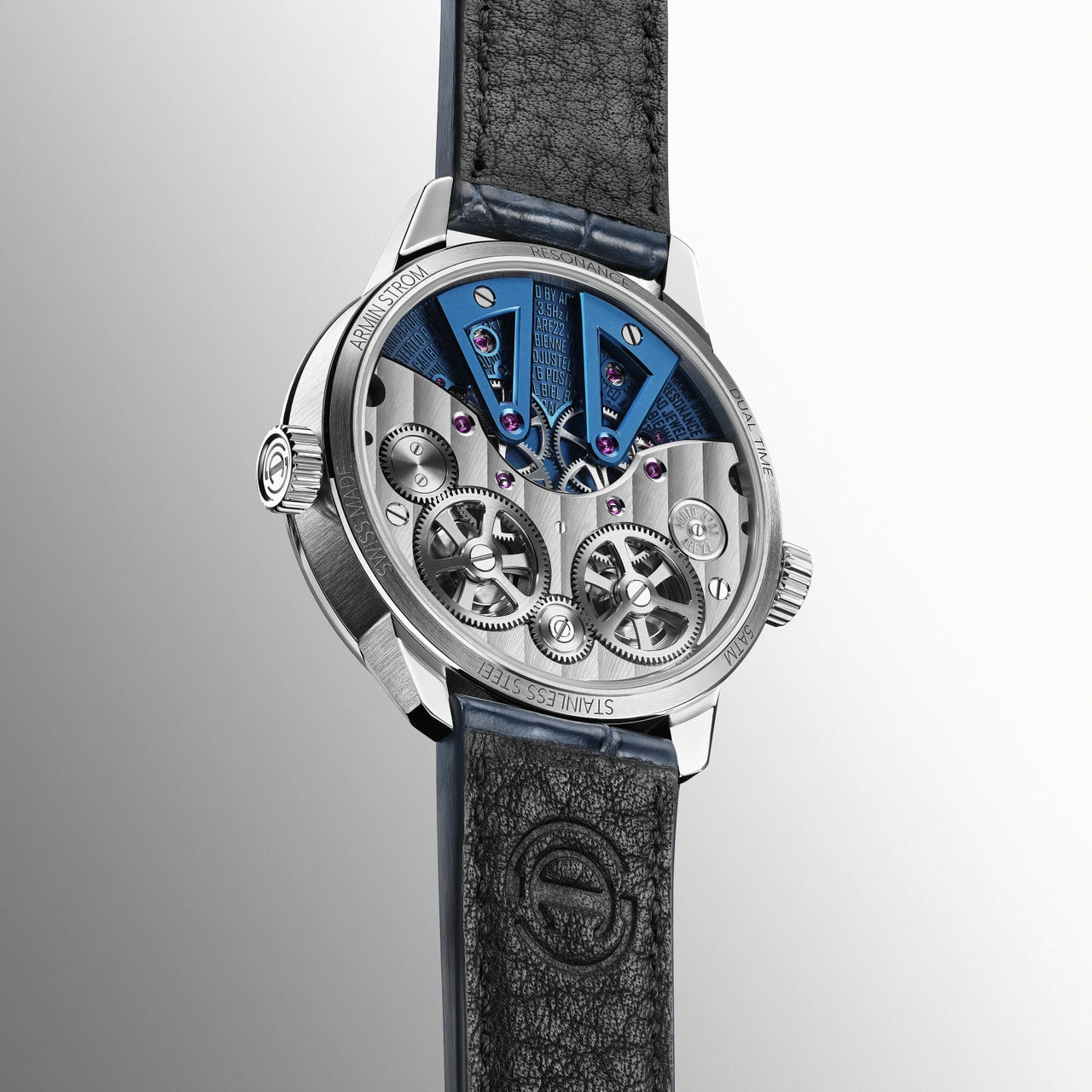
The other side of the ARF22
Turning the watch over does not result in the visual calm often found behind an open-worked dial. The blue theme continues across the reverse of the mainplate and two matching gear-train bridges, creating continuity between the front and back of the calibre.
Traditional finishing then becomes the counterpoint. Polished bevels trace the edges of the blue components, while relief lettering is produced through laser engraving. The barrel bridge is rhodium coloured rather than blue and decorated with Côtes de Genève. That difference is important. Had every component received the same treatment, the architecture might have become visually flat. The brighter barrel bridge breaks up the composition and introduces a more familiar piece of traditional Swiss finishing.
Elsewhere there are black-polished elements, circular graining and perlage. Individually, none of these techniques is revolutionary, nor should it be. Their significance lies in Armin Strom applying traditional decorative methods to a movement whose architecture and resonance technology feel very modern.
That combination has become something of a hallmark for the manufacture. Independent watchmaking is sometimes divided rather simplistically between classical handcraft and avant-garde engineering. Armin Strom sits comfortably between the two. The technology can be unconventional, but the watches still reward examination through a loupe.
Complex watch, surprisingly restrained case
Perhaps one of the most appealing aspects of this release is what has not grown. The case remains 39 mm in diameter, only 9.05 mm thick and 44.5 mm from lug to lug. Considering what is taking place inside, those figures are unusually civilised.
A dual-time resonance watch could easily have become a 43 or 44 mm mechanical showcase designed primarily to impress in photographs. Instead, Armin Strom has kept the dimensions within the territory of a genuinely wearable contemporary watch. The relatively short lug-to-lug measurement should also make the case sit neatly on a broad range of wrists.
The case itself is stainless steel, with sapphire crystal on both sides and anti-reflective treatment. Water resistance is rated to 5 ATM. Nobody is likely to mistake it for a sports watch, but that level of protection is appropriate for a complicated everyday mechanical piece. The matte dark blue alligator strap, finished with white stitching and a stainless steel pin buckle, continues the colour scheme without drawing attention away from the movement.
There is an important point here about proportion. A watch this visually busy needs boundaries. The relatively compact case stops the open architecture from feeling sprawling, while the twin white dials provide two clear anchors for the eye. It feels dense rather than oversized, which is an important distinction.

A different interpretation of the GMT idea
For collectors accustomed to conventional travel watches, the Dual Time GMT Resonance requires a slight change in thinking. Its appeal is not based on being the fastest possible watch to adjust when crossing an airport terminal. There are simpler GMT watches if pure convenience is the priority.
Instead, Armin Strom has taken the practical idea of displaying two time zones and used it as a framework for something much more mechanically ambitious. Two separate indications justify two separate regulating systems, and those two systems create the conditions required for resonance. The complication and the watch’s practical purpose therefore feel interconnected rather than assembled from unrelated modules.
That coherence matters. Some high-complication watches can feel like demonstrations of everything a manufacture knows how to build. The Dual Time GMT Resonance is more focused. There is a clear idea behind it, and virtually every major component contributes to that idea.
Fifty pieces and a very particular audience
Only 50 examples of the Manufacture Edition Blue will be produced. Limited production alone does not make a watch important, particularly in an industry where edition numbers are sometimes more marketing strategy than genuine rarity. In this case, though, the small production run feels consistent with the nature of the watch. This is a complicated, extensively finished manufacture movement from a relatively small independent producer, not a mass-market model being artificially restricted.
The audience is also likely to be quite specific. Someone looking for a discreet traditional GMT may find the open architecture excessive. Someone attracted primarily to blue watches can find far simpler ways to satisfy that preference. The Dual Time GMT Resonance Manufacture Edition Blue makes the most sense for the collector who enjoys understanding why a mechanism exists, how its components interact and why its finishing has been executed in a particular way.
It is also the sort of watch that benefits from being seen more than once. The first impression is dominated by the blue and white contrast. The second tends to focus on the twin dials. Then the balances start attracting attention, followed by the resonance clutch, the day/night discs, the polished bevels and the smaller finishing details. There is a gradual process of noticing rather than one overwhelming visual trick.
A compelling new chapter for the Dual Time GMT Resonance
The phrase “Manufacture Edition Blue” could make this release sound like an aesthetic footnote to an existing watch. In reality, the colour treatment changes how the Dual Time GMT Resonance communicates its mechanical architecture. It provides contrast where contrast is useful, gives polished finishing a stronger presence and links the twin displays together without obscuring their individuality.
More importantly, everything that made the original concept technically interesting remains intact. The calibre ARF22 still offers two independent time displays. Each retains its own hours, minutes and day/night indication. Two regulating systems remain connected by Armin Strom’s patented resonance clutch, providing a living demonstration of a phenomenon that has intrigued watchmakers for generations.
There is a great deal happening here, but the watch avoids feeling like an exercise in complication for complication’s sake. Resonance is the central idea. Dual time gives that idea a practical framework. Open architecture makes it visible. Traditional finishing gives the machinery refinement. The compact case makes the whole thing wearable.
For enthusiasts of independent watchmaking, that sense of coherence is perhaps the Manufacture Edition Blue’s strongest quality. Armin Strom has not simply created an unusual mechanism and wrapped a watch around it. The movement, displays, finishing and design all seem to have grown from the same underlying concept.
And then there is the blue. Familiar enough to feel classical, unconventional enough in its application to feel new, it changes the character of the watch without competing with what really matters underneath. For a limited edition of just 50 pieces, that is arguably exactly the right approach. The colour brings attention to the watch, but the mechanics give collectors a reason to keep looking.