There is an important difference between a watch associated with a famous person and a watch created to manufacture that association after the fact. The distinction becomes particularly clear with Steve McQueen and the Hanhart 417 ES. McQueen was not wearing the watch as part of a carefully arranged campaign. It appeared on his wrist because it was a watch he owned, used and evidently liked. Photographs show it during motorcycle competition, in the desert, around family and in the quieter parts of his life away from the film set. That makes the story behind the new Hanhart 417 ES Steve McQueen Limited Edition unusually compelling.
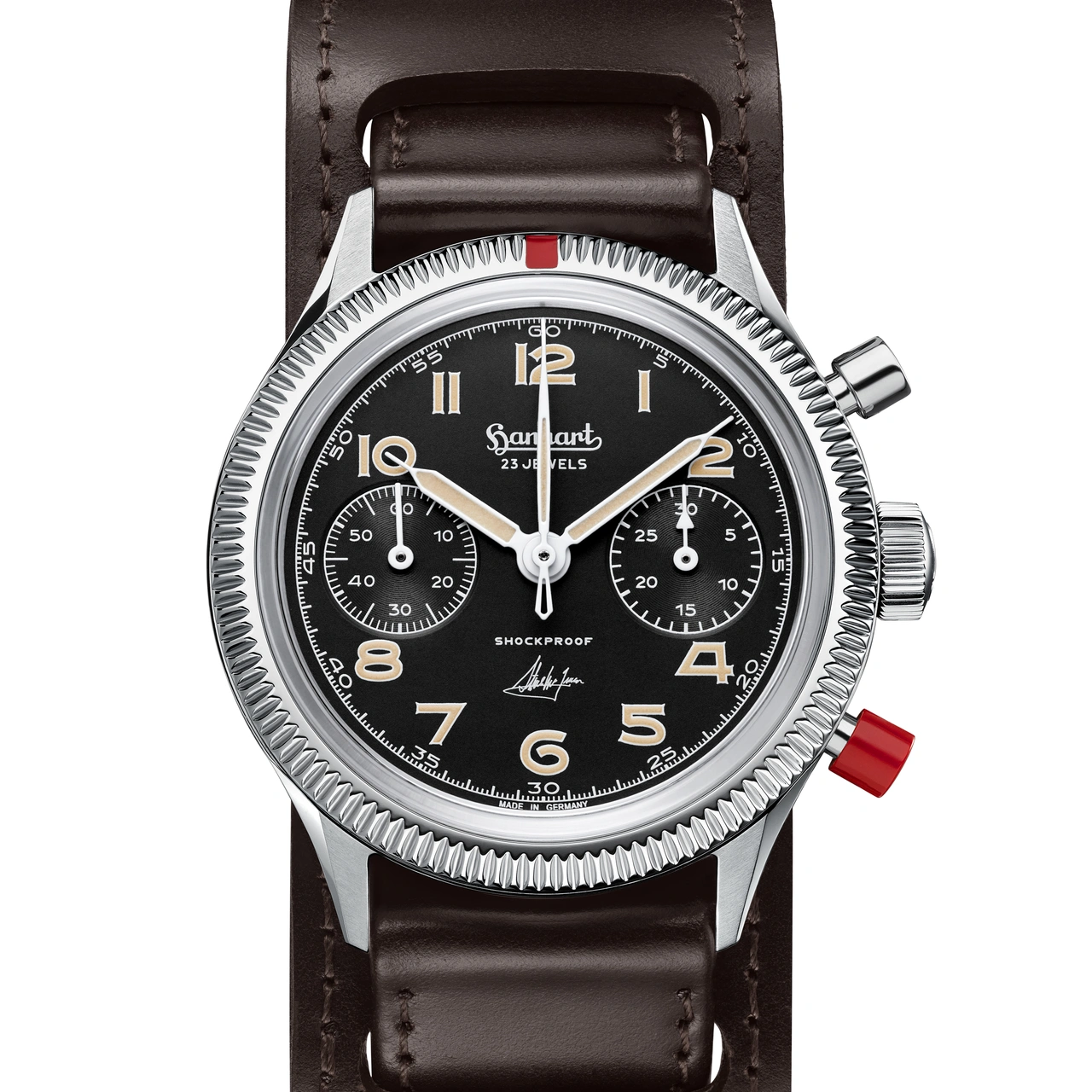
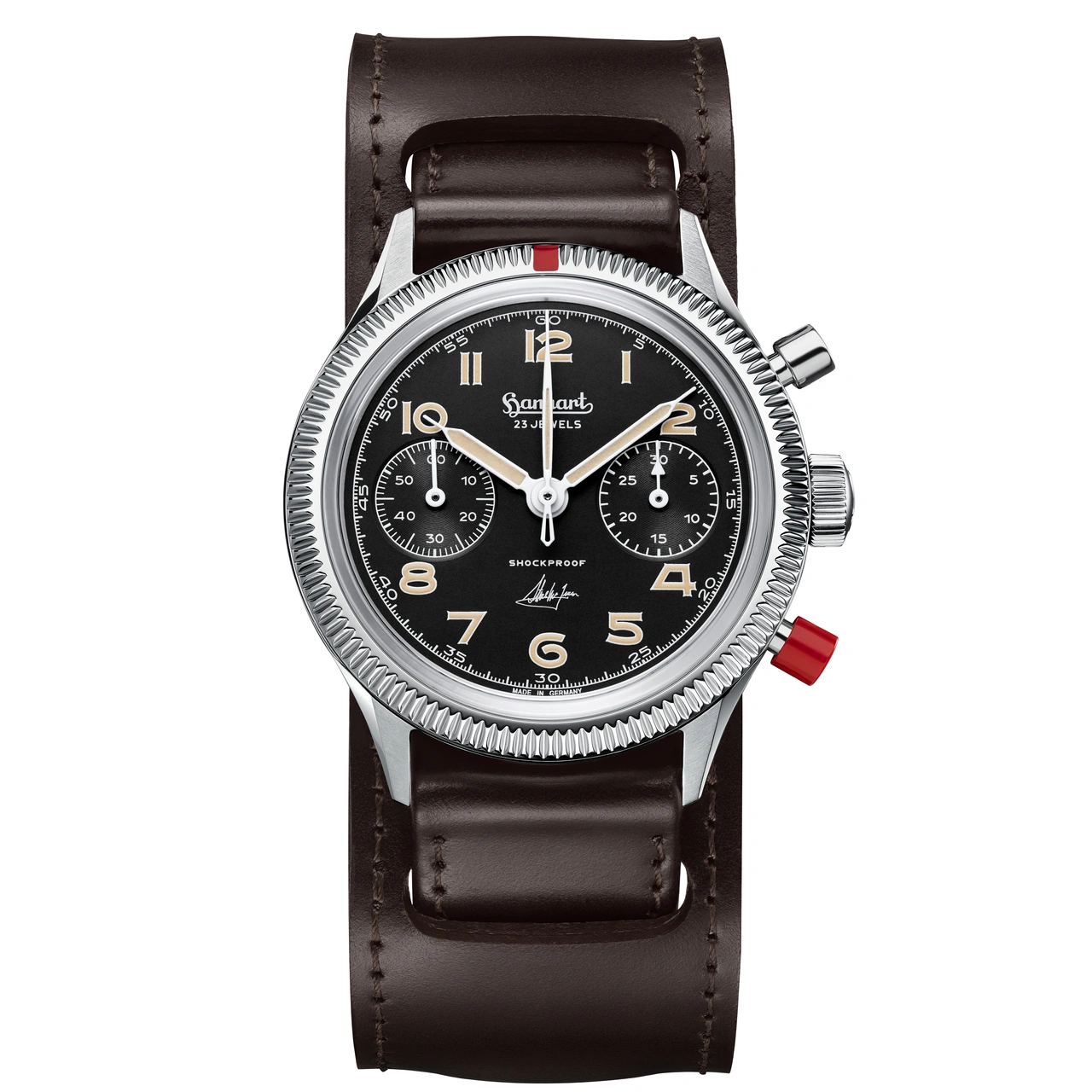
For its first official Steve McQueen edition, Hanhart has resisted turning the 417 ES into a piece of heavily branded memorabilia. Instead, the company has worked with the details already present in the historical record. The case remains 39 mm. The famous red pusher remains. McQueen’s signature is there, but small enough not to overwhelm the dial. The watch sits on a dark brown cuff strap modelled on the style he wore himself. Even the accompanying limitation card refers back to his 1964 motorcycle racing licence.
That approach matters because the original 417 ES already has a considerable story of its own. This is not a watch that required Steve McQueen’s name to make it interesting. The connection simply adds another layer to a chronograph with legitimate military, motorsport and German watchmaking history.
A Chronograph With a Life Before Hollywood
The Hanhart 417 was developed in the mid-1950s as a pilot’s chronograph for the newly established German Bundeswehr. Its priorities were straightforward: clear information, reliable operation and the ability to survive demanding conditions. The letters ES refer to Edelstahl, the German term for stainless steel, distinguishing the steel-cased version from other variants of the period.
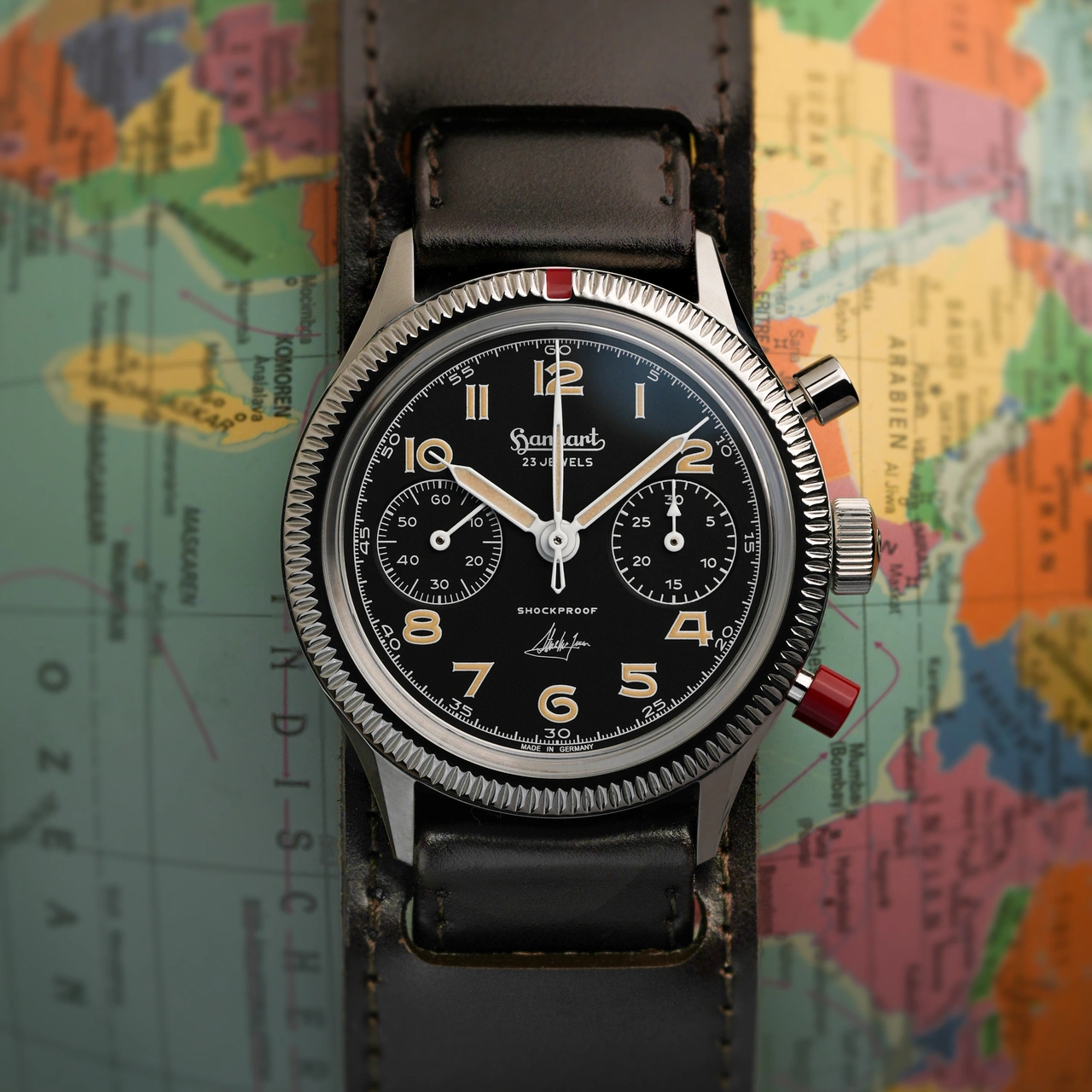
Those military origins explain why the basic 417 design continues to look so convincing decades later. There is little on the dial that exists simply for decoration. Large Arabic numerals establish the hours quickly, two recessed registers provide chronograph information, and the rotating fluted bezel gives the case a strong functional outline. The red pusher adds the one flash of colour that has become almost inseparable from Hanhart’s identity.

The modern Steve McQueen edition does not attempt to smooth those features into something more luxurious or contemporary. Its appeal comes from preserving their utility. At 39 mm across and 46 mm from lug to lug, it is compact by modern chronograph standards. Even with the pronounced dome of the sapphire crystal included, total thickness is 13.3 mm. Remove the crystal from that measurement and the case itself is only 11.55 mm high.
These dimensions are important. A larger interpretation might have created more wrist presence, but it would also have weakened the connection with the original. The restrained sizing gives the watch the character of an instrument from another era without making it fragile or impractical for present-day use.
Steve McQueen, Without Turning the Dial Into Memorabilia
The most obvious new element is Steve McQueen’s signature on the black dial. It would have been easy to make this oversized and immediately dominant, particularly on a watch carrying such a recognisable name. Hanhart has instead kept it deliberately restrained.
That decision suits the personality of the 417 ES remarkably well. The watch remains a Hanhart first and a Steve McQueen edition second. The historical Hanhart logo retains its position, the two-register chronograph architecture remains intact, and the white markings continue to dominate the visual hierarchy. McQueen’s signature rewards a closer look rather than announcing itself from across a room.
The luminous material also contributes considerably to the character of the watch. Hanhart uses Super-LumiNova® Light Old Radium GL across the numerals and hands. Against the matte black dial, the warm beige tone gives the watch some of the visual softness associated with aged tritium or radium-era instruments without relying on genuinely vintage luminous compounds.
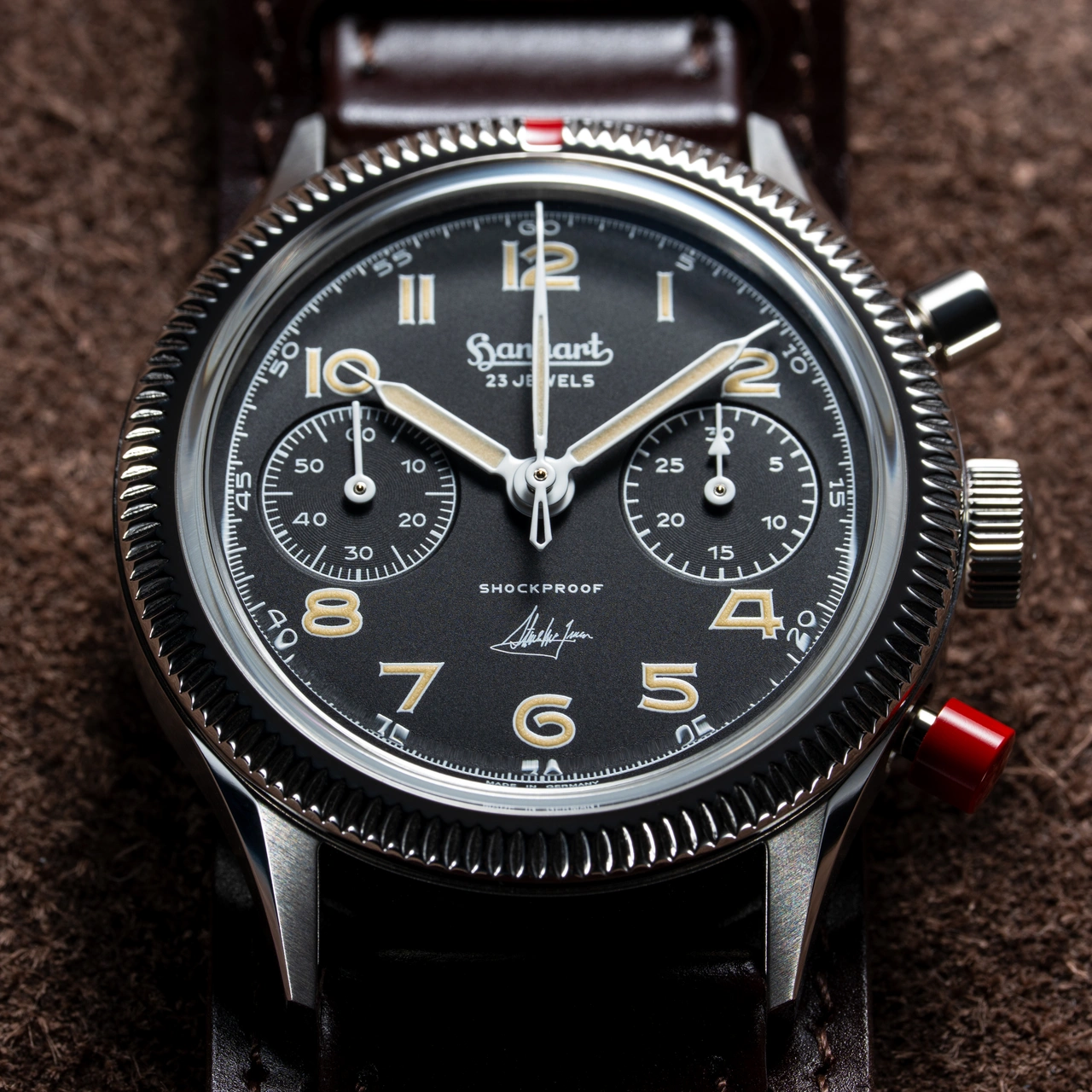
There is also a technical detail hidden within the hand design. The tips of the minute hand and central chronograph seconds hand curve downward towards the dial. The intention is to reduce parallax error when reading the markings from an angle. It is exactly the kind of detail that can easily go unnoticed, yet it says a great deal about why the 417 was designed the way it was in the first place.
The Red Pusher Is More Than Decoration
No discussion of a Hanhart chronograph feels complete without the red pusher. On this model it is made from HyCeram®, providing the familiar colour in a modern material while maintaining one of the brand’s most recognisable design signatures.
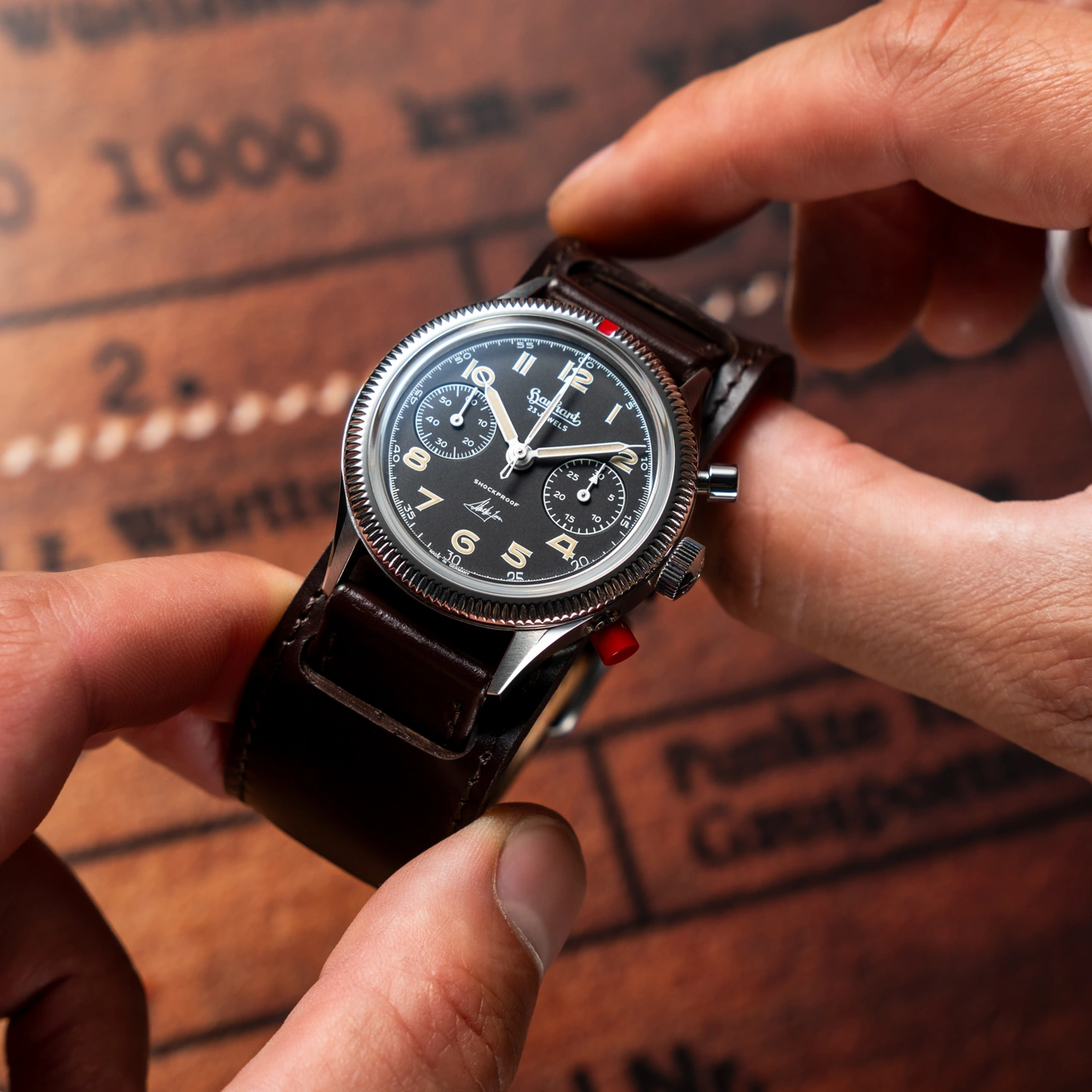
The romantic version of the story says that a pilot’s wife once painted the pusher of his Hanhart with red nail polish so that every glance at his watch would remind him to return safely. There was also a practical argument for making a chronograph control visually distinctive. A prominent red pusher reduced the chance of mistakenly actuating the wrong control at an important moment.
Whether viewed through the story or through the practical reasoning, the red pusher has become part of the language of a Hanhart chronograph. Including a small bottle of red nail polish in the presentation box could easily have felt gimmicky on another watch. Here, it works because it refers directly to a story already embedded in the company’s history rather than being invented solely for the limited edition.
A Flyback Movement That Fits the Purpose
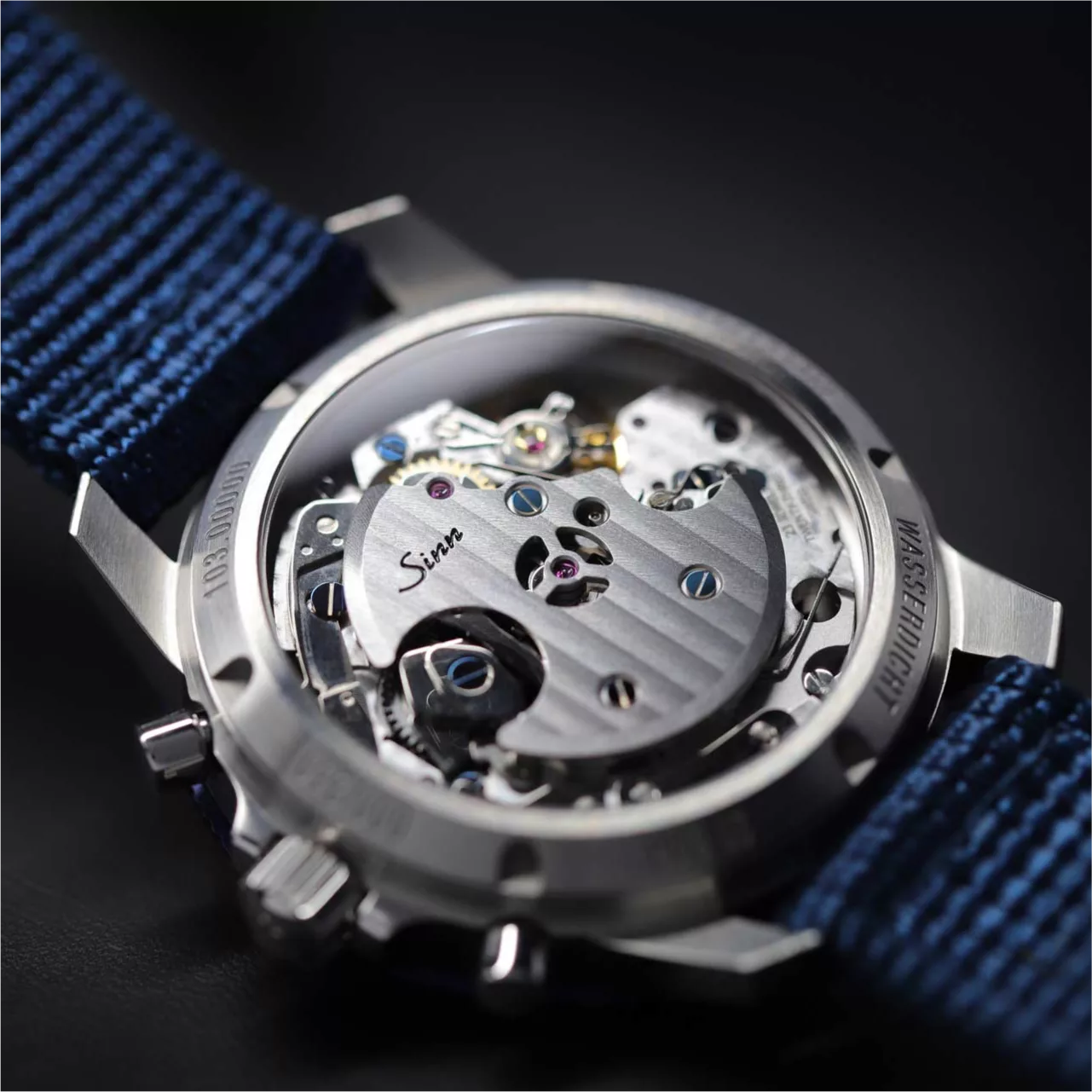
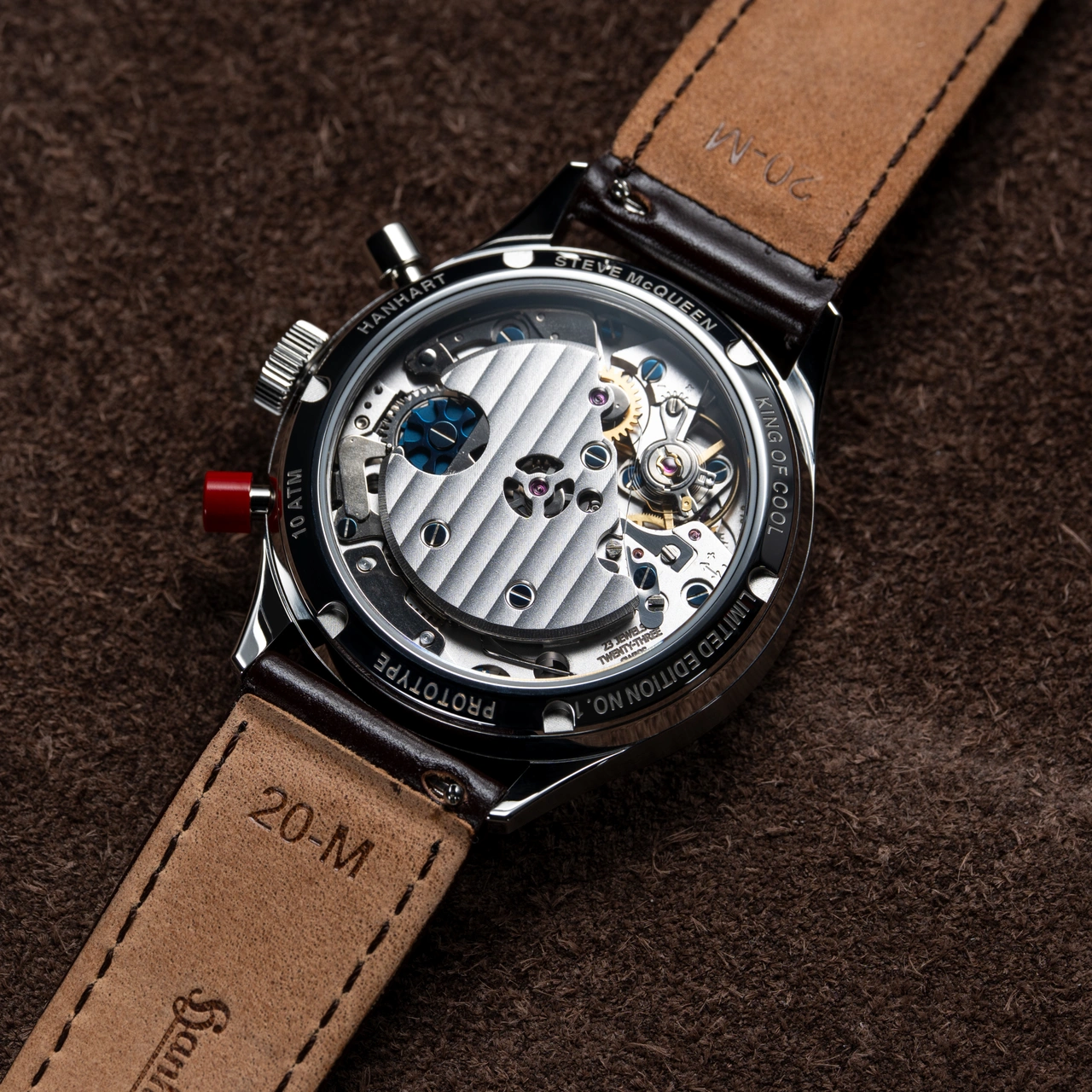
The historical styling is supported by a genuinely useful chronograph movement. Visible through the sapphire caseback is the hand-wound Sellita AMT5100 M, a 23-jewel calibre operating at 28,800 vibrations per hour and offering at least 58 hours of power reserve.
More importantly, it is a flyback chronograph. With a conventional mechanical chronograph, beginning a new timing interval usually requires three separate actions: stop the chronograph, reset it to zero and start it again. A flyback allows all of that to happen with one press while the chronograph is running. The hand returns immediately to zero and begins timing the next interval.
For a watch derived from aviation and motorsport instrumentation, the complication makes perfect sense. Flyback functionality is not being added simply to make the specification sheet longer. It reduces the number of actions required when timing consecutive intervals, precisely the sort of task that historically justified the mechanism.
The hand-wound nature of the movement is equally appropriate. Modern automatic chronographs are convenient, but the ritual of winding the 417 gives this version a mechanical directness that suits the design. Hanhart has also included hacking seconds, allowing the running seconds to stop when setting the time for more precise synchronisation.
Hanhart’s Approach to Accuracy
Another worthwhile detail is Hanhart’s own regulation standard. Each movement is tested and adjusted at the manufacture in Gütenbach, with the average rate across six positions required to fall between 0 and +8 seconds per day.
The interesting part is not simply the width of that tolerance. Hanhart intentionally places the acceptable range on the positive side rather than allowing the same margin in both directions. The company does not permit a losing rate in the principal positions, while the maximum permitted difference between individual positions is ten seconds.
It is a small but telling piece of engineering philosophy. Mechanical movements will always vary according to position, temperature, state of wind and numerous other factors, but Hanhart is setting a clear target for how the finished watch should behave before it leaves Gütenbach.
The Cuff Strap Changes the Whole Watch
Perhaps the most visually distinctive element of the Steve McQueen edition is not found on the dial or inside the case at all. It is the strap.
Historical photographs showed McQueen wearing his 417 ES on a dark brown cuff-style strap, with a broad piece of leather extending beneath the watch case. Hanhart has recreated that configuration using dark brown Shell Cordovan produced by Italian tannery Comipel.
Shell Cordovan is an interesting choice because it feels far more deliberate than simply fitting a generic vintage-effect leather strap. The material comes from a dense fibrous layer beneath the hide of a horse’s hindquarters and requires a lengthy tanning process. Properly finished Cordovan has a distinctive smooth surface and lustre, and tends to develop character differently from ordinary calf leather.
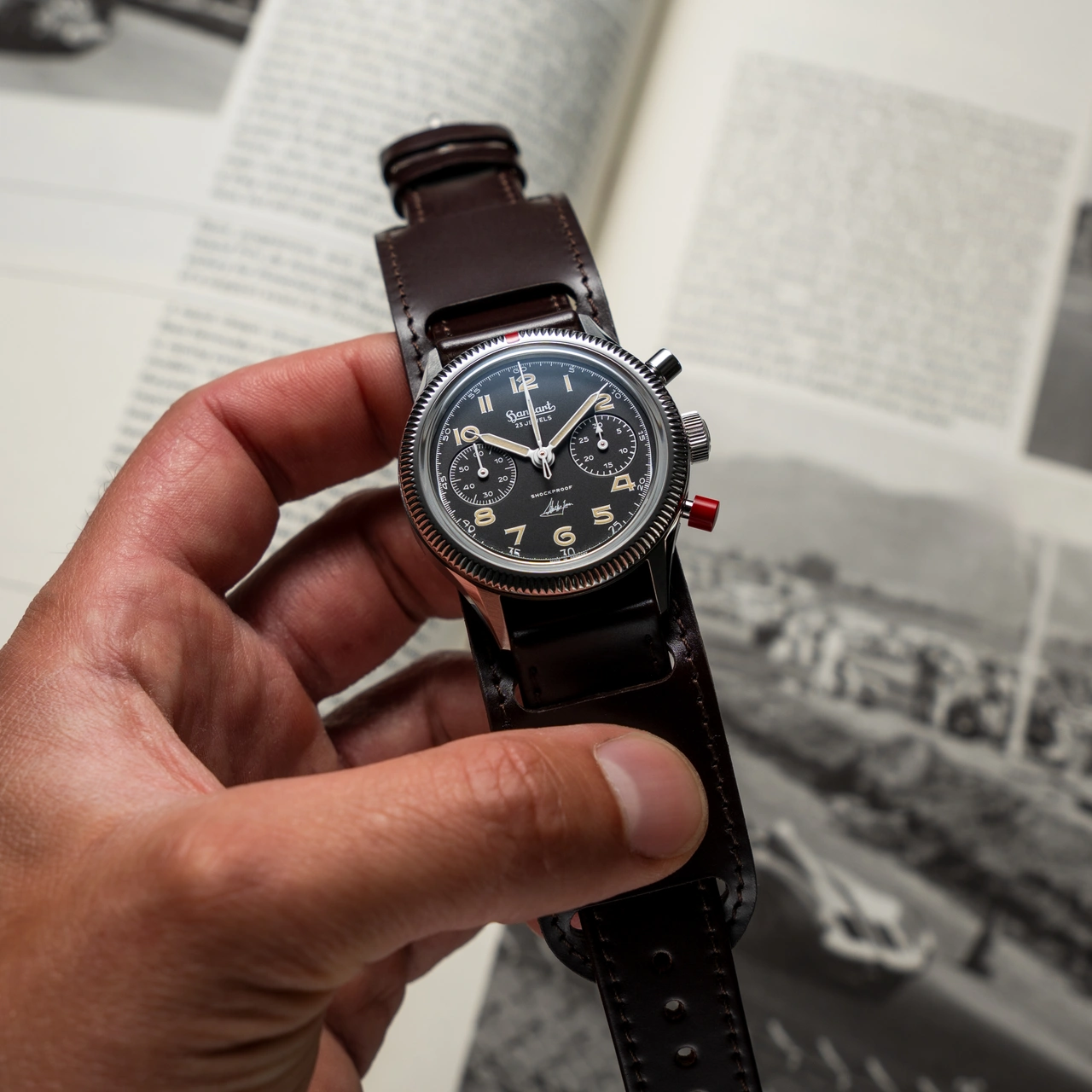
The cuff format also alters how the 417 looks on the wrist. The relatively compact 39 mm case gains visual presence from the larger leather pad beneath it, which helps recreate the slightly rugged appearance visible in photographs of McQueen. It feels connected to motorcycles, workshop equipment and practical clothing in a way that a polished exotic strap never could.
Importantly, the watch is not permanently tied to that appearance. Its standard 20 mm lug width allows owners to fit other compatible straps, and Hanhart offers black, dark brown and light brown leather alternatives both with and without pads. A new-generation steel bracelet with tool-free micro-adjustment is also compatible. Someone who likes the historical McQueen presentation can keep the cuff strap, while those wanting a more conventional everyday 417 can change the personality of the watch considerably.
The Racer Matters More Than the Movie Star
The most interesting aspect of the McQueen connection is that Hanhart has concentrated heavily on his motorsport life rather than simply referencing his most famous films. McQueen’s reputation as an actor is unavoidable, particularly through films such as The Great Escape and Bullitt, but racing was not a superficial hobby attached to his public image.
In 1964 he competed as part of the first official United States team at the International Six Days Trial, riding a modified Triumph through the demanding six-day event in East Germany. In other competitions he used the pseudonym Harvey Mushman, partly to avoid the attention surrounding his acting career and the objections of film producers who were less enthusiastic about their leading man risking injury on a motorcycle.
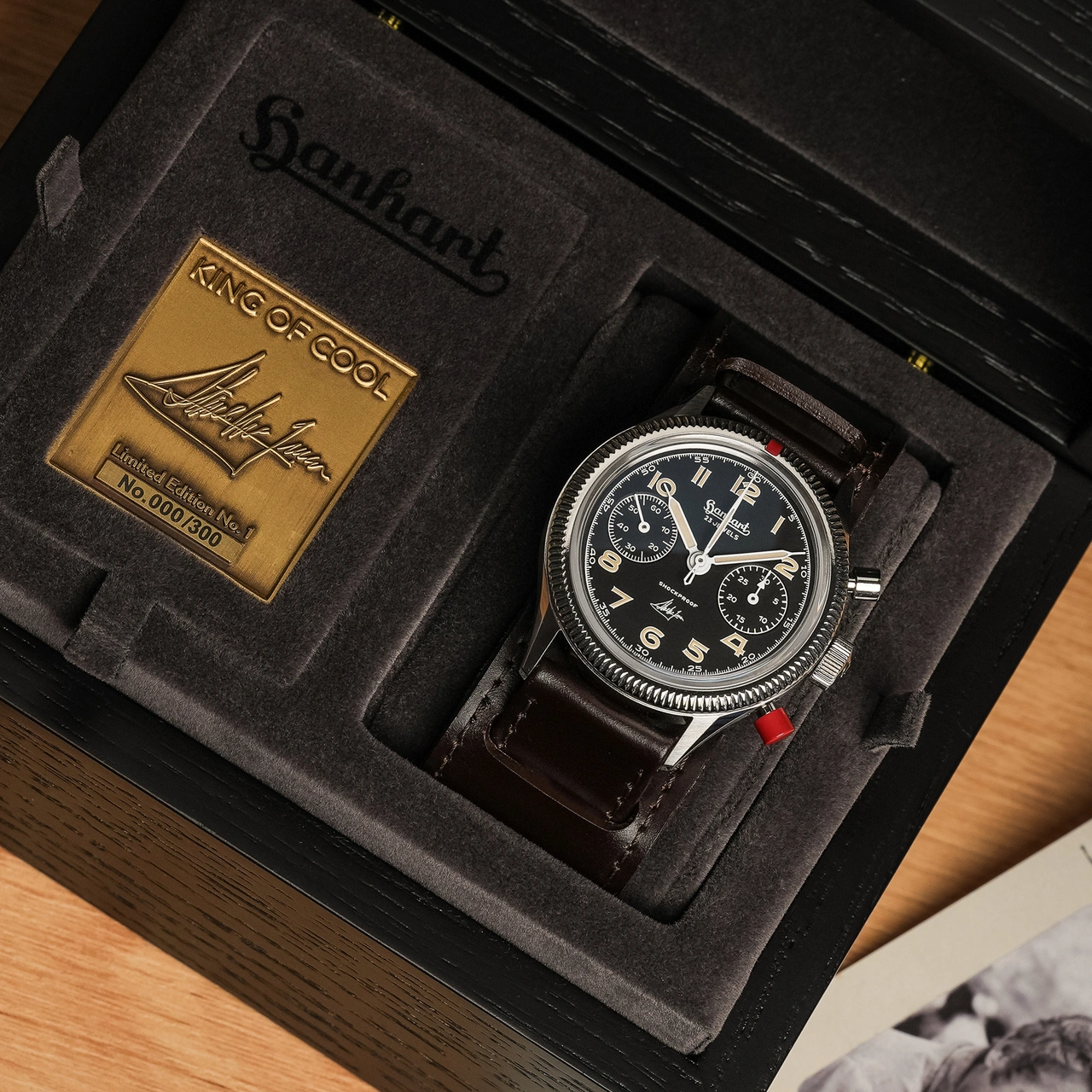
The 417 ES appears naturally within that world. It was a rugged, readable chronograph designed around timing and utility, exactly the sort of watch that feels plausible on the wrist of somebody mechanically interested in motorcycles and racing. That authenticity is difficult to reproduce through a modern partnership conceived purely as a marketing exercise.
A Family Connection to the Edition
Hanhart has also involved McQueen’s family in the project. His grandchildren Chase and Madison McQueen proposed the use of their grandfather’s signature on the dial and approved its inclusion. Their involvement extends to the limited-edition card included with each watch.
The card takes its design from McQueen’s 1964 international FIM racing licence. The original licence itself became a valuable piece of McQueen memorabilia when it was auctioned by Bonhams in 2009. Rather than merely printing another portrait inside the box, Hanhart has used that document as a more specific reference to the period in which McQueen was actively racing motorcycles.
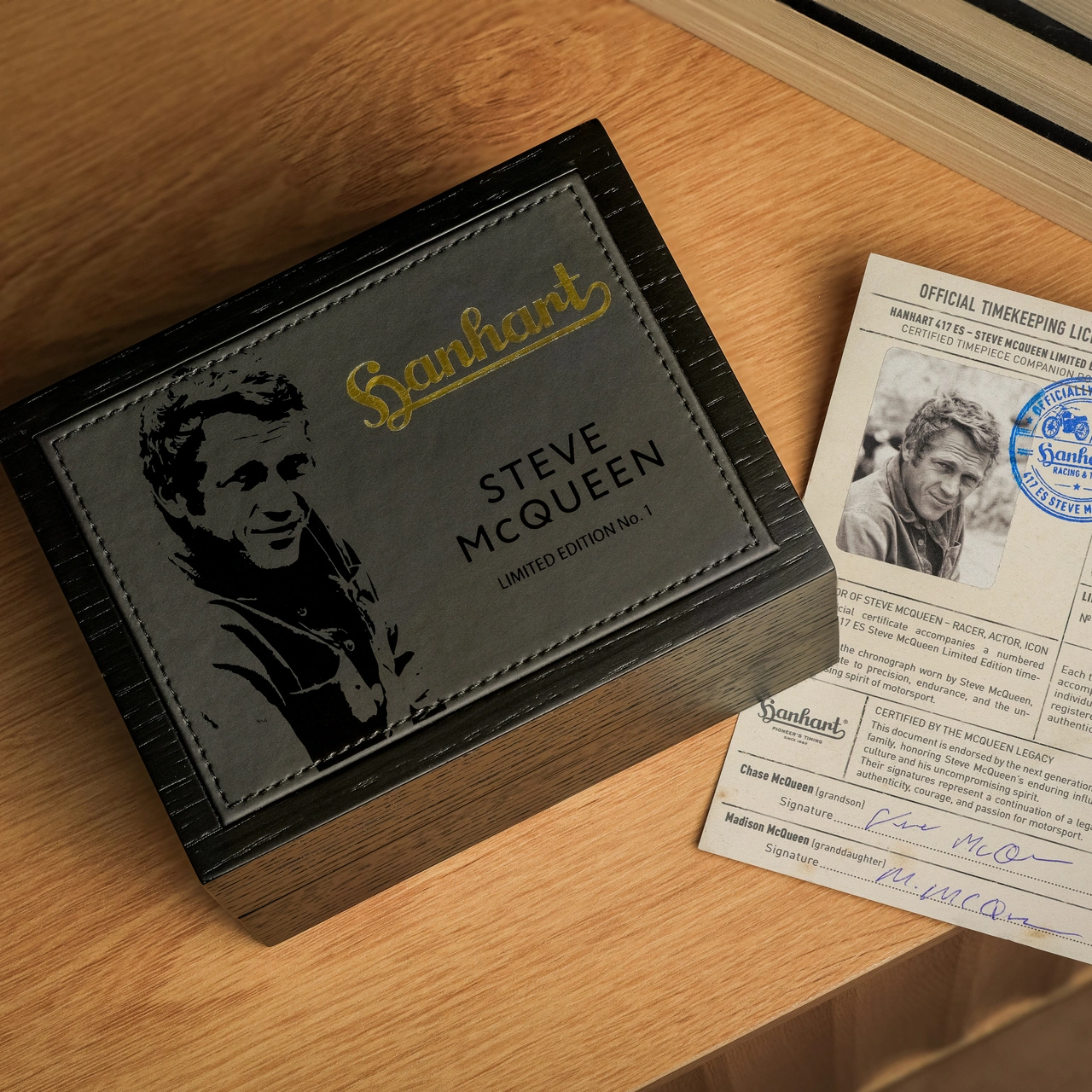
Chase and Madison sign the card, while the reverse carries the signature of the watchmaker who assembled the chronograph in Gütenbach. That final detail brings two otherwise very different stories together: the McQueen family connection and the modern craft involved in producing the watch itself.
A Modern Watch That Has Not Forgotten the Original
Historical faithfulness is appealing, but there is little virtue in reproducing every weakness of a watch from the 1950s. Hanhart has sensibly modernised the areas that affect everyday ownership while maintaining the character that made the original distinctive.
The crystal, for example, is now highly domed sapphire rather than an easily scratched vintage material, with anti-reflective treatment on both sides. The exhibition caseback uses sapphire as well. Water resistance is rated to 10 bar, giving the watch considerably more practicality than its historical predecessor.
The strap system uses quick-release spring bars, and owners who choose Hanhart’s latest steel bracelet gain tool-free micro-adjustment. None of these elements fundamentally changes the appearance of the 417, but all make living with the watch considerably easier.
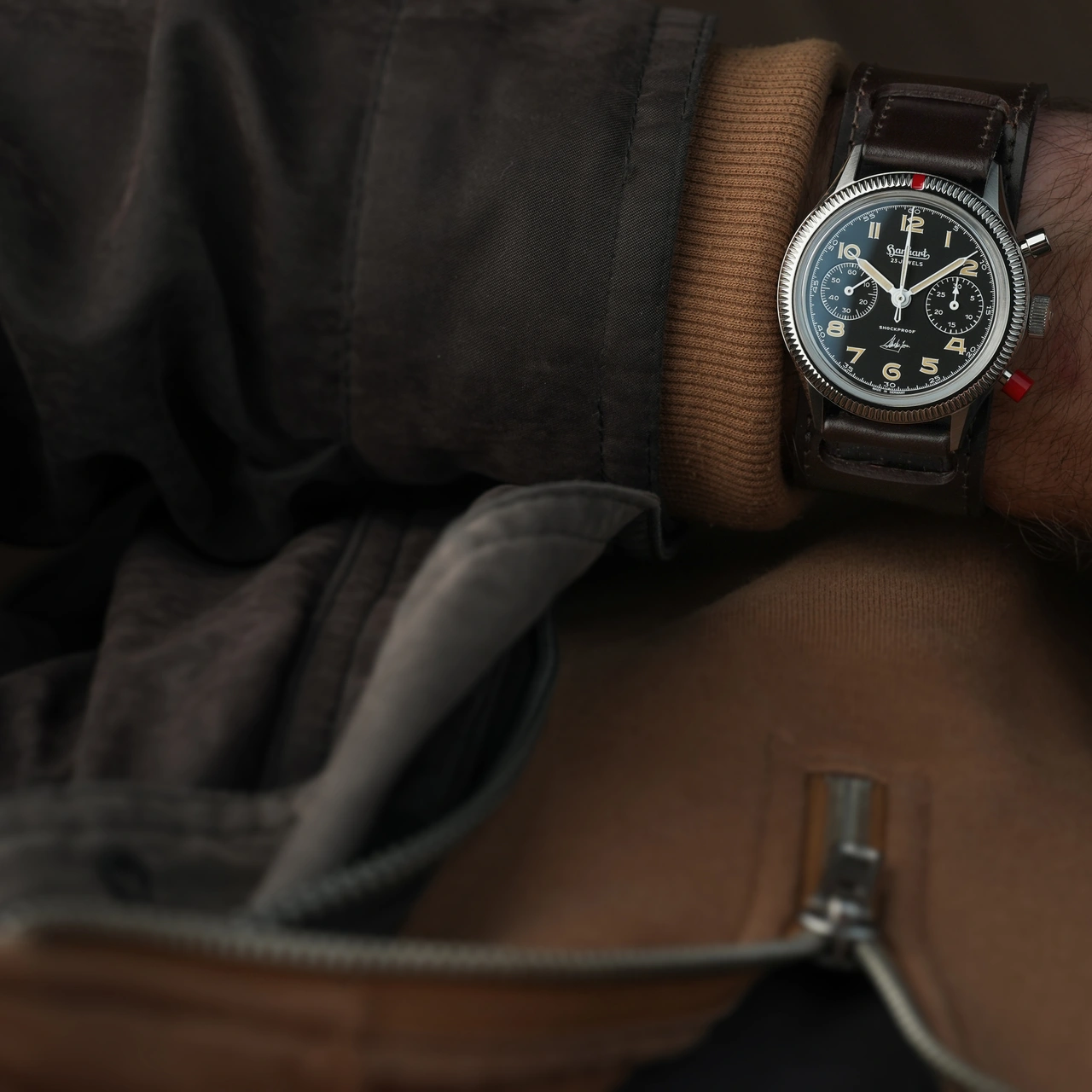
This Limited Edition Works
Limited editions connected with actors, racing drivers, musicians and other public figures are now common in watchmaking. Some are clever. Others feel like a name has been placed onto an existing dial because the marketing opportunity was too tempting to ignore.
The 417 ES Steve McQueen Limited Edition sits in a different position because the watch came before the collaboration. McQueen already wore a Hanhart. The photographs already existed. The cuff strap was already there. His motorsport career already overlapped naturally with a flyback chronograph created from the world of functional timing instruments.
Hanhart’s job, therefore, was not to invent a connection. It was to avoid overworking one that already existed.
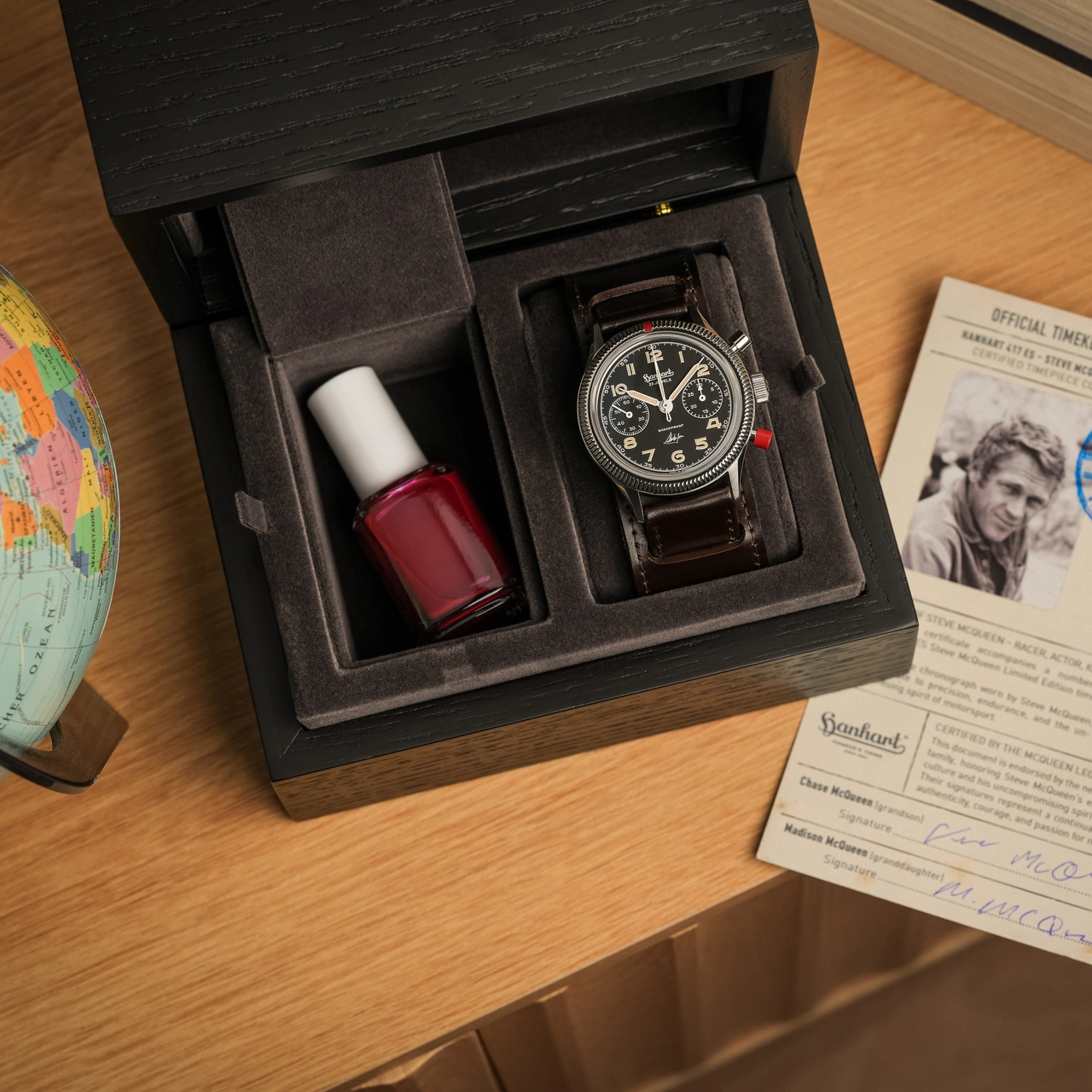
The company has largely succeeded by keeping the intervention restrained. The 39 mm proportions are right. The signature is small. The old-radium coloured lume creates warmth without turning the entire watch into theatrical faux ageing. The red pusher remains instantly recognisable. The Shell Cordovan cuff strap gives the edition a visual identity that makes sense when placed beside the historical photographs.
There is also enough horological substance beneath the story. The hand-wound AMT5100 M is not merely there to provide mechanical credibility. Its flyback function belongs naturally in a watch rooted in aviation and racing, while Hanhart’s regulation standard reinforces the functional philosophy behind the brand.
Final Thoughts
The most convincing detail of the Hanhart 417 ES Steve McQueen Limited Edition may ultimately be the simplest: Steve McQueen did not need an official Hanhart collaboration to wear a 417 ES. He had already chosen one.
That changes the character of this release. Rather than attaching an unrelated celebrity name to a watch, Hanhart is returning to a documented piece of its own history and recreating some of the details that made that connection recognisable. The cuff strap, racing licence-inspired card, understated signature and familiar red pusher all contribute to the story without replacing the watch beneath them.
For collectors interested in Hanhart, the 417 ES is already an important design. For enthusiasts drawn to motorsport history, the McQueen association adds another dimension. And for those who simply appreciate mechanical chronographs with compact proportions, manual winding and genuinely useful complications, there is plenty here even after the celebrity connection is removed.
With only 300 pieces being produced, this will inevitably be a scarce version of the modern 417 ES. Yet scarcity is not the most interesting thing about it. What makes the watch memorable is that its story does not begin with the launch of a limited edition. It begins decades earlier, with a man known for fast motorcycles, fast cars and an instinctive sense of style choosing a German chronograph for himself.