The mechanical watch industry has spent much of the past two decades convincing people that capability should be measured in millimetres. Sports watches became larger, bezels became broader, cases became thicker and somewhere along the way a 36 mm watch started being described as small rather than normal. The new Hanhart MAD Preventor HD12 is interesting precisely because it pushes against that thinking. It takes the construction of a genuinely rugged everyday watch and packages it inside dimensions that would have been entirely conventional for much of wristwatch history.
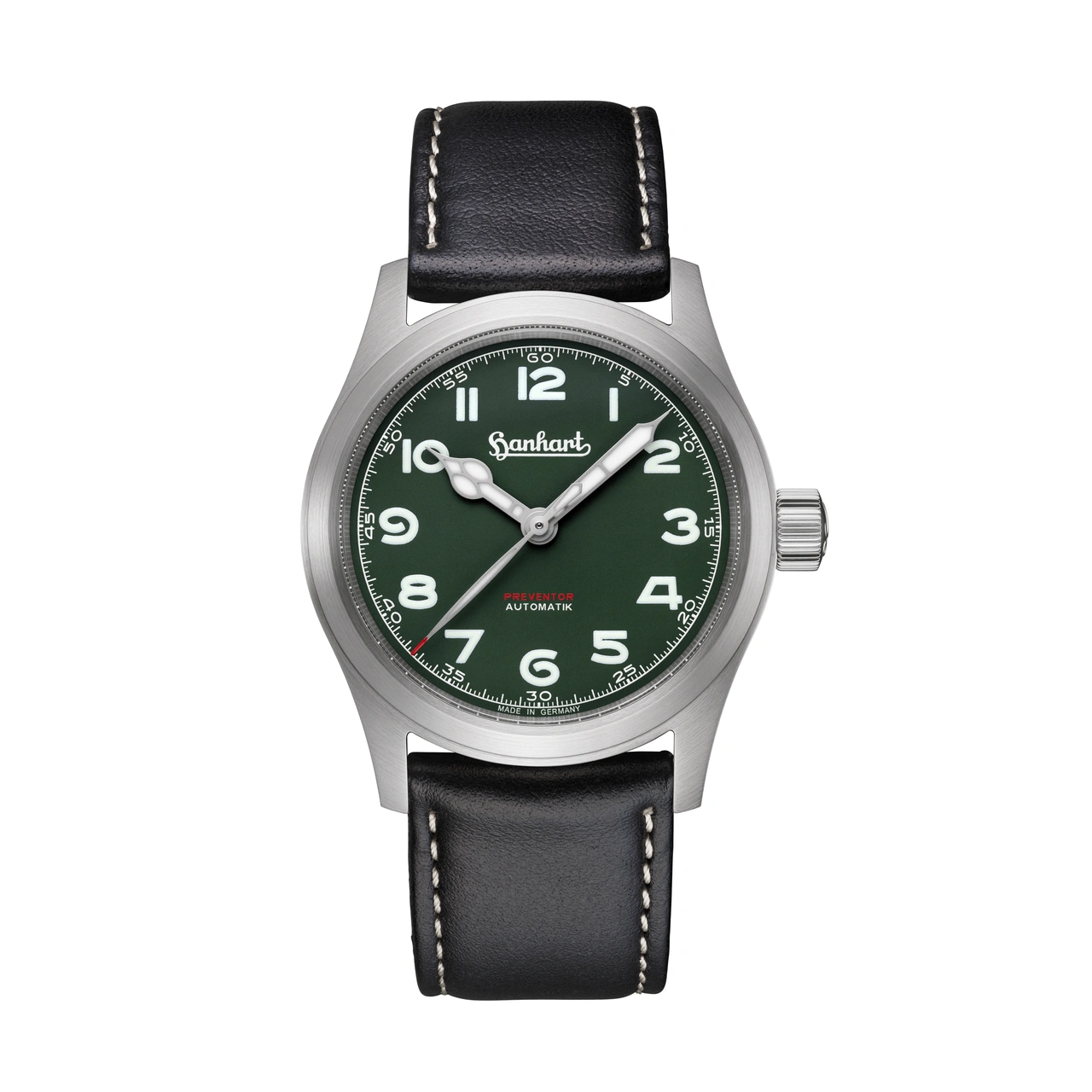
That alone would make it worth examining, but the story becomes better once the details emerge. This is not simply a smaller Preventor produced because compact watches happen to be fashionable again. Hanhart says it has repeatedly received requests for a smaller version, and the final watch was developed together with British enthusiast Russell, better known as the MAD Watch Collector. The result is a 36 mm limited edition with a distinctive Black Forest green dial, a remarkably scratch-resistant HD12™ steel case and several proportional decisions that reveal the influence of someone who actually thinks about how watches are worn.
There is something particularly appropriate about that approach for Hanhart. This is a company with considerably more history than its level of mainstream recognition might suggest. Founded in 1882, Hanhart became closely associated with stopwatches, timing instruments and wrist chronographs, building its reputation around instruments that had a job to do. Precision, straightforward operation and legibility were not marketing concepts added later. They were fundamental requirements. The MAD Preventor HD12 is obviously a very different watch from Hanhart’s historic chronographs, yet the underlying philosophy is remarkably familiar.
The 36mm Case Is More Important Than It Sounds
The headline specification is, of course, the diameter. At 36 mm across, 43 mm from lug to lug and only 10.5 mm thick, the MAD Preventor HD12 occupies a part of the market that remains surprisingly underserved. There are plenty of compact dress watches and a growing number of vintage-inspired pieces in the 36 to 38 mm range, but substantially fewer modern everyday watches that combine those dimensions with serious water resistance, hardened steel and contemporary construction.
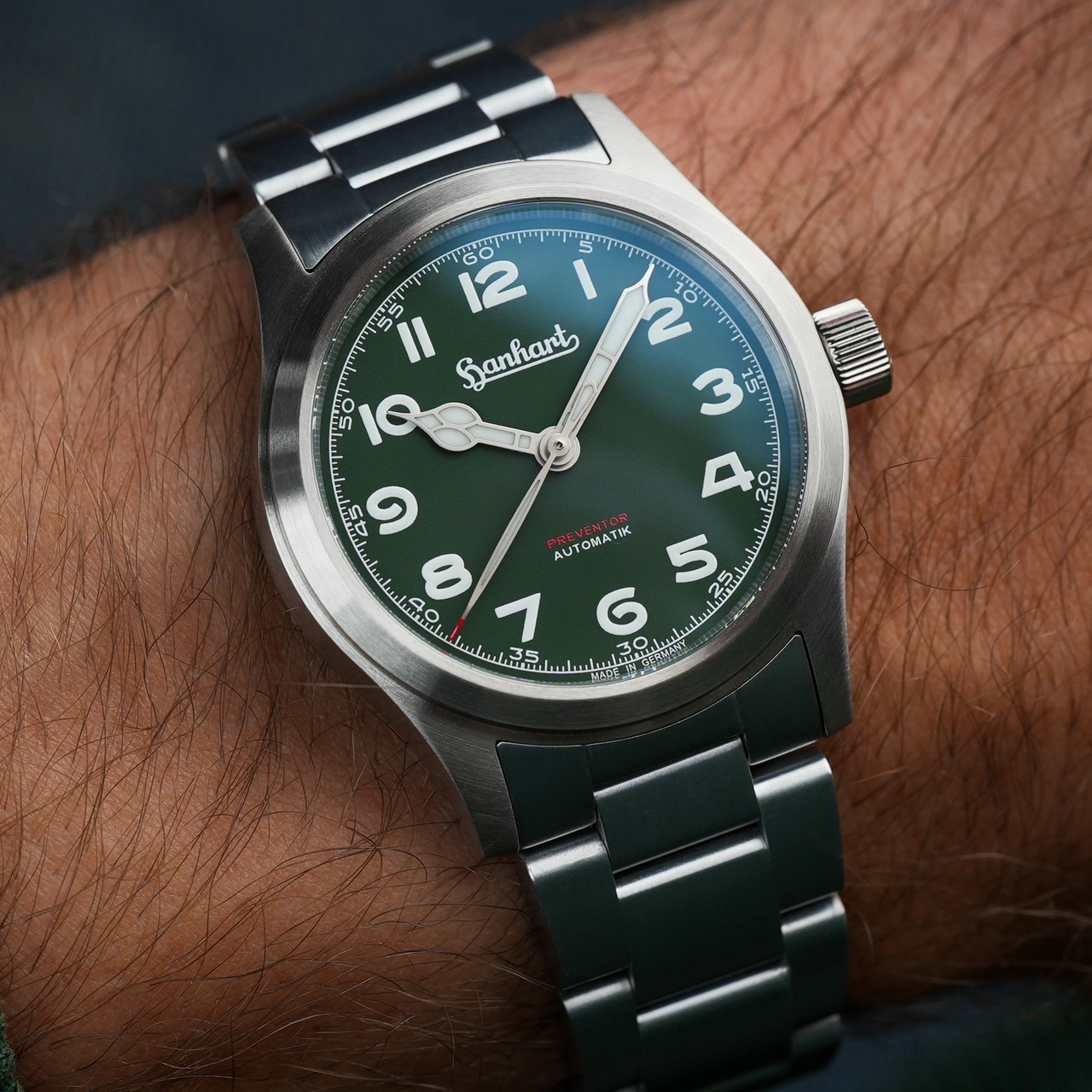
What makes the proportions especially interesting is the decision to retain a 20 mm lug width. On paper, that sounds quite broad for a 36 mm case, and that is precisely why it works. Russell reportedly suggested retaining the width from the larger design rather than narrowing everything proportionally. The effect should give the watch considerably more wrist presence than the diameter suggests. It also avoids the slightly delicate appearance that can occur when a compact case is paired with a narrow strap.

There is a practical advantage too. Twenty millimetres is one of the easiest strap sizes to work with, opening the door to an enormous selection of leather, fabric and rubber alternatives. For a watch deliberately positioned as an everyday piece, that matters. A compact watch on green or brown leather can lean towards traditional field-watch territory, while the same case fitted to steel becomes something much more contemporary.
It also illustrates an important point about watch dimensions. Diameter is only one part of how a watch wears. Lug length, lug width, dial opening, bezel thickness and overall height can completely change the impression. A 36 mm case with a purposeful 20 mm bracelet and relatively open dial can carry far more visual weight than the number on the specification sheet suggests.
Black Forest Green Without the Usual Drama
The dial is described as Black Forest green, a reference that could very easily have become a little too literal. Thankfully, Hanhart has resisted turning the dial into a scenic tribute to its home region. Instead, the colour is matte, restrained and functional.
That feels far more appropriate. Hanhart develops and produces its mechanical watches in Gütenbach in Germany’s Black Forest, so there is an authentic geographical connection behind the colour. Yet this is not intended to be a decorative landscape watch. The green is there to give the Preventor identity while still allowing the functional dial architecture to dominate.
The historic Hanhart signature, Arabic numerals and cathedral-style hands reinforce that balance between heritage and modern practicality. Cathedral hands can sometimes pull a watch too far into deliberate vintage styling, particularly when combined with artificial patina or overly aged dial treatments. Here they are being used on a watch with hardened steel, sapphire crystal and 150 metres of water resistance, which creates a much more interesting contrast.
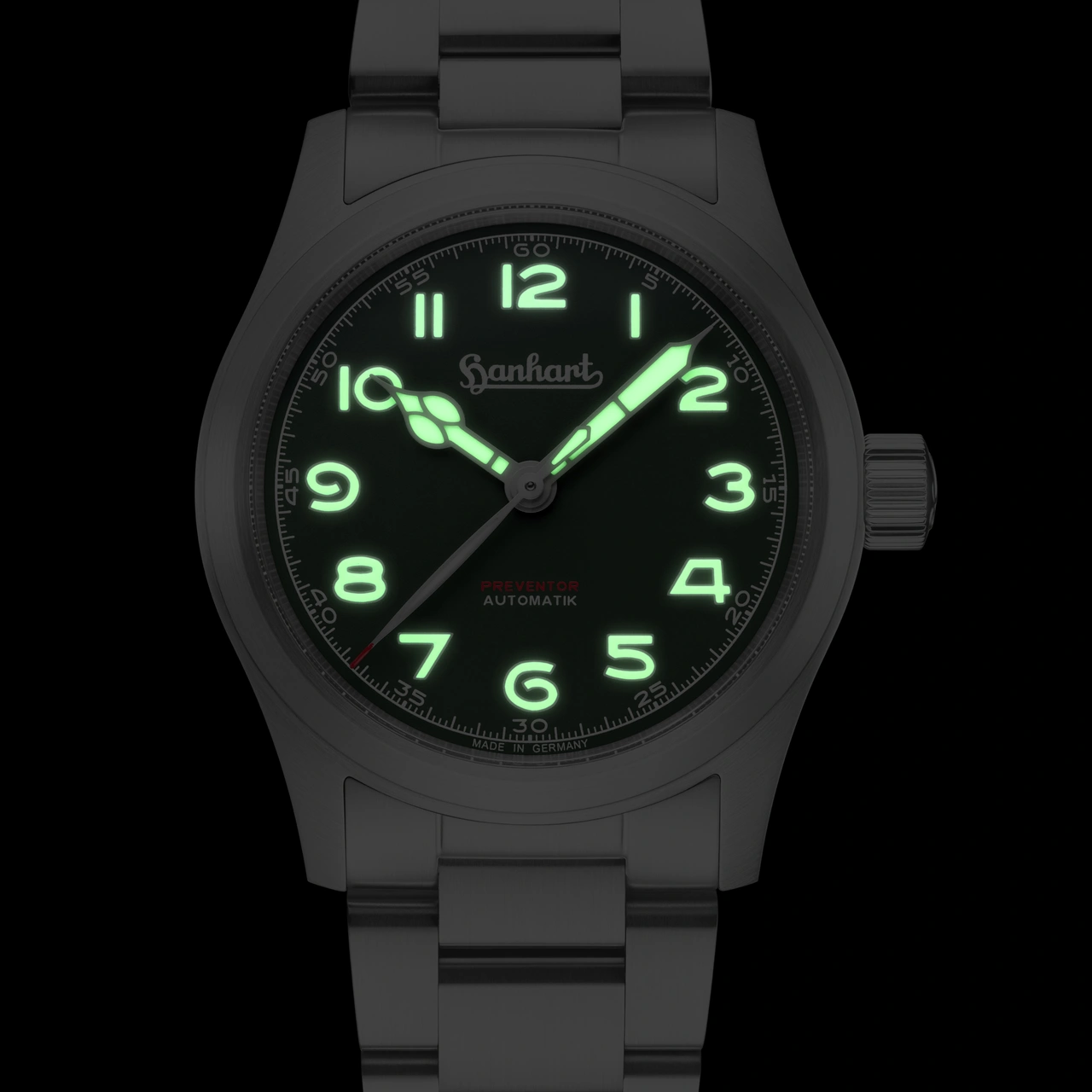
Super-LumiNova® C3 X2 GL is applied to the numerals and hands, giving the watch strong low-light legibility. Again, this is an area where the Preventor seems refreshingly uncomplicated. The dial is not trying to create a dozen talking points. Its purpose is to tell the time quickly and clearly, day or night.
There is also no date window, and that decision deserves more credit than it might initially receive. The Sellita movement inside has been configured as a genuine no-date calibre, so there is no hidden or redundant crown position where a date setting would normally sit. The crown has only two positions, one for winding and one for setting the time. It is a small mechanical detail, but exactly the type of detail enthusiasts notice.
HD12 Steel Is the Real Technical Story
The smaller diameter may attract the most attention, but arguably the most technically interesting part of the MAD Preventor is the material around it.
Hanhart calls it HD12™ steel. The objective is fairly straightforward: dramatically increase the surface hardness and scratch resistance of stainless steel without sacrificing the corrosion resistance or underlying toughness that make steel so useful for watch cases in the first place.
The process is more sophisticated than applying a dark or transparent coating over a conventional case. Hanhart first uses a surface-hardening treatment in which significant quantities of carbon diffuse into the stainless steel. This produces a gradual transition from the extremely hard exterior towards the softer core of the material.
That gradient is important because simple hard surface layers can potentially become brittle. A very hard exterior sitting abruptly on top of much softer material can behave differently under impact. By modifying the steel itself before adding the final protection, Hanhart is attempting to retain the structural advantages of stainless steel while significantly improving resistance to everyday marks.
After the initial hardening stage, a transparent PVD coating provides another protective layer. The final surface can reach approximately 1,200 HV on the Vickers hardness scale. For perspective, conventional 316L stainless steel is roughly 220 HV. The difference is enormous.
Perhaps more impressive is that the treatment does not require Hanhart to abandon conventional case finishing. The MAD Preventor combines satin-finished and polished areas rather than presenting the uniform appearance sometimes associated with hardened or coated watch cases. The material technology sits underneath what still looks like a properly finished steel watch.
That makes far more sense on a Preventor than it would on an ultra-thin dress piece. A watch with a screw-down crown and 15 ATM water resistance is clearly expected to accompany its owner into situations where desks, door frames, tools, bags and outdoor equipment are all potential enemies of polished steel. Nobody buys a mechanical watch hoping to scratch it, but there is considerable appeal in owning one that does not require constant protection.
A Familiar Movement, Taken Seriously
Inside sits the Sellita SW200-1. It is unlikely to win an originality contest, and that is perfectly fine.
Independent watch enthusiasts have become increasingly interested in unusual movements, elaborate finishing and technically ambitious calibres. There is good reason for that enthusiasm. At the same time, not every watch becomes better simply because its movement is exotic. The requirements here are reliability, serviceability and predictable performance, areas in which the SW200-1 has established a very long track record.
It beats at 28,800 vibrations per hour, provides hacking seconds and offers at least 38 hours of power reserve. None of those figures is revolutionary. What is more significant is what Hanhart does after receiving the movement.
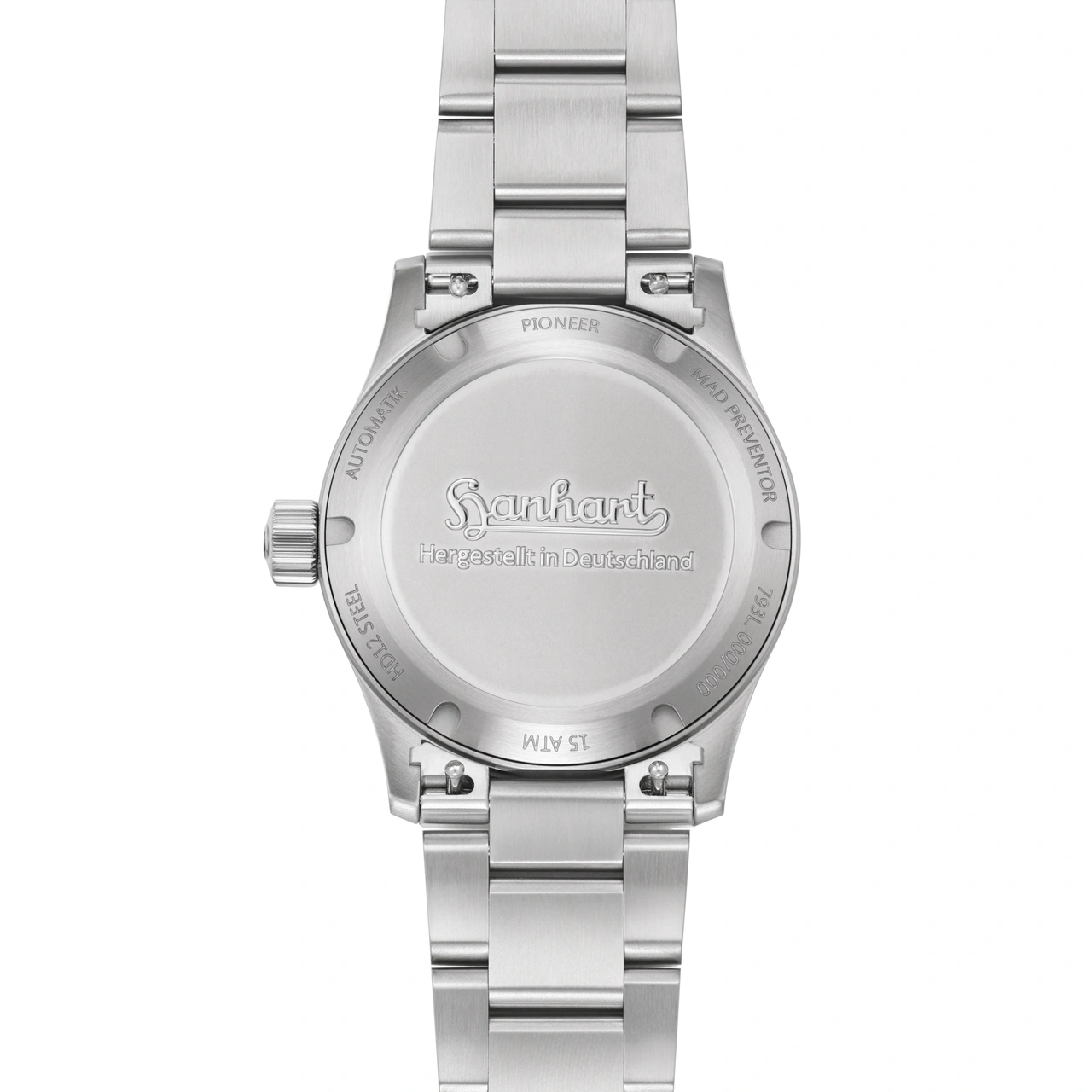
Each calibre is tested and regulated at the manufacture in Gütenbach. Hanhart specifies an average daily deviation of between 0 and +8 seconds across six positions. Mathematically, that eight-second tolerance is no narrower than a hypothetical -4 to +4 second range, but Hanhart deliberately biases its specification so the watch does not run slow in the principal positions.
That is an interesting piece of old-fashioned watchmaking logic. A mechanical watch running a few seconds fast can be corrected easily. One running slow means the wearer is gradually falling behind the actual time. Hanhart also limits the maximum deviation between individual positions to ten seconds, demonstrating that the regulation is about more than achieving a favourable reading in one orientation.
This distinction matters because two watches containing the same base movement do not necessarily offer the same real-world performance. Regulation, testing and quality control remain part of watchmaking even when the movement itself arrives from a specialist supplier.
A Bracelet Designed for Actual Wrists
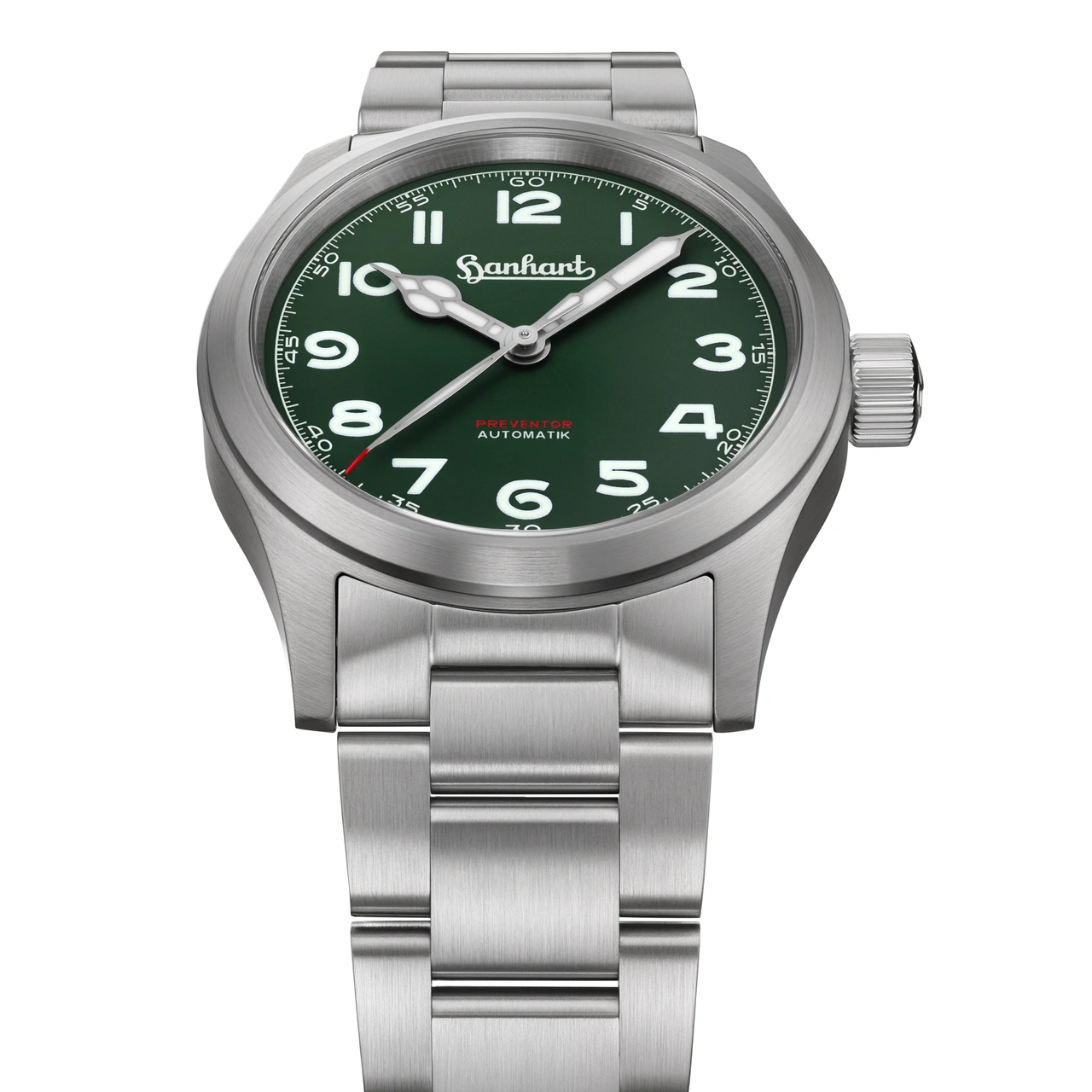
The optional bracelet also deserves attention because Hanhart appears to have concentrated on the details that make a bracelet pleasant to own rather than merely attractive in photographs.
Quick-release spring bars allow the bracelet to be removed without tools, which makes the 20 mm lug width even more useful. More importantly, the folding clasp incorporates tool-free fine adjustment. Wrist size changes during the day, particularly in warmer climates, and a bracelet that feels perfect in the morning can become irritatingly tight several hours later.
Micro-adjustment systems have gradually moved from being enthusiast wish-list items to becoming expected equipment on serious everyday watches. Once used regularly, it becomes difficult to understand why so many expensive bracelets still require a spring-bar tool to make a minor adjustment.
Hanhart also offers calfskin straps with Alcantara lining in black, dark brown and light brown. The leather will undoubtedly make the 36 mm case feel more classically proportioned, but the hardened bracelet probably expresses the technical character of the HD12 most completely.
The MAD Watch Collector Collaboration Makes Sense
Watch collaborations have become so common that the word itself is no longer enough to make a release interesting. Putting a different colour on an existing dial and attaching a familiar enthusiast name to the press release does not automatically result in a compelling watch.
This project feels more credible because the enthusiast influence appears in the proportions rather than simply the branding. The demand for a smaller Preventor already existed, and Russell’s involvement seems to have helped shape the details of how that smaller case should work, particularly the decision to maintain the 20 mm lug width.
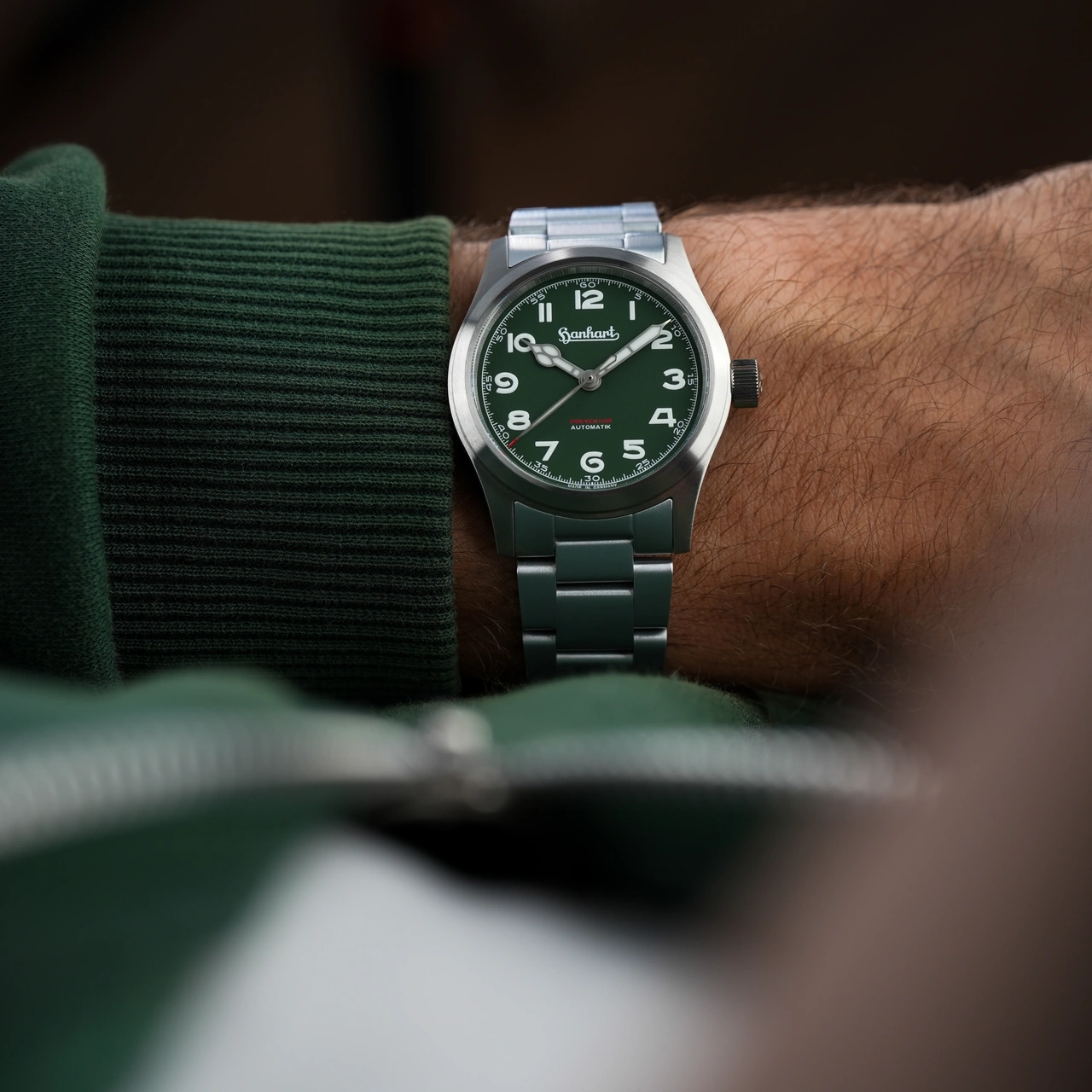
The MAD designation is there, but the watch still looks unmistakably like a Hanhart. That is generally the best outcome for this sort of collaboration. A guest should add something to the design without overwhelming the identity of the manufacture responsible for making it.
Limiting production to 200 pieces also keeps this particular configuration genuinely uncommon without turning the watch into an exercise in artificial scarcity. It feels more like a focused variation made for enthusiasts who have specifically wanted these dimensions.
Why This Release Works
The broader return towards smaller mechanical watches has produced some excellent designs, but it has also generated plenty of watches that rely almost entirely on nostalgia. Reduce the case to 36 mm, add beige luminous material, use an old logo and the job is apparently done.
The MAD Preventor HD12 takes a more convincing route. Its dimensions are traditional, but the construction is not. The sapphire crystal, hardened steel, screw-down crown, 15 ATM water resistance, modern luminous compound, adjustable bracelet and regulated automatic movement are all contemporary features. The watch happens to be 36 mm because that size makes sense for many wrists, not because it is pretending to have been manufactured in 1954.
That distinction gives it considerably broader appeal. Someone interested in Hanhart’s history will recognise the typography, cathedral hands and traditional proportions. Someone primarily interested in a practical daily watch can concentrate on the HD12 steel, water resistance and bracelet. And someone who simply thinks modern watches became unnecessarily large now has another serious alternative.
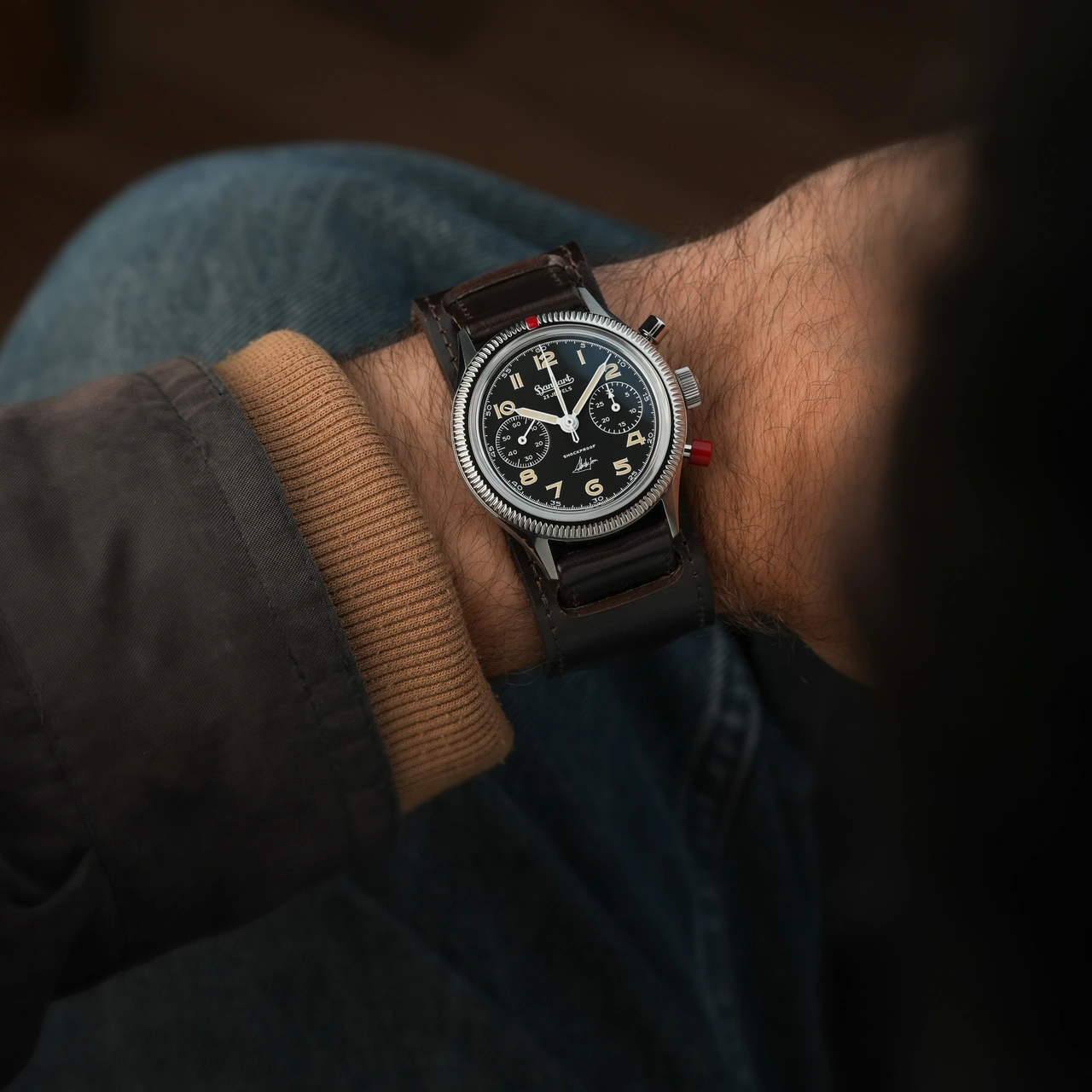
There is also a particular satisfaction in the contrast between the size and the specification. At 36 mm by 10.5 mm, the Preventor should almost disappear beneath a cuff. Yet underneath that restrained exterior is a case hardened to around 1,200 HV and water resistance equivalent to 150 metres. It has the specifications normally associated with much larger sports watches without looking as though it needs to prove them from across the room.
A Very Hanhart Kind of Watch
The most appealing aspect of the Hanhart MAD Preventor HD12 may ultimately be that none of its strongest features feels unnecessary.
The Black Forest green has a genuine relationship with the brand’s home. The 36 mm diameter answers repeated requests rather than chasing an arbitrary trend. The 20 mm lug width improves both its proportions and versatility. HD12 steel solves a real problem faced by people who regularly wear their watches. The uncluttered no-date movement suits the dial, and Hanhart’s regulation standards give an otherwise familiar calibre additional meaning.
That combination makes the watch particularly representative of what smaller independent brands can do well. Hanhart does not need to redesign the entire concept of mechanical timekeeping for a release to be interesting. Instead, it can take a straightforward three-hand watch and obsess over the practical decisions that determine whether someone will still enjoy wearing it years from now.
For collectors accustomed to larger contemporary sports watches, 36 mm may initially sound conservative. On the wrist, however, the combination of short lug-to-lug dimensions and the unusually broad 20 mm stance should create something far more purposeful. For enthusiasts already comfortable with vintage proportions, the attraction is perhaps even clearer: here are the dimensions many have always preferred, without the compromises of actually wearing a vintage watch every day.
The MAD Preventor HD12 is therefore not particularly interesting because it is small. It is interesting because Hanhart has demonstrated how much capability can fit into a small mechanical watch.
Limited to 200 examples, it occupies a very specific space within the current Hanhart collection. It carries enough historical character to feel connected to the company’s past, enough modern engineering to survive genuine daily wear, and enough input from the enthusiast community to feel like a watch created with wrists rather than specification sheets in mind.
For anyone drawn to independent German watchmaking, that makes the MAD Preventor HD12 a quietly significant release. It does not shout about its technical credentials, and it does not need oversized dimensions to communicate toughness. It simply brings Hanhart’s familiar combination of precision, durability and functional clarity into what may be one of the most wearable cases the company has offered in years.