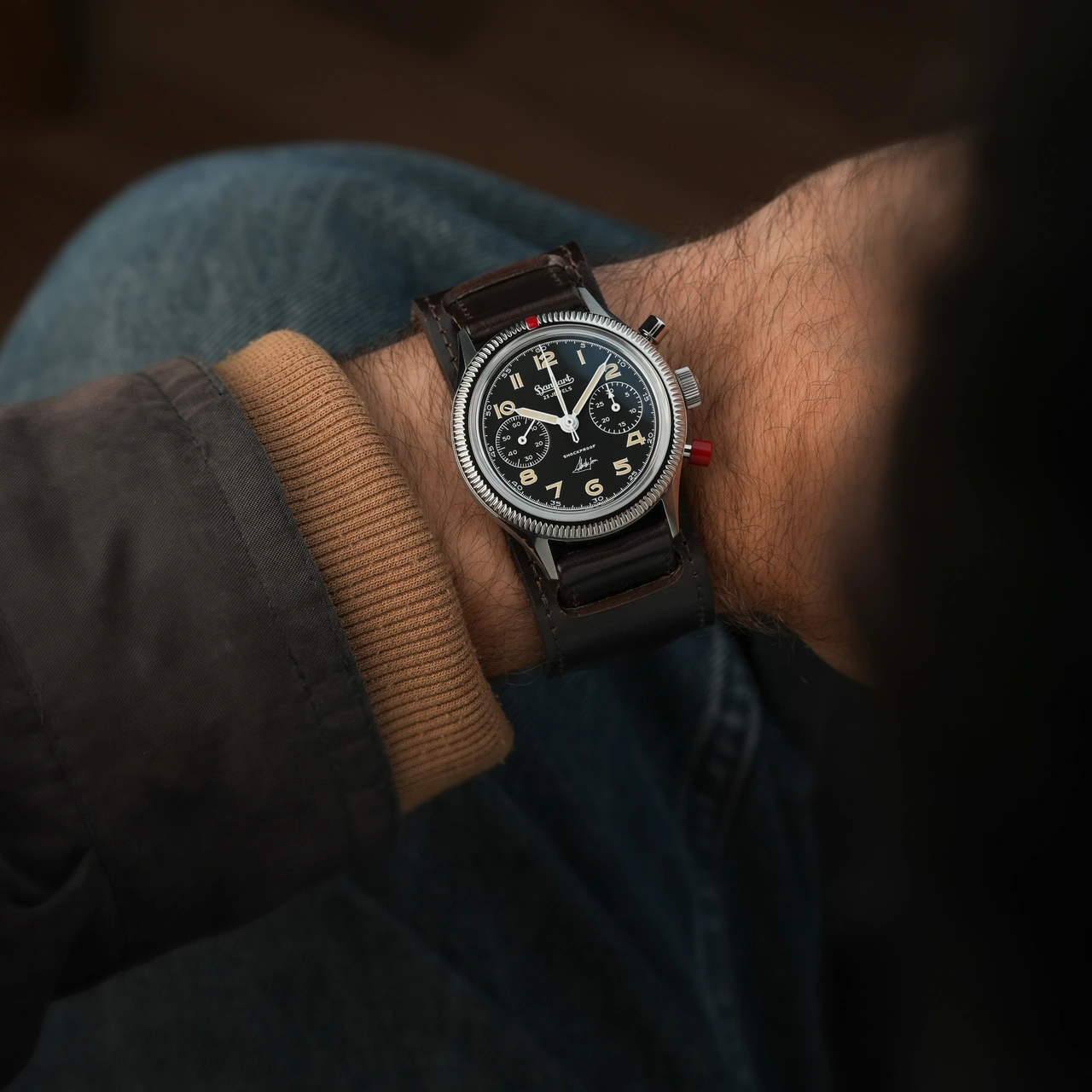
Hanhart is a brand with an unusually clear visual identity. For most enthusiasts, the name immediately brings to mind purposeful chronographs, highly legible instrument dials, unmistakable pushers and a design language shaped by more than a century of timing things accurately. The new Square by Square Mother-of-Pearl is therefore quite a surprise.
There is no round chronograph case here. No obvious aviation reference. No attempt to make a familiar Hanhart slightly more contemporary. Instead, the Square by Square approaches the wristwatch almost from first principles, using an unconventional shaped case, sculptural sapphire crystal and deeply architectural dial to create something that sits well outside the brand’s established collection.
Even more interestingly, this particular version places a naturally iridescent mother-of-pearl dial inside all that tightly controlled geometry. It is an unusual pairing. The case is calculated, precise and almost mathematical. Mother-of-pearl is organic, unpredictable and constantly changing. One side of the watch is about structure, the other about variation. Bringing the two together gives the Square by Square much of its character.
There is also the matter of rarity. Hanhart is initially producing only six Square by Square prototypes, with just three receiving the mother-of-pearl dial. Whether the concept develops into a regular production watch remains undecided. For now, this is less a conventional collection launch than an opportunity to see Hanhart testing the boundaries of what a Hanhart can be.
A Hanhart That Could Only Have Started in the Archive
As radical as the finished watch appears, the Square by Square did not begin with the intention of rejecting Hanhart’s past. In fact, the project started by going directly into it.
Hanhart again worked with Munich-based designer Marcus Wiedemann of Studio supercreative, following their earlier collaboration on the CXD NFT Watch. This time, the brief was connected to the Dubai Watch Week x Grail Watch Design Competition, where the resulting concept became a finalist in the category for the “Most out-of-the-box, innovative yet viable shaped watch design”.
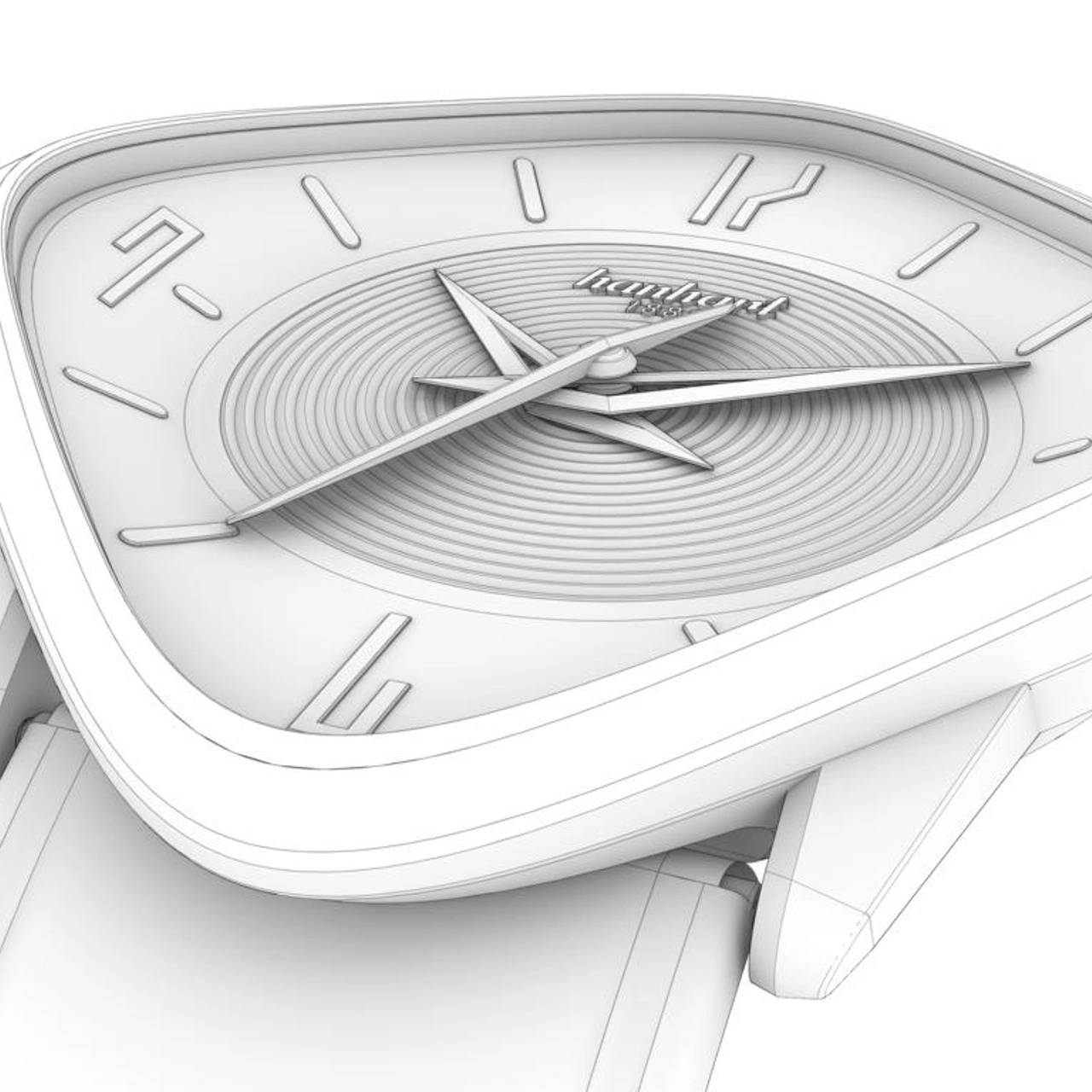
Wiedemann’s research into historical Hanhart catalogues uncovered a broader variety of watches than the modern brand’s chronograph-focused identity might suggest. Different case forms, dial structures and typographic arrangements appeared throughout the archives. The obvious approach would have been to select one of those historical watches and recreate it with modern materials.
That is not what happened.
The archive instead became a collection of ideas. Proportions were studied. Lines were reconsidered. Construction principles were pulled apart and recombined. The classic rectangular watch gradually became something far more difficult to categorise. It is not properly rectangular, not really square and not simply a cushion case either.
That distinction is important because the Square by Square does not feel like another heritage reissue. Its connection with Hanhart’s history is there, but the history sits beneath the design rather than being displayed on the surface.
A Case That Changes Depending on Where You Stand
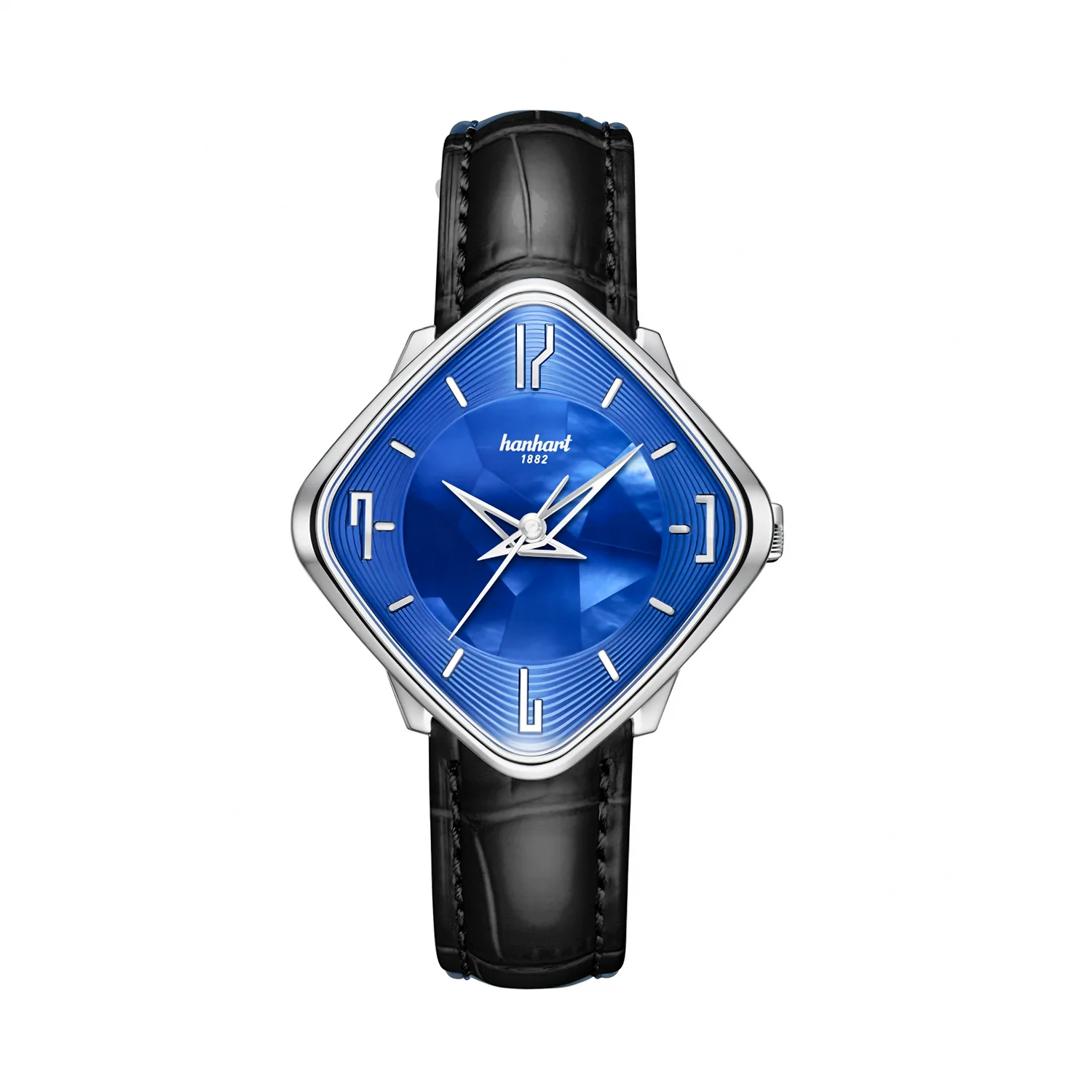
The shape is undoubtedly the first thing that demands attention. At 40 mm from 12 to 6 o’clock and 38 mm from 9 to 3, the Square by Square is compact on paper. The lug-to-lug dimension is only 32.8 mm, while the overall thickness is 10.9 mm.
Those numbers are worth considering because photographs make the watch appear larger and more imposing than its measurements suggest. There is a great deal happening within a relatively small area. The sides curve gently, the contour narrows towards the lugs and the transitions between surfaces prevent the case from being read as one simple geometric form.
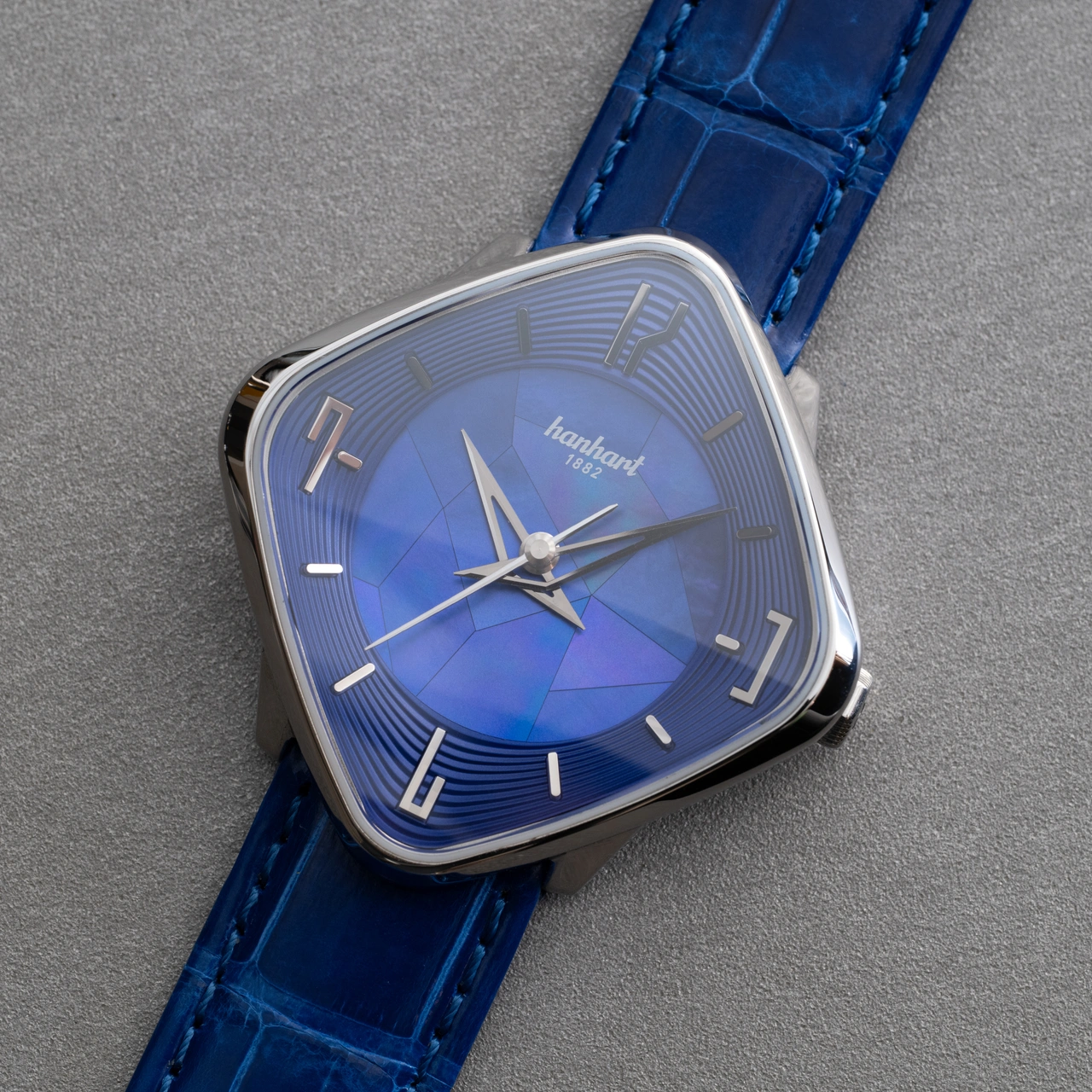
This was intentional. Among the more unusual influences during the design process were curved spacetime and hyperbolic paraboloids. The latter are saddle-shaped surfaces that curve in two opposing directions simultaneously. It sounds like an unlikely starting point for a wristwatch, but the idea becomes much easier to understand when looking at the Square by Square from different perspectives.
Some surfaces seem to rise while others fall away. The case can look more angular from one viewpoint and noticeably softer from another. Rather than placing decoration on a conventional case, Hanhart and Wiedemann have made the construction of the case itself the decorative element.
That could easily have become excessive. Shaped watches often risk looking like design exercises rather than objects someone might genuinely want to wear. The Square by Square avoids much of that through its proportions. The dimensions remain restrained and the integrated, very short lugs keep the watch concentrated around the wrist instead of extending across it.
The result is one of those watches where the specification sheet and the visual impression tell different stories. The numbers suggest something compact and manageable. The geometry gives it considerably more presence.
The Sapphire Crystal Is Not Just a Window
One of the most successful elements of the Square by Square is the heavily domed sapphire crystal. In most watches, the crystal is functionally important but visually secondary. Here, it becomes part of the architecture.
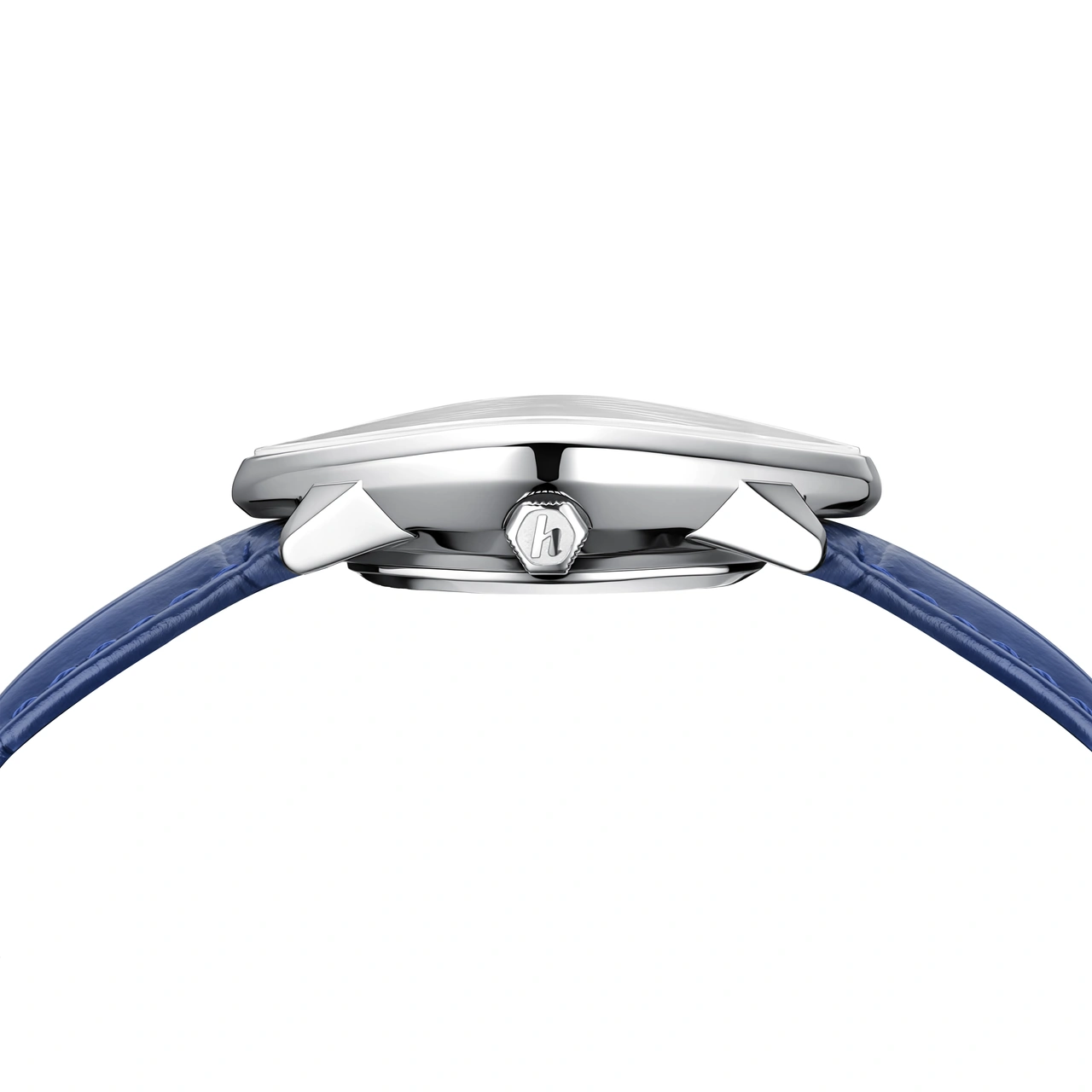
The sapphire extends over the edges of the case, continuing the form rather than sitting neatly inside a traditional bezel. Viewed from an angle, the crystal distorts and reflects the dial beneath it while changing the perceived shape of the watch itself.
It was also one of the more difficult parts of the prototype to manufacture. Hanhart notes that several crystals broke during development before the correct production solution was achieved. That detail adds something important to the story of the watch. Unusual industrial design is easy to sketch. Making it physically work in sapphire, steel and moving mechanical components is where the difficulty begins.
The crown receives similar attention. It is hexagonal, signed with Hanhart’s “h” and recessed into the side of the case so that it does not interrupt the overall silhouette. Water resistance is rated to 10 bar, or 10 ATM, in accordance with DIN 8310, giving the watch a level of everyday practicality that might not be obvious from its experimental appearance.
This is ultimately what makes the competition brief particularly relevant. The Square by Square needed to be innovative, but it also needed to be viable. It could not simply be an interesting object rendered on a computer screen.
Mother-of-Pearl Changes the Entire Character
Of all the dial treatments Hanhart could have chosen for such a technically driven design, mother-of-pearl is perhaps one of the least predictable.
That is exactly why it works.
Mother-of-pearl has very little interest in remaining visually consistent. Depending on the light, it can appear silvery, creamy, cool, warm or subtly coloured with pink, blue and green reflections. Move the wrist and those colours shift again. No printed texture or conventional sunburst finish quite behaves the same way.
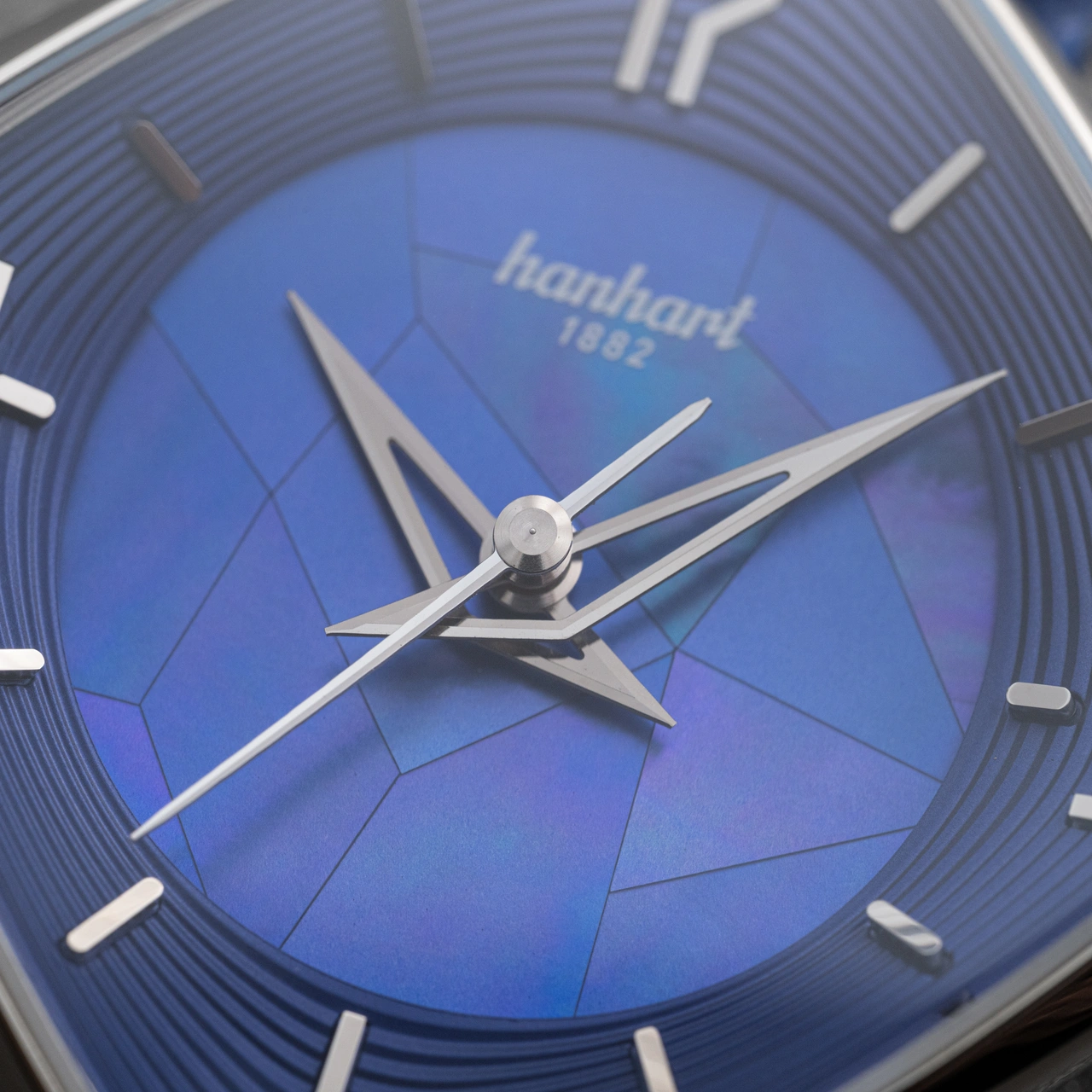
Against the Square by Square’s carefully calculated case, that natural irregularity becomes particularly noticeable. The watch is effectively built around a tension between order and unpredictability. Its steel architecture establishes strict boundaries, while the dial inside them refuses to look exactly the same twice.
It also prevents the watch from becoming too clinical. A blue sunburst dial naturally suits technical watch design, but mother-of-pearl introduces something less obvious. There is a softness and visual depth that plays against the strong case geometry rather than simply reinforcing it.
Only three of the six initial Square by Square prototypes use this dial, giving the mother-of-pearl version its own position within an already extremely small project.
A Dial Built in Layers
The mother-of-pearl surface is only one part of the dial’s appeal. The architecture around it is just as important.
A deep stepped rehaut surrounds the central display, making the dial feel recessed within the case. This gives the watch a three-dimensional quality that would have been lost with a simple flat chapter ring. The applied numerals and indices are rendered in a steel colour and have been shaped specifically to suit the new case.
There is a notable absence of the familiar Hanhart pilot-watch vocabulary. The typography does not attempt to reassure the viewer by referencing the 417 ES or another recognisable model from the current collection. Even the logo has been treated in a more contemporary manner.
That decision gives the Square by Square greater credibility as an independent design. It would have been very easy to place traditional Hanhart dial furniture inside an unconventional case and call the combination a new direction. Instead, almost every visible component has been considered as part of the same design language.
The relationship between the mother-of-pearl and the rehaut is especially effective. The central area behaves organically as it catches the light, while the surrounding structure remains sharply controlled. It creates visual depth without relying on unnecessary complication.
Hands Designed as Part of the Architecture
The handset might be the most thoughtful detail on the entire watch.
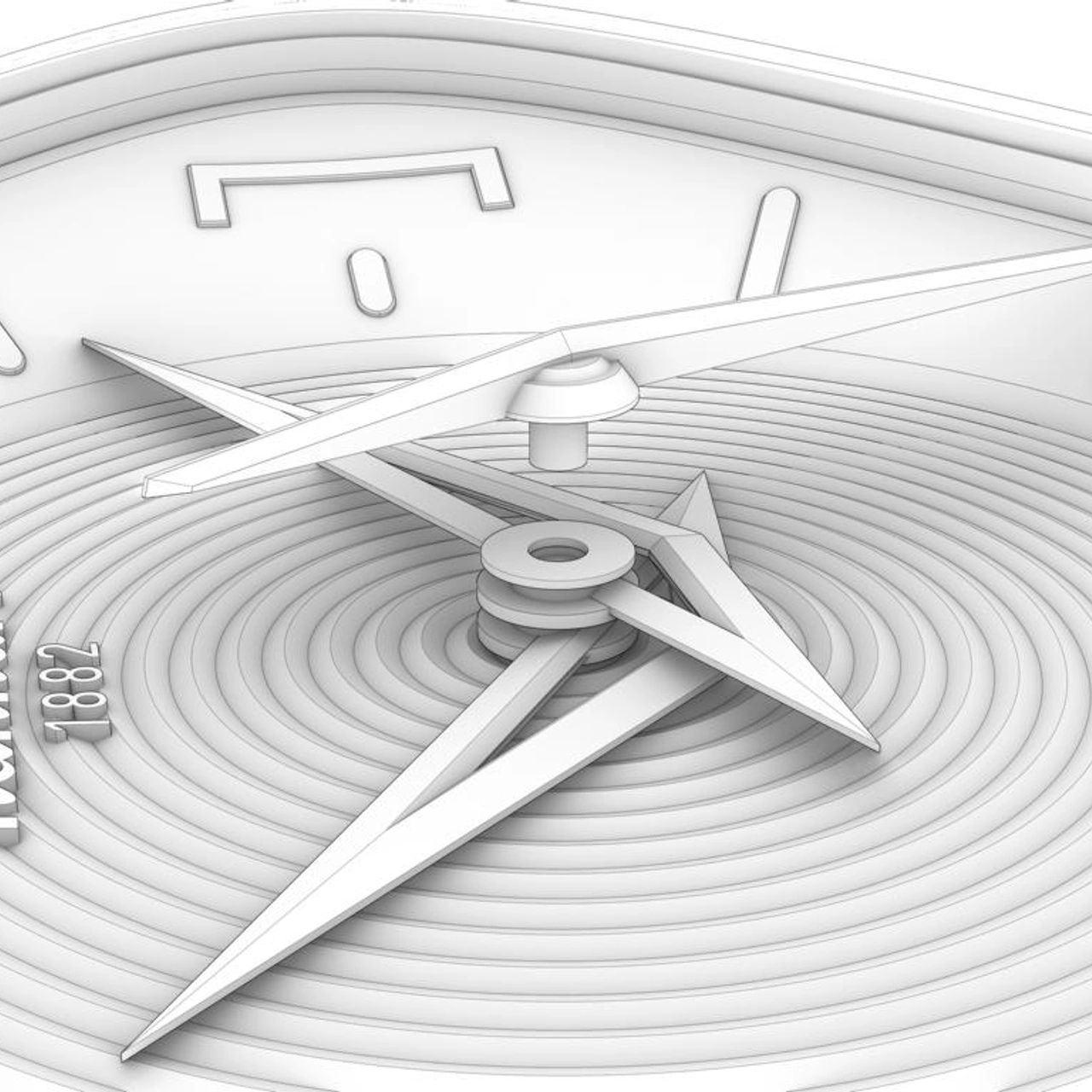
Both hands are skeletonised, multi-faceted and fully polished. As the viewing angle changes, their various surfaces catch and lose reflections, allowing them to move between bright highlights and much darker tones. Skeletonising them also prevents the broad forms from obscuring too much of the mother-of-pearl beneath.
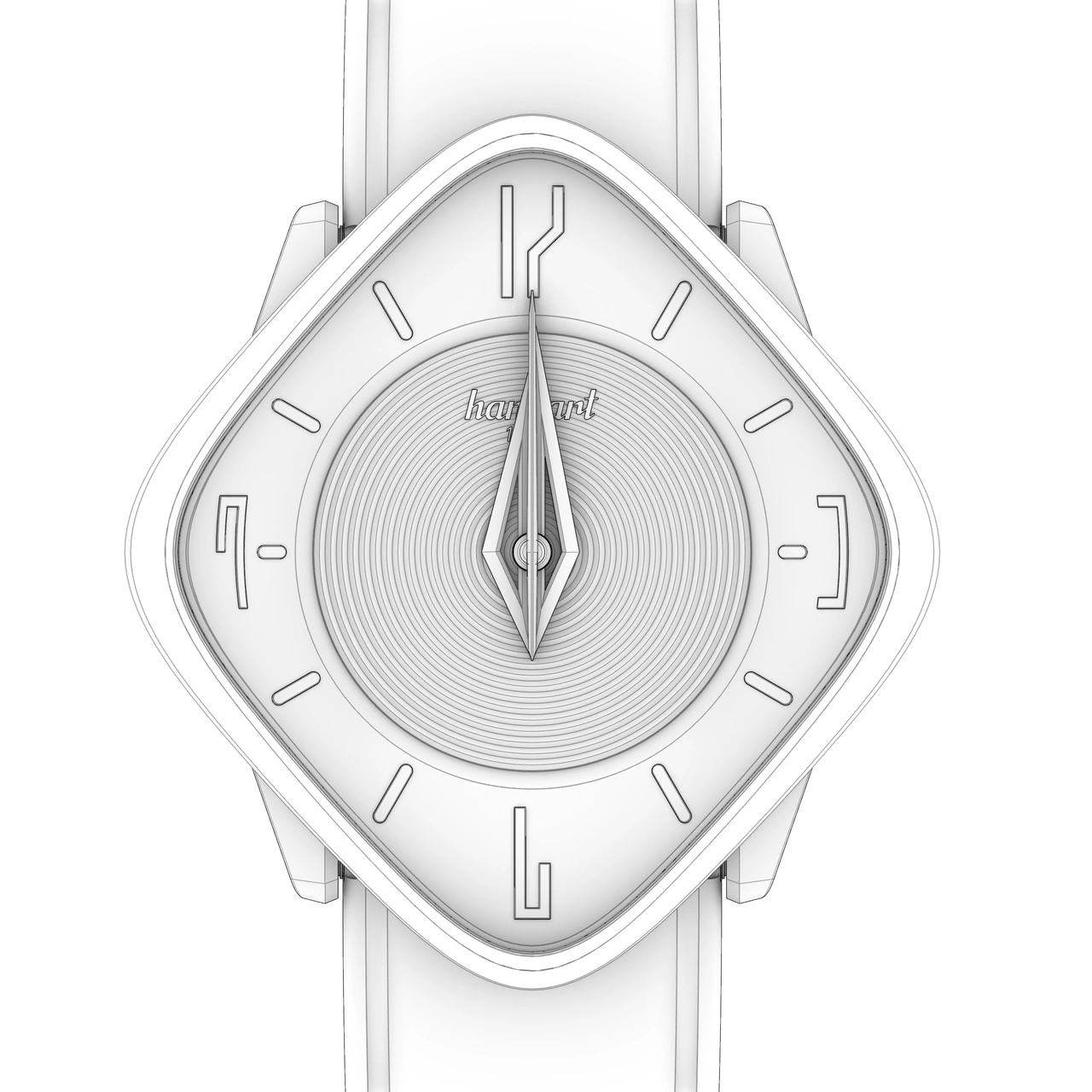
The cleverest part becomes apparent at 12 o’clock. When the hour and minute hands align, their respective shapes combine to create one elongated diamond.
It is the sort of detail that does not need to exist. The watch would function perfectly well without it. That is precisely why it says so much about the project. Someone has considered not only how each hand should look individually, but what the two shapes should become when they meet.
Small moments like this often distinguish a properly resolved design from one that is simply unusual. The Square by Square contains plenty of unconventional ideas, but those ideas are consistently connected to one another.
A Sensible Movement Inside an Unusual Watch
After so much visual experimentation, the movement is refreshingly straightforward. Hanhart has selected the automatic Sellita SW1000-1 b.

The calibre operates at 28,800 vibrations per hour, equivalent to 4 Hz, contains 18 jewels and provides a typical power reserve of 46 hours. Most importantly for this particular project, it is compact enough to support the Square by Square’s relatively slim case construction.
There is a tendency in contemporary watchmaking to assume that an unusual exterior needs an exotic proprietary movement to justify itself. That is not necessarily true. In the Square by Square, the primary work has gone into industrial design, case construction, crystal manufacture and dial architecture. Using a proven automatic calibre allows the watch to remain practical and serviceable without distracting from its real point of difference.
Hanhart does, however, apply its own standards to the movement once it reaches Gütenbach.
Each movement is tested and regulated by the company’s watchmakers. Hanhart specifies an average daily rate between 0 and +8 seconds across six positions, with no negative deviation permitted in the principal positions. The maximum allowable difference between positions is 10 seconds.
The philosophy behind that regulation is characteristically Hanhart. A watch may run slightly fast, but according to the company’s thinking, it should never make its owner late.
It is a charmingly traditional idea sitting inside a watch that looks anything but traditional.
Why the Square by Square Matters
The most significant aspect of the Square by Square may not be its case shape, its mother-of-pearl dial or even the fact that just six prototypes currently exist.
What makes it interesting is what it says about Hanhart.
Heritage is one of the greatest advantages a watch manufacturer can possess. It gives a brand stories, historical designs, credibility and a recognisable identity. It can also become restrictive. Once collectors decide what a company is supposed to make, moving beyond that expectation becomes surprisingly difficult.
Hanhart could probably continue producing variations of historically inspired chronographs indefinitely. The 417 ES and related models provide plenty of evidence that the formula still has considerable appeal. There would be little commercial reason to abandon it.
The Square by Square does not abandon that history, but it demonstrates that Hanhart does not necessarily want to be trapped by it either.
The project goes back into the archive, finds ideas that are less familiar, hands them to an external designer and allows those ideas to evolve into something that no longer looks historical at all. It is a much more interesting use of heritage than simply making another faithful reissue.
An Experimental Watch That Still Feels Finished
There is an important distinction between a prototype that feels unfinished and a prototype that feels experimental. The Square by Square belongs firmly in the latter category.
The watch clearly pushes outside Hanhart’s normal boundaries, but the individual elements do not appear random. The proportions keep the unusual case wearable. The curved sapphire responds to the geometry beneath it. The layered rehaut continues the architecture into the dial. The polished skeletonised hands relate directly to the case facets. Mother-of-pearl introduces movement and visual variation where a more conventional dial might have made the watch feel overly rigid.
Even the Sellita movement plays its role by allowing the overall package to remain compact and mechanically straightforward.
That coherence is more important than novelty alone. Plenty of watches can attract attention through strange shapes or exotic materials. Far fewer remain interesting once the initial surprise has passed.
The Square by Square Mother-of-Pearl appears to have enough depth to survive that second look.
A Fascinating Detour for Hanhart
For collectors who associate Hanhart almost exclusively with pilot’s chronographs and stopwatches, the Square by Square may initially look as though it comes from an entirely different manufacturer. Spend more time with the thinking behind it, however, and the connection becomes clearer.
There is still an emphasis on practicality. There is still a serious approach to timekeeping. The case is unusual but wearable, the water resistance is useful, the movement is robust and Hanhart continues to regulate the calibre according to its own standards.
What has changed is the visual vocabulary.
The mother-of-pearl model arguably demonstrates that new vocabulary particularly well. There is something compelling about placing such an organic, constantly changing material inside a case inspired by mathematical surfaces and precise geometric transitions. One half of the design seeks control, while the other seems determined to escape it.
Whether the Square by Square ultimately becomes a regular production model remains unknown. Perhaps it will lead to a wider shaped-watch collection. Perhaps the six prototypes will remain a fascinating one-off chapter in Hanhart’s history.
Either outcome makes the project worthwhile.
Independent and smaller-scale watchmaking is at its most interesting when manufacturers are willing to take genuine design risks, especially when those risks are grounded in thoughtful construction rather than novelty for novelty’s sake. The Hanhart Square by Square Mother-of-Pearl does exactly that.
It is unusual without becoming ridiculous, technically considered without looking clinical and historical without looking backwards.
Most importantly, it proves that after more than 140 years of watchmaking, Hanhart can still surprise people.