The Alexander Shorokhoff Cadamomo Black arrives at a time when collectors are increasingly drawn to watches that offer more than technical excellence alone. In a landscape filled with familiar designs and predictable complications, this watch stands apart by embracing artistic expression without sacrificing mechanical substance. It is a full calendar watch that challenges expectations, both visually and conceptually.
Alexander Shorokhoff has long been associated with avant-garde watchmaking, and the Cadamomo Black builds upon that reputation with confidence. The original Cadamomo quickly gained attention for its bold presentation of a traditionally conservative complication. Rather than refining the idea into something safer, the manufacture chose to push further, resulting in a black-dial successor that feels more focused, more confident, and arguably more mature.

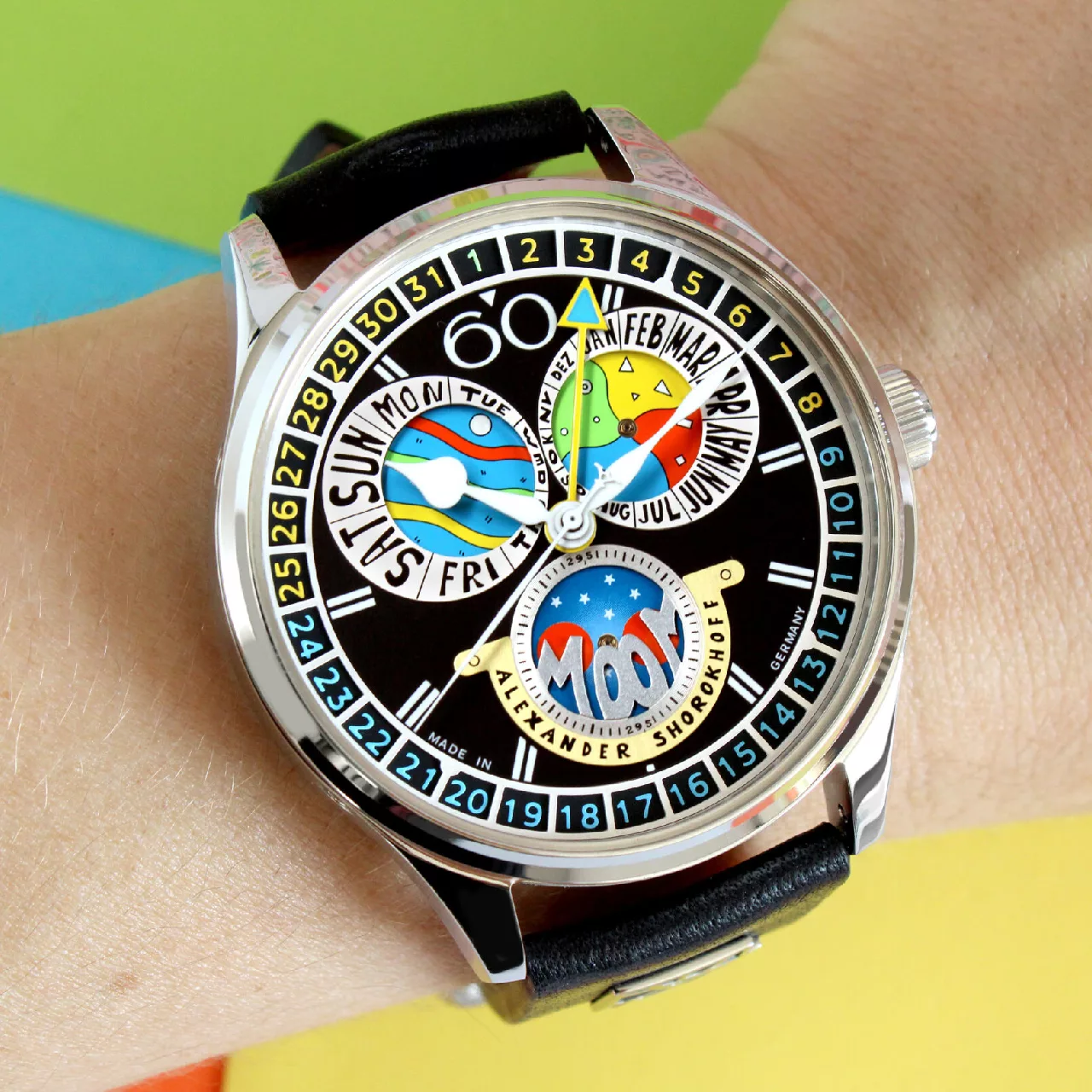
The dial is where the Cadamomo Black reveals its true character. Set against a deep black background, the calendar indications are arranged with an almost architectural intent. The outer date scale immediately draws the eye, highlighted by vivid yellow, blue, and green accents that create contrast without chaos. The central yellow date hand, tipped in blue, moves gracefully across this scale, providing both clarity and visual rhythm.

Equally distinctive are the subdial indications for day, month, and moon phase. Rather than traditional hands or windows, the day of the week is marked by a small white sphere at 10 o’clock, while the month is indicated by a subtle white arrow at 2 o’clock. These design choices may appear unconventional, yet they contribute to a balanced and legible display. At 6 o’clock, the moon phase introduces a quieter, almost poetic element, grounding the boldness above with a sense of continuity and time’s natural cycles.

Behind this expressive dial lies a movement that has been carefully adapted to suit the watch’s artistic ambitions. The automatic calibre DD9000 from Dubois Depraz serves as the foundation, a respected movement known for its versatility in complex calendar applications. For the Cadamomo Black, the calibre is significantly modified, with three custom subdial discs designed by Alexander Shorokhov himself. These components are then reworked, assembled, and finished by the manufacture’s watchmakers, ensuring that the movement aligns with the visual language of the dial.
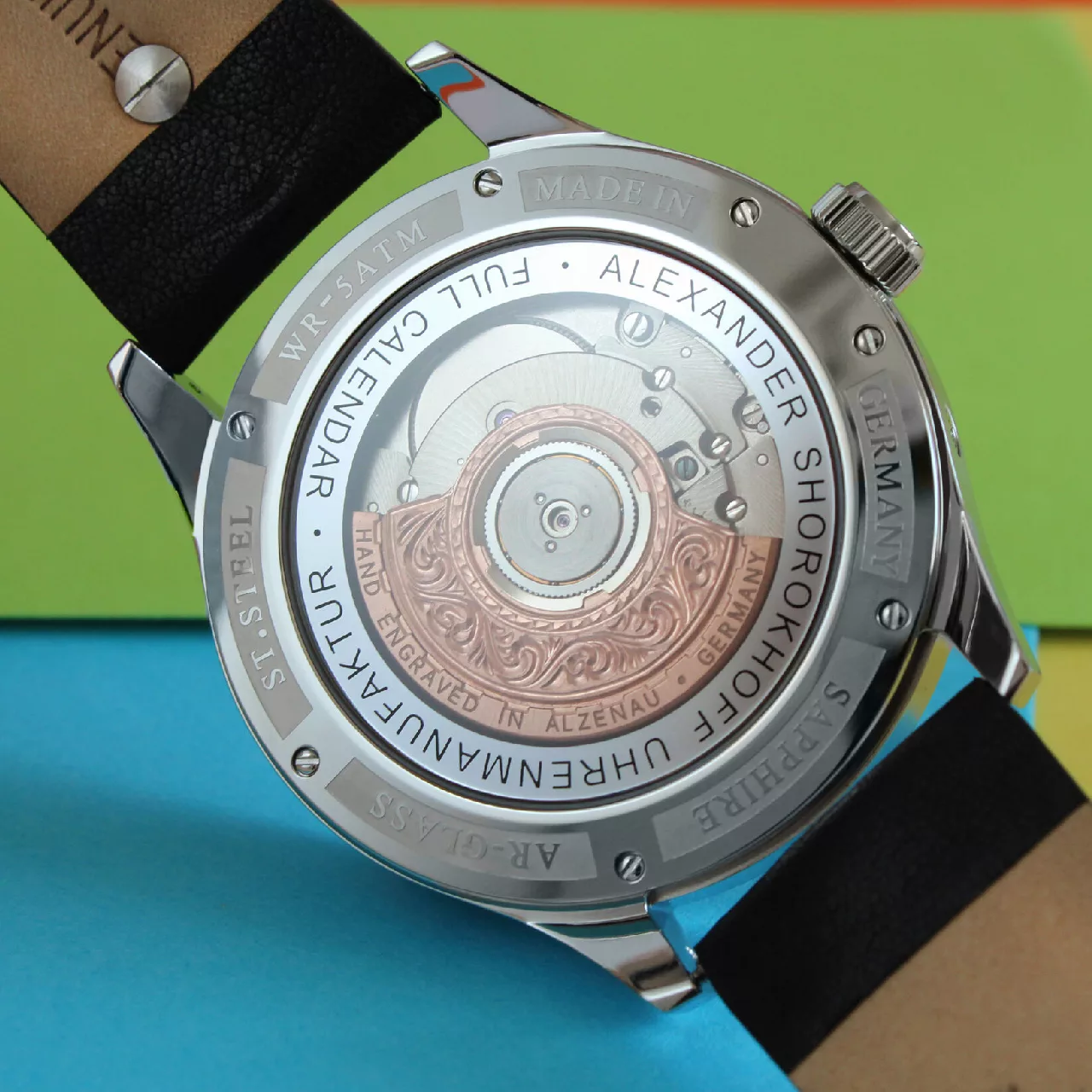
Details such as blued screws and a refined oscillating weight further enhance the movement’s appeal. While the Cadamomo Black is undeniably a design-led watch, it never feels superficial. The mechanical execution supports the aesthetic vision, reinforcing the idea that avant-garde watchmaking can be both expressive and serious.

The name “Cadamomo” offers insight into the structured thinking behind the watch’s creativity. Each syllable directly references a core function of the watch, calendar, day, month, and moon. This layered meaning reflects the watch itself, where artistic freedom is underpinned by logical order. It is a reminder that even the most expressive designs are often built upon disciplined foundations.
Limited to just 50 pieces worldwide, the Cadamomo Black carries an exclusivity that feels genuine rather than manufactured. Its scarcity is a natural outcome of the complexity involved in its production, from the customised movement components to the carefully assembled dial elements. For collectors, this limitation adds to the watch’s appeal, positioning it as a piece that is unlikely to be encountered often, even within experienced circles.
Ultimately, the Alexander Shorokhoff Cadamomo Black speaks to those who appreciate watchmaking as a form of artistic expression. It is not designed to blend in or to appeal to the broadest audience possible. Instead, it rewards collectors who value individuality, mechanical nuance, and the courage to approach traditional complications from a fresh perspective. In doing so, it reinforces Alexander Shorokhoff’s place within the world of independent horology, where creativity remains as important as precision.