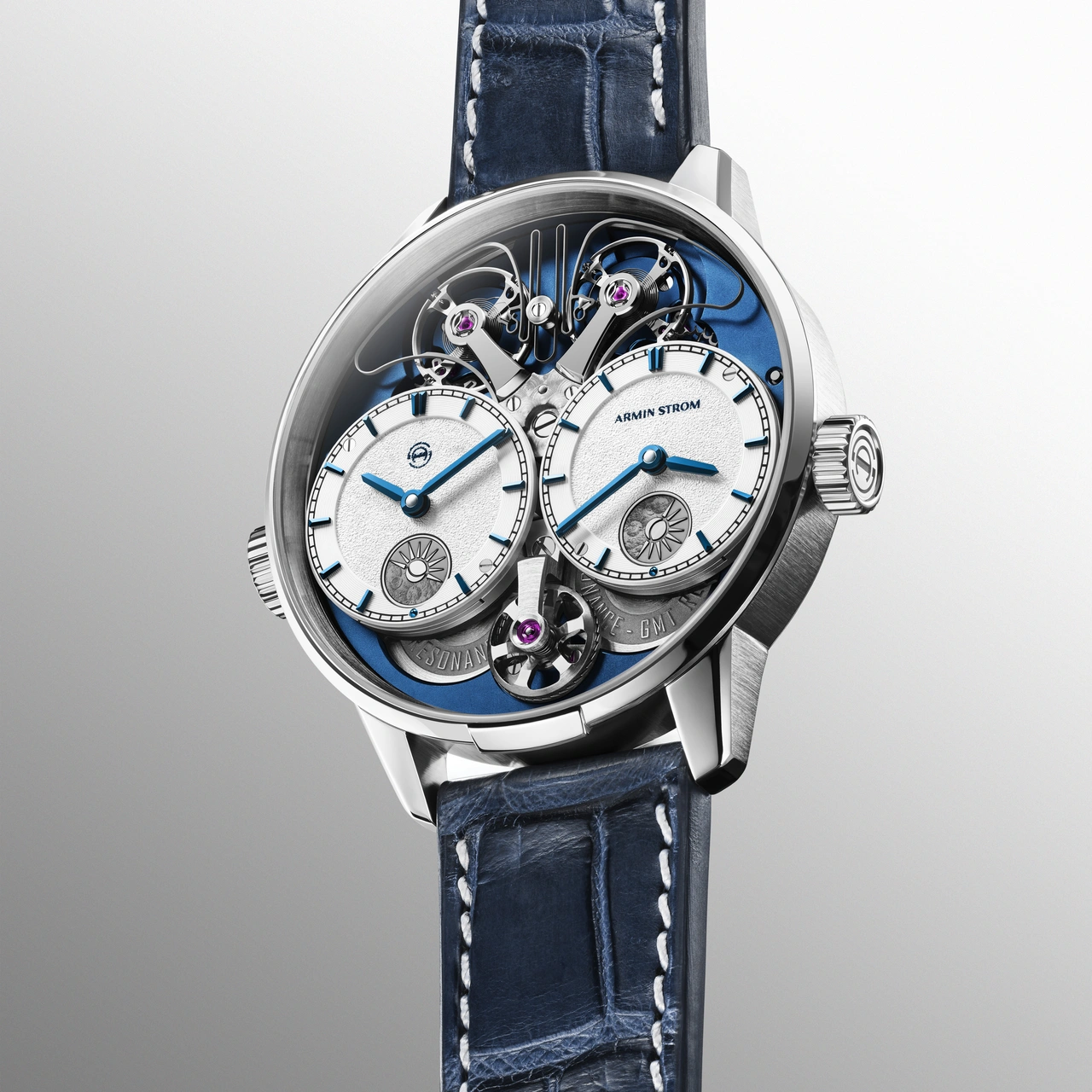
Most skeletonised watches are built around a relatively simple idea: reveal the movement and let the mechanics do the talking. Armin Strom’s Mirrored Force Resonance Zeitgeist 1665 3N takes that philosophy considerably further. The fascinating part is not simply that its movement is exposed, but that two of its most important components are designed to influence one another. Two independent balance wheels, each oscillating at its own natural rhythm, are connected through a mechanical system that encourages them to synchronise. It is a remarkable thing to observe, and even more remarkable to understand.
Of course, Armin Strom’s fascination with resonance is hardly new. The Swiss independent manufacture has spent years refining its approach to this unusual method of mechanical regulation, developing movements that place the phenomenon at the centre of both their engineering and their appearance. What makes the new Zeitgeist 1665 3N particularly interesting is the direction taken with its design. Instead of pushing the aesthetic further towards the contemporary, Armin Strom has turned to the visual traditions of classical watchmaking.
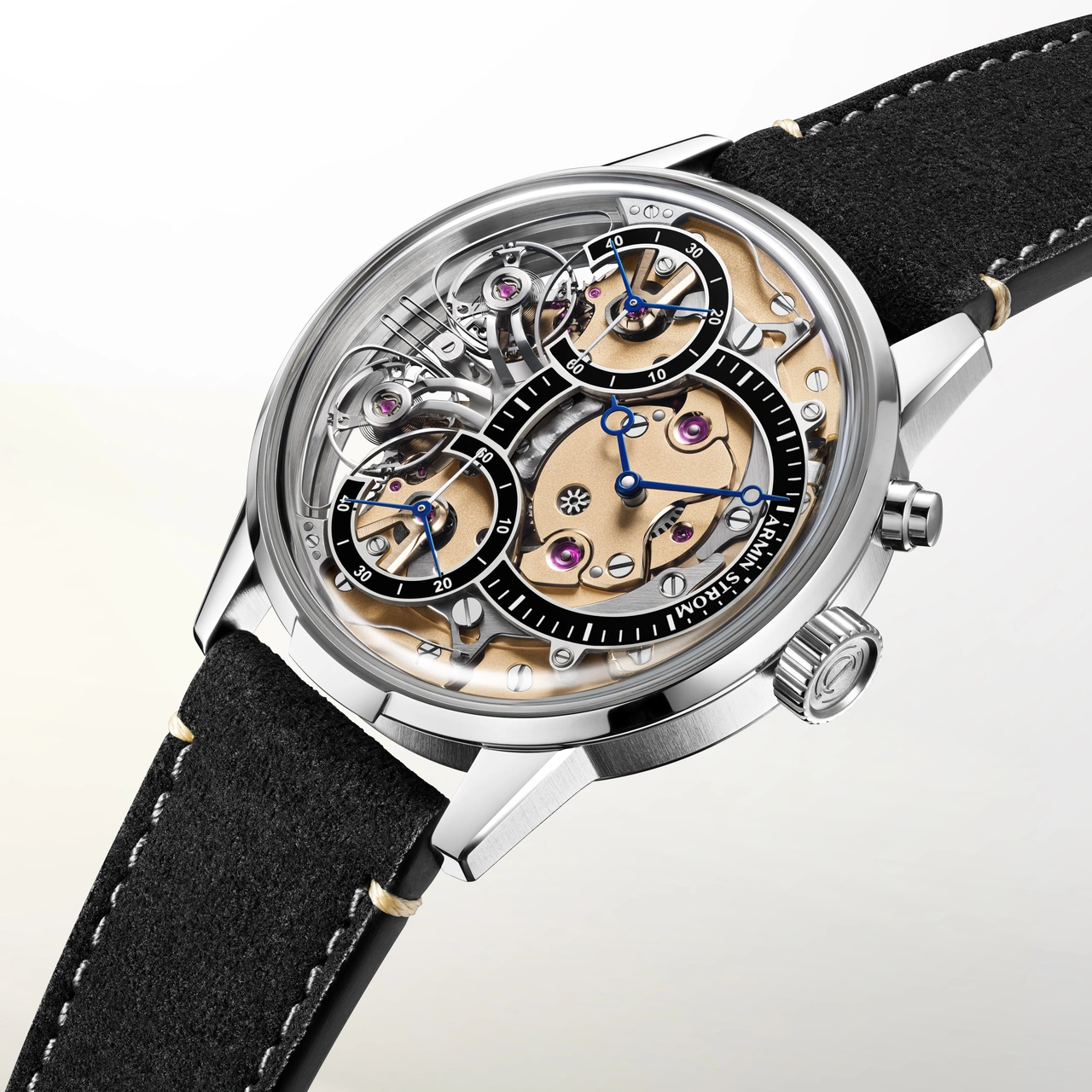
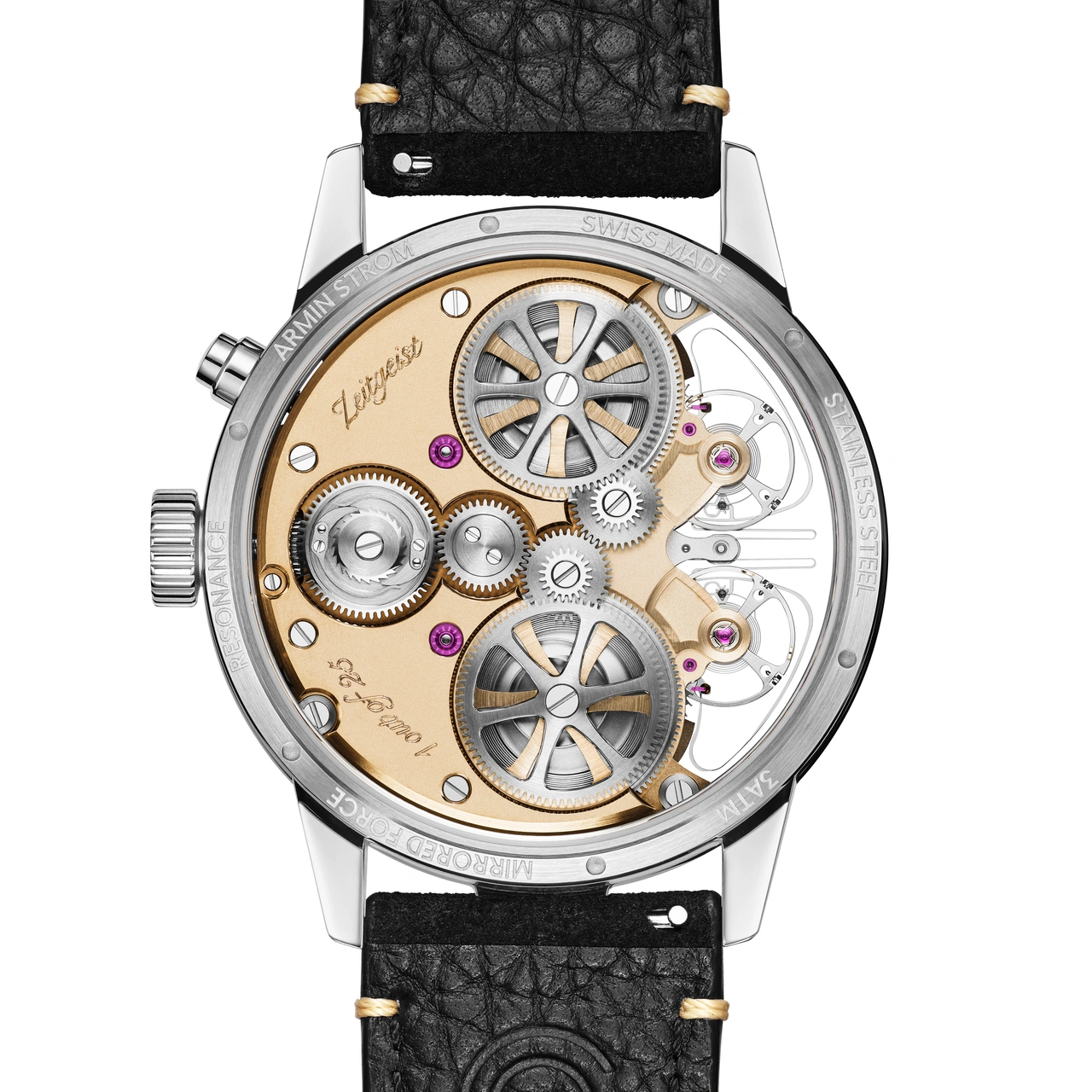
The movement’s mainplate and bridges are finished in warm 3N yellow gold tones, accompanied by a black lacquer dial and beautifully traditional heat-blued steel hands. It is a relatively small collection of colours, but one that changes the entire personality of the watch. The intricate mechanics retain their distinctly modern appearance, while the finishing evokes the carefully decorated movements of traditional haute horlogerie.
There is an appealing contradiction here. The Zeitgeist 1665 3N looks as though it belongs to an imagined chapter of watchmaking history, yet its defining mechanical achievement is the result of thoroughly contemporary engineering. That contrast, rather than the limited production of just 25 pieces, is what makes this new release worthy of closer attention.
To appreciate what Armin Strom has achieved, it helps to understand the peculiar observation that inspired the movement.
In 1665, Dutch scientist Christiaan Huygens noticed that two pendulum clocks could begin to synchronise when their vibrations were transmitted through a shared supporting structure. Despite operating as separate mechanisms, the pendulums influenced each other’s motion until they settled into a coordinated rhythm.
Huygens had observed a physical phenomenon that would intrigue watchmakers for centuries. The possibility that two oscillators might work together to produce more stable timekeeping was enormously appealing, particularly during a period when improvements in mechanical accuracy were among horology’s greatest challenges.
The difficulty was turning that observation into something useful for a portable mechanical watch.
Two pendulum clocks mounted to a shared structure operate under very different conditions from two balance wheels enclosed within a wristwatch. Clocks remain relatively stationary, whereas wristwatches are constantly moving, changing orientation and encountering disturbances. Even minor changes in the conditions affecting an oscillator can alter its behaviour.
Simply placing two balance wheels inside a movement does not create a practical resonance system. They need an effective means of transmitting vibrations, and that connection must allow their oscillations to influence one another in a controlled manner.
This is where Armin Strom’s patented resonance clutch becomes so important. It provides a mechanical connection between two independent regulating systems, transferring vibrations between them and enabling the balance wheels to synchronise through resonance.
The aim is improved chronometric stability, with a system specifically engineered to maintain synchronisation under the changing conditions encountered on the wrist. It is an ambitious objective, and one that requires considerably more ingenuity than the visual arrangement of two balance wheels might initially suggest.
For the Zeitgeist 1665 3N, the historical connection is particularly appropriate. The name references the year of Huygens’ observations, while the watch’s classical finishing imagines how a sophisticated resonance mechanism might have been presented by watchmakers of an earlier period.
It is historical inspiration without historical imitation. Armin Strom has not attempted to reproduce an antique movement. Instead, it has imagined an alternative evolution of traditional watchmaking, where a centuries-old mechanical ambition could have been fulfilled with knowledge that only became available much later.
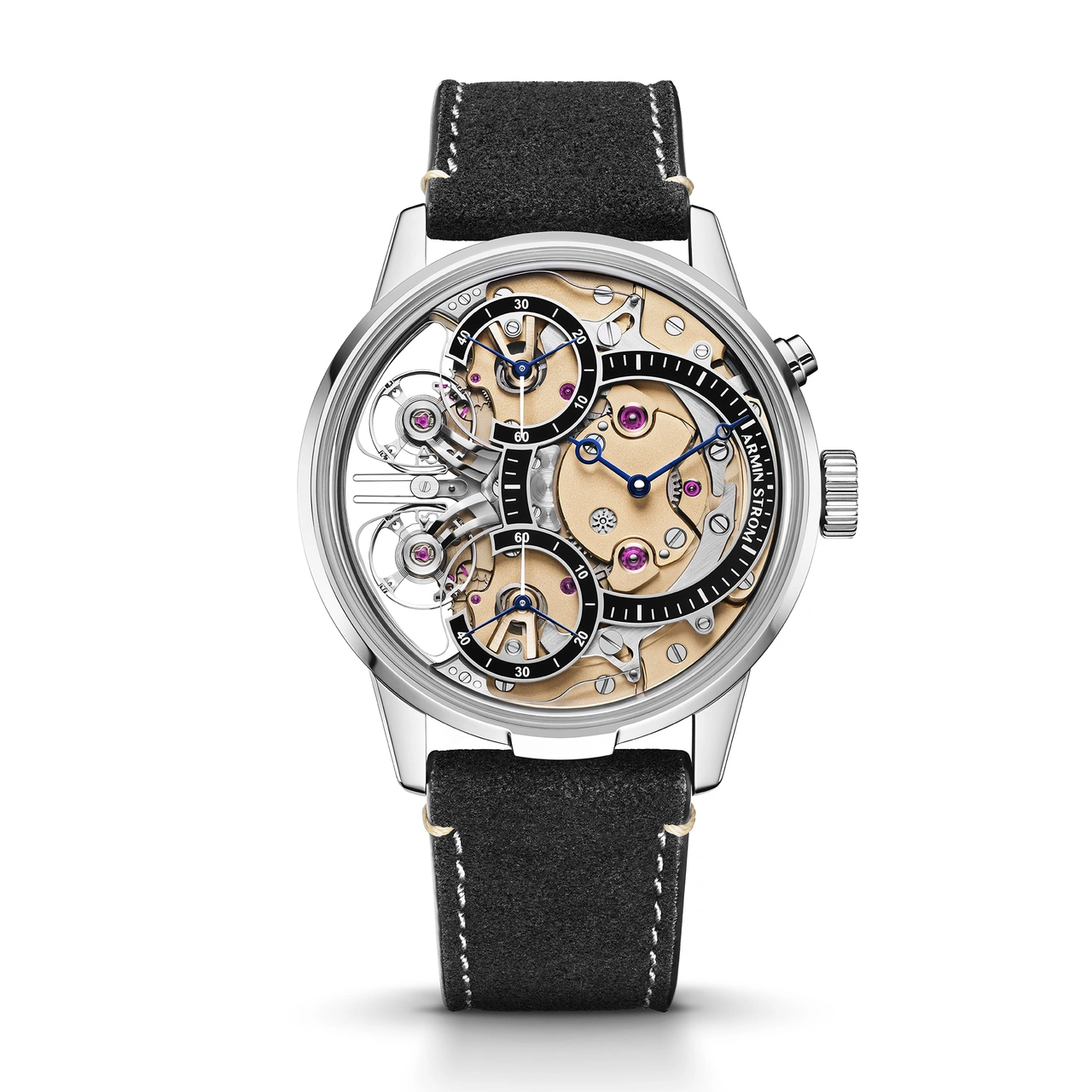
The manufacture calibre ARF21_ZG contains 260 components and 39 jewels, but those numbers reveal very little about what makes the movement special. Its real significance lies in the arrangement and interaction of its two regulating systems.
Mechanical watches ordinarily depend on one balance assembly to regulate the release of energy from the mainspring. The escapement delivers impulses to the balance, whose repeated oscillations establish the movement’s timekeeping rhythm.
Armin Strom’s Mirrored Force Resonance architecture introduces a second independent regulating system. Rather than operating entirely in isolation, the two are linked by the manufacture’s patented resonance clutch. As vibrations pass through this connection, the regulating systems can influence one another and settle into synchronisation.
What makes this particularly satisfying from a mechanical perspective is that the relationship is visible. The two regulating organs are presented prominently within the movement, their oscillations providing a continuous display of the calibre’s underlying purpose.
There is no need for an additional animated feature or decorative mechanical flourish. The movement’s most compelling visual element is also its central technical achievement.
The calibre operates at 3.5 Hz, equivalent to 25,200 vibrations per hour, and uses two independent mainspring barrels to provide an 80-hour power reserve. That is a useful amount of running autonomy for a manually wound mechanical watch, especially one incorporating two regulating systems.
Another interesting inclusion is the twin-seconds flyback mechanism. Both seconds hands can be reset simultaneously, introducing a functional interaction that complements the mirrored arrangement of the regulators. It is not a conventional chronograph complication, but rather a distinctive feature of the Mirrored Force Resonance movement.
The use of manual winding feels entirely appropriate. A watch built around the visibility and intricacy of its movement benefits from a relatively direct relationship between the wearer and the mechanics. There is also something fitting about manually winding a timepiece whose conceptual origins reach back to the earliest investigations into precision mechanical timekeeping.
At 37.20 mm in diameter and 6.70 mm thick, the calibre occupies a substantial area within the watch. The design gives its regulating organs and connecting mechanism room to be appreciated, rather than reducing them to small features hidden among a crowded collection of complications.
That architectural clarity is an important part of the watch’s character. There is a considerable amount happening mechanically, but relatively little that appears unnecessary.
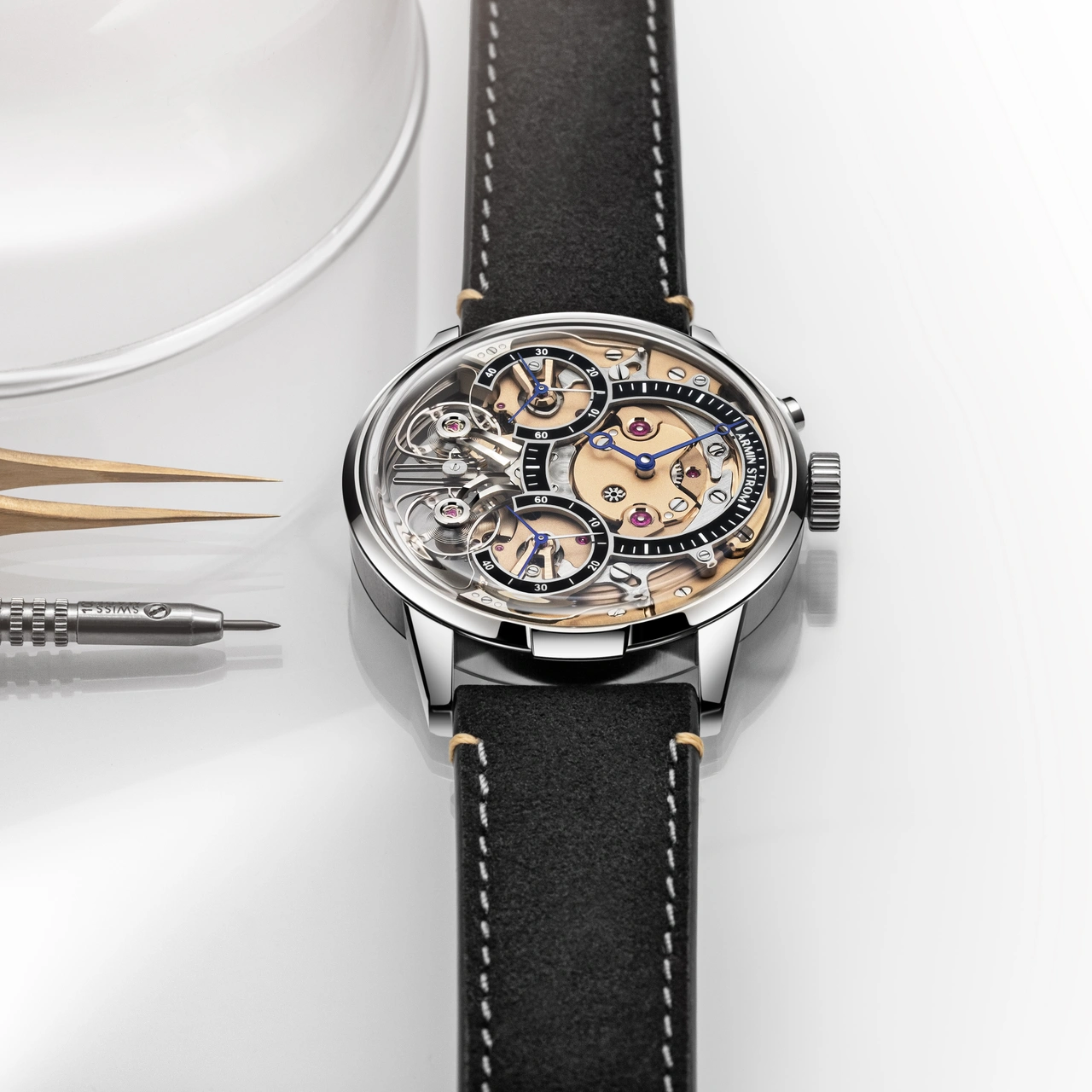
The new Zeitgeist’s most immediate visual distinction comes from the 3N yellow gold-coloured PVD coating applied to its mainplate and bridges. While earlier interpretations of the resonance concept have demonstrated its compatibility with contemporary movement architecture, the warm gold finish introduces a much more traditional atmosphere.
Importantly, the mainplate and bridges are not described as solid gold. The colour is achieved through PVD coating, with the underlying surfaces and their finishing responsible for much of the visual depth. This is a meaningful distinction in a watch where the quality of the movement’s decoration matters considerably more than the material value of its individual components.
The decision to use a matt finish is particularly effective. Gold-coloured surfaces can easily become overwhelming when applied across an intricate, openworked movement. Too much reflection would compete with the mechanisms and make the individual components harder to distinguish.
Here, the subdued finish allows the hand-polished bevels and other decorative details to stand apart from the larger surfaces. Light catches the edges of bridges while the matt gold areas retain a more restrained appearance. The effect is one of carefully controlled contrast rather than indiscriminate brilliance.
It also makes the movement look rather different from a typical contemporary skeletonised calibre. The golden components introduce a sense of visual weight and warmth, while the openings in the mainplate reveal the underlying construction. The resonance mechanism appears almost suspended within the surrounding architecture.
This is where the Zeitgeist concept becomes most convincing. The movement remains unmistakably modern, but the finishing gives it a visual connection to the traditional decorated calibres found in high-end historical watchmaking.
The contrast is subtle enough to feel considered, yet significant enough to give the 1665 3N a personality quite distinct from a movement finished in conventional contemporary tones.
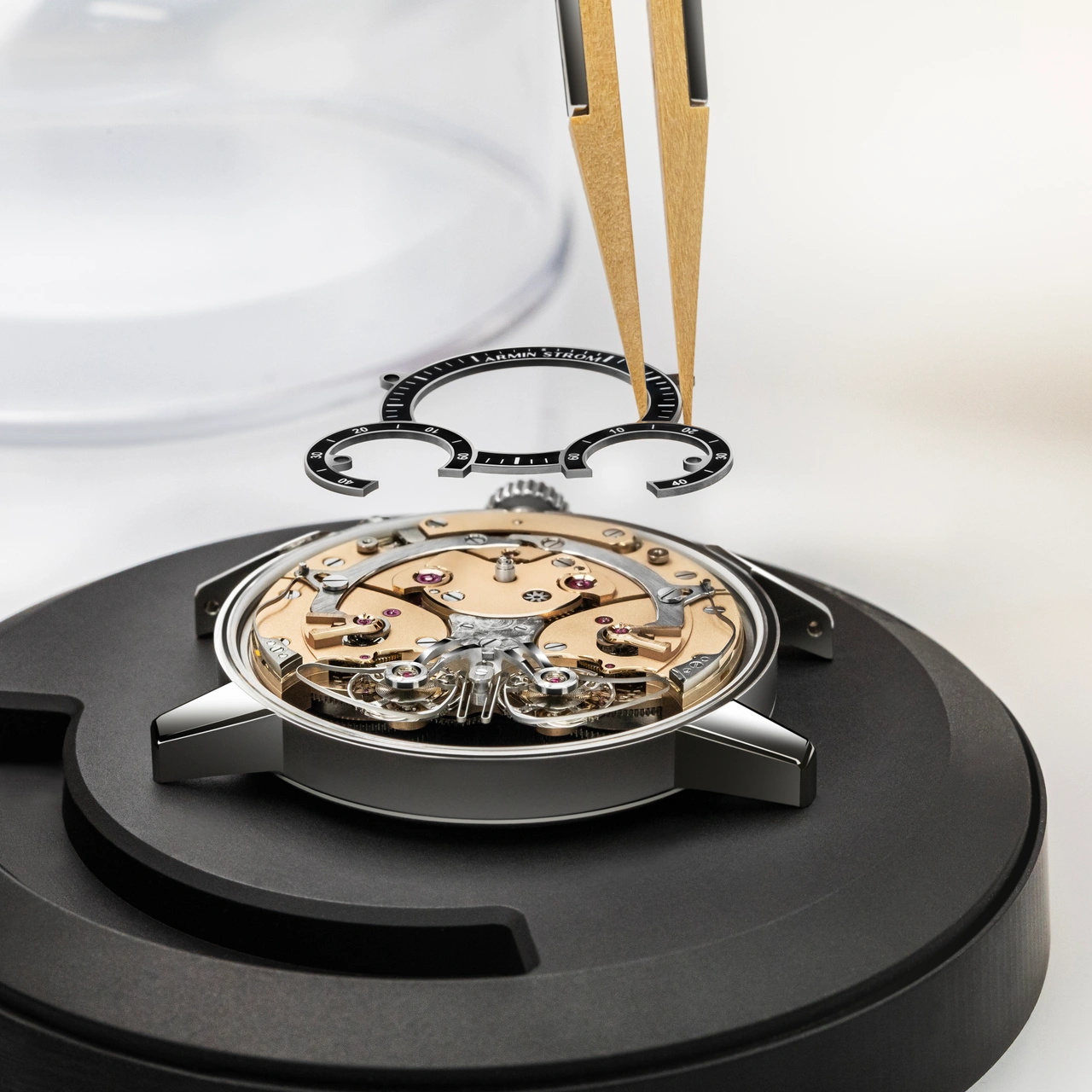
With so much detail surrounding the regulating systems, the polished black lacquer dial performs an important role. It provides a visually quiet surface in the middle of an otherwise complex composition.
Finished in noir “vernis laqué poli”, the off-centre dial has a deep, reflective appearance. Against the warm gold tones of the movement, the black becomes an effective counterpoint, drawing the eye towards the time display without allowing it to dominate the entire watch.
That separation matters. One of the common difficulties with highly skeletonised watches is that the display of mechanical craftsmanship can undermine the straightforward task of reading the time. Individual hands, scales, bridges and exposed wheels may begin to compete for attention.
Armin Strom has addressed that problem through composition rather than concealment. The black lacquer establishes a defined visual area for the hours and minutes, while the surrounding movement retains its mechanical openness.
The heat-blued stainless steel hands are another carefully chosen detail. Manufactured and finished by Armin Strom, they introduce a traditional element whose rich blue colour provides contrast against the black lacquer without competing with the surrounding golden architecture.
Heat-blued steel is closely associated with traditional fine watchmaking, and its presence here feels particularly well judged. The hands do not attempt to appear futuristic simply because the movement is technically sophisticated. Instead, they reinforce the historical character established by the movement finishing.
There is also something refreshing about the restrained use of colour. Yellow gold, black, blue and the natural metallic tones of the mechanical components are sufficient. The watch does not require elaborate dial graphics or excessive decorative additions to communicate its complexity.
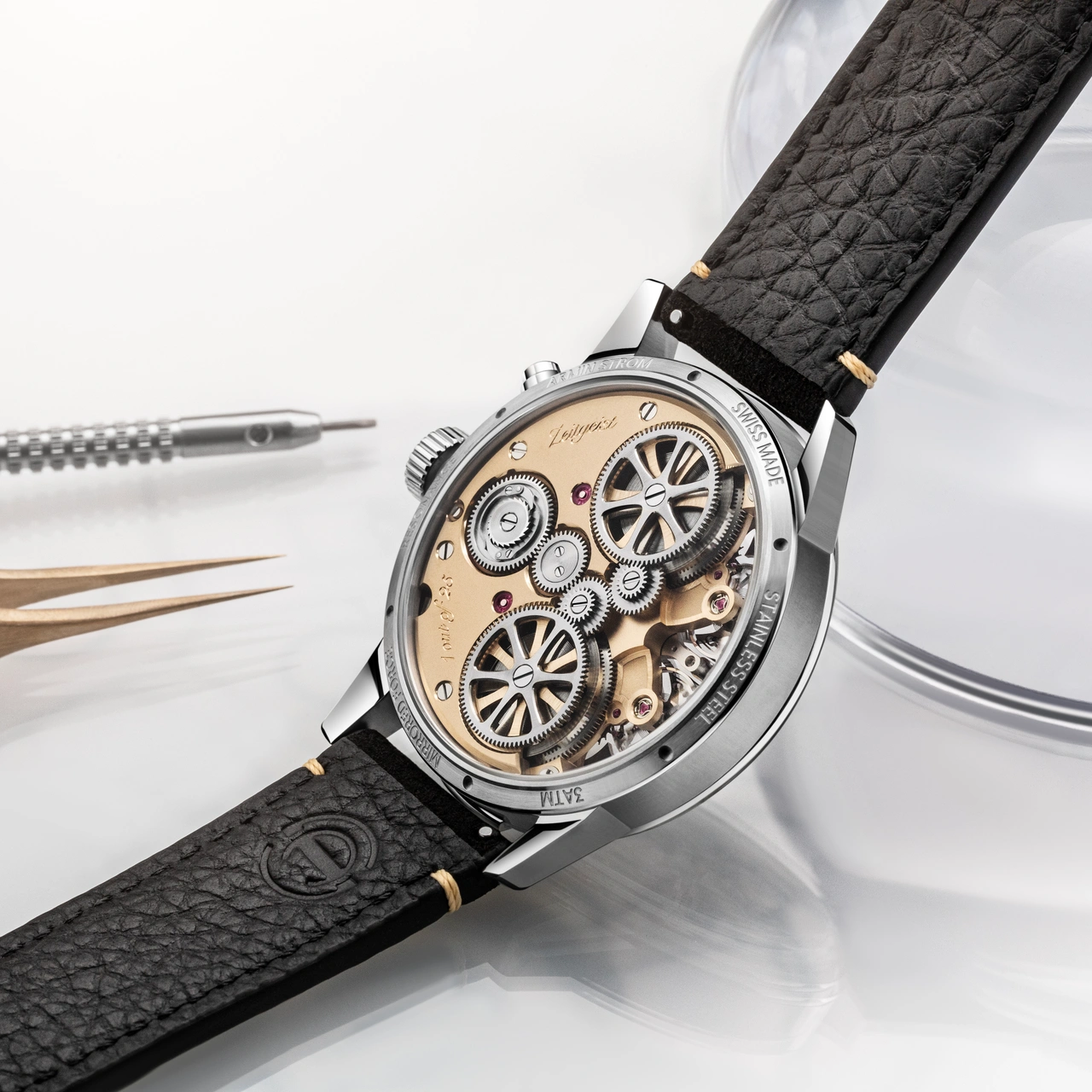
Much of the appeal of Armin Strom’s watchmaking comes from the way the manufacture treats movement finishing as an integral part of construction, rather than a decorative layer applied after the mechanical work is complete.
On the Zeitgeist 1665 3N, the gold-coloured bridges and mainplate feature hand-bevelled and polished edges, complemented by black-polished screws, perlage and circular graining. Each technique contributes a different visual texture, creating small contrasts that become increasingly interesting under magnification.
Hand-bevelling is particularly rewarding to examine on a movement of this type. The edges of the bridges are carefully shaped and polished, producing reflective surfaces that define the contours of the components. Against the matt 3N gold-coloured finish, these polished edges become especially prominent.
Black polishing produces a very different effect. Depending on the angle of the light, the finished surface can appear intensely reflective or almost completely dark. Applied to screws, it creates small points of contrast that might initially go unnoticed but contribute enormously to the overall impression of refinement.
Perlage and circular graining introduce further layers of decoration, connecting the movement to techniques associated with traditional Swiss watchmaking.
What makes Armin Strom’s approach especially interesting is its attention to components that are rarely visible once the movement is assembled. The manufacture applies hand-finishing even to parts that will not ordinarily be seen, maintaining consistency between the visible presentation of the calibre and its concealed construction.
This philosophy is reinforced by the manufacture’s double-assembly process. Each Armin Strom watch is assembled twice, an approach intended to ensure that the finished movement meets the required standards of mechanical performance as well as visual refinement.
It is a demanding method of production, but also an appropriate one for a mechanism as sensitive as a dual-regulator resonance calibre. Fine decoration has little value if the underlying movement cannot perform as intended.
The relationship between mechanical precision and traditional finishing is particularly evident in this watch. Its components must perform exacting technical functions, yet their surfaces are treated with the attention expected from a traditionally finished high-end mechanical movement.
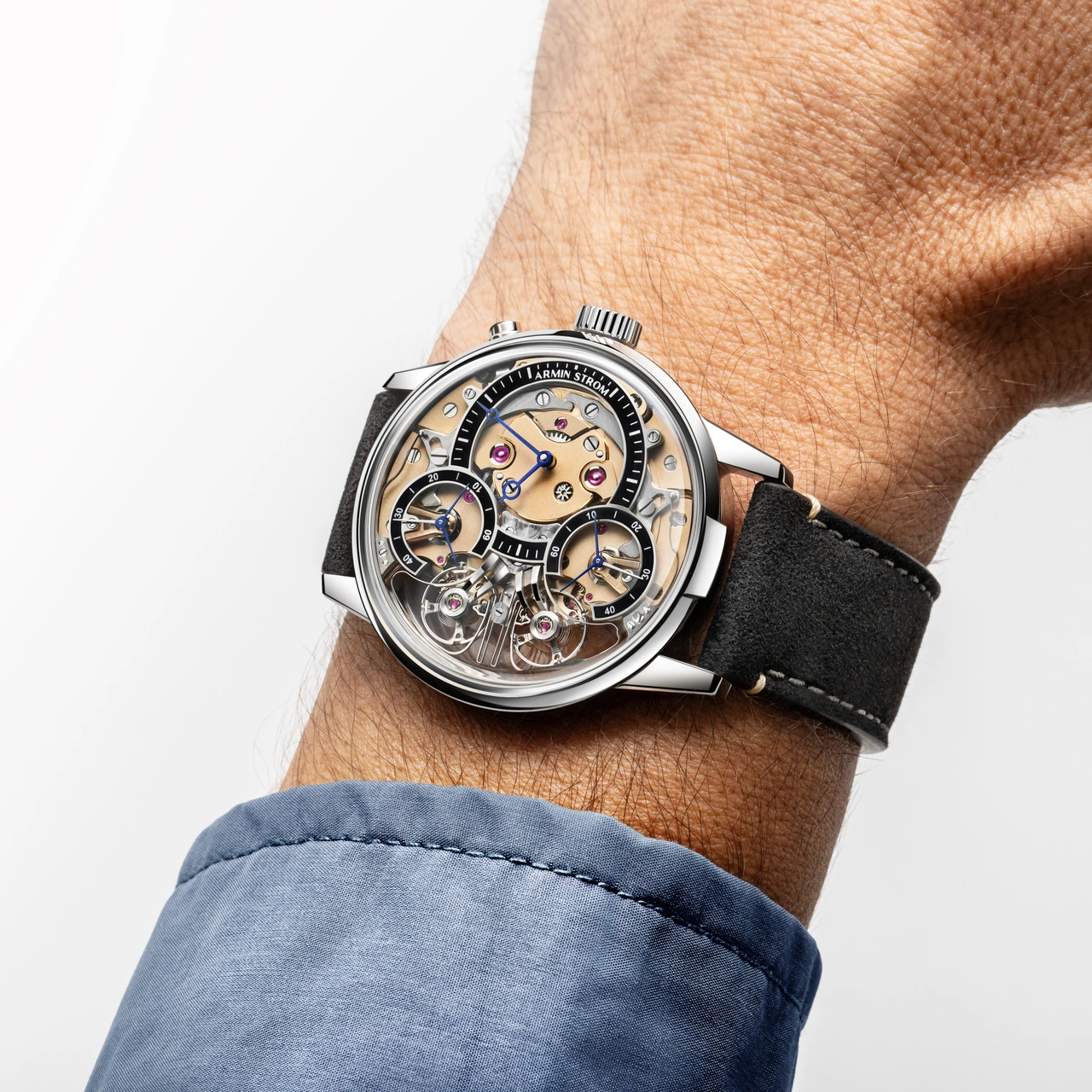
The Zeitgeist 1665 3N is housed in a stainless steel case measuring 43 mm in diameter, 11.55 mm thick and 49.60 mm from lug to lug. These are substantial dimensions, particularly when compared with the relatively compact proportions often associated with traditional dress watches.
However, the size makes sense in the context of the movement. The Mirrored Force Resonance architecture depends on the visible relationship between two regulating systems, and the generous dial-side area allows those components to be presented without feeling unnecessarily compressed.
Whether the proportions suit an individual wrist will naturally depend on personal preference. At nearly 50 mm from lug to lug, this is not a watch designed to disappear beneath a shirt cuff, and its intricate presentation is unlikely to appeal to collectors who favour restrained, minimalist watches.
Yet the design feels more deliberate than excessive. The movement is the centre of attention, and the case largely serves as its framework.
The choice of stainless steel also contributes to that balance. A yellow gold case might have overwhelmed the carefully considered contrast between the movement and dial. The cooler appearance of steel provides a more neutral boundary around the warm interior architecture.
Anti-reflective sapphire crystals protect both the front and rear of the watch, allowing the movement to be appreciated from either direction. For an enthusiast interested in the construction and finishing of the calibre, the transparent case back is an important part of the overall presentation.
Water resistance is rated to 3 ATM, reinforcing the watch’s position as a specialised mechanical timepiece rather than something intended for demanding physical activities.
The dark grey Alcantara strap is a particularly interesting finishing choice. Its understated texture and colour introduce a softer, more contemporary quality, contrasting with the formality of the golden movement and polished lacquer dial. Grey stitching and a stainless steel pin buckle complete the arrangement.
It is not necessarily the combination one might expect from a watch so heavily influenced by classical horology, but that is precisely why it works. The strap prevents the historical references from becoming too literal and maintains a connection to the watch’s contemporary origins.
One of the more appealing qualities of the Zeitgeist 1665 3N is its refusal to complicate the dial simply for the sake of offering additional functions.
There is no calendar display, moon phase, second time zone or conventional chronograph competing for space with the resonance mechanism. The movement offers hours, minutes and twin-seconds, with the flyback function providing a further mechanical point of interest.
In conventional terms, that might seem relatively restrained for a watch of such complexity. But the underlying regulating system is far more unusual than many familiar complications.
Resonance belongs to a different category of mechanical achievement. Rather than adding information to the dial, it changes the way the watch attempts to maintain a stable rate. Its complexity exists primarily in the mechanics of timekeeping itself.
That distinction gives the Zeitgeist a particular appeal. For collectors who value the engineering behind a movement as much as the functions it performs, the twin-regulator architecture offers a subject worthy of considerable study.
It is also worth keeping the technical claims in perspective. The principle of resonance and the sophistication of Armin Strom’s implementation are fascinating, but the mere presence of two synchronising balance wheels should not be interpreted as a guarantee of a particular daily accuracy. Chronometric performance depends on numerous factors, and the manufacturer’s objective of improved stability is distinct from a specific, independently measured performance result.
That does not diminish the movement’s significance. If anything, it makes the engineering more interesting. The challenge is not simply creating two oscillating balances, but achieving a controlled and useful interaction between them under the conditions encountered by a mechanical wristwatch.
Production of the Mirrored Force Resonance Zeitgeist 1665 3N is limited to 25 pieces worldwide, with each case back engraved “1 out of 25”. The restricted production adds a measure of exclusivity, although scarcity alone is hardly sufficient to make a timepiece important.
What makes the limited edition meaningful is the combination of its specialised calibre and distinctive aesthetic treatment. Armin Strom has not simply introduced another dial colour to an otherwise conventional watch. The change in movement finishing reshapes how the entire mechanical construction is perceived.
For collectors already familiar with the Mirrored Force Resonance, the Zeitgeist 1665 3N offers a fresh perspective on a movement whose architecture has become closely associated with Armin Strom’s independent identity. For those encountering the manufacture’s resonance work for the first time, it provides an unusually accessible visual introduction to the mechanical principle.
There is plenty to appreciate before understanding the finer points of resonance. The exposed balances, sculptural bridges, carefully finished surfaces and interplay between gold and black are immediately engaging. Understanding the mechanical relationship between the two regulating systems simply adds another layer of fascination.
That is perhaps the strongest argument in favour of the design. It operates convincingly on two levels, as an intricate piece of mechanical craftsmanship and as a sophisticated attempt to address a centuries-old timekeeping challenge.
Final Thoughts
The most memorable aspect of the Armin Strom Mirrored Force Resonance Zeitgeist 1665 3N is not its gold-coloured finish, elaborate movement or limited production. It is the way those elements have been brought together without losing sight of the original mechanical idea.
Resonance remains the reason this watch exists. Everything else, from the skeletonised architecture to the contrasting surfaces and traditional heat-blued hands, has been arranged around that central principle.
The 3N yellow gold-coloured movement brings warmth to an otherwise thoroughly contemporary construction, while the black lacquer dial gives the intricate mechanics room to breathe. Extensive hand-finishing provides the traditional craftsmanship expected at this level, and the manually wound calibre offers a fascinating demonstration of mechanical regulation.
There are practical considerations, of course. The case dimensions, unconventional appearance and specialised movement will make it a watch for a relatively narrow audience. Yet independent watchmaking is often at its most interesting when it is driven by a specific mechanical ambition rather than an attempt to satisfy every possible preference.
The Zeitgeist 1665 3N is particularly compelling because it avoids treating history as a collection of decorative references. Its connection to 1665 is rooted in the actual behaviour of the movement, while its traditional finishes offer a thoughtful interpretation of how that mechanical idea might have been presented in another era.
More than three and a half centuries after Huygens observed the strange synchronisation of two pendulum clocks, Armin Strom continues to investigate what happens when two independent oscillators are encouraged to find a common rhythm.
In the Zeitgeist 1665 3N, that investigation has resulted in something unusual: a modern mechanical watch whose most sophisticated feature is also its most historically meaningful.