A blue dial can look remarkably different depending on the case surrounding it. Set against natural stainless steel, it can feel refined, understated and distinctly mechanical. Surround that same dial with black-coated steel and its character changes considerably, with the colour becoming more prominent against a darker, more purposeful exterior. The new Damasko DC89 GMT Steel Blue and DC89 GMT Black Blue demonstrate this relationship beautifully. Sharing the same sophisticated movement, dial design and unusual GMT complication, the two releases offer contrasting interpretations of one of the German manufacturer’s most technically interesting chronographs.
The difference between them is more than a matter of personal colour preference. Damasko is a manufacturer whose reputation has been built around materials technology, precision engineering and the development of specialised mechanical components. The Steel Blue highlights its expertise in ice-hardened stainless steel, while the Black Blue takes that construction further with the addition of the manufacturer’s patented DAMEST® protective coating. Both approaches reflect a philosophy in which the materials used to manufacture a watch are considered just as carefully as the movement inside it.
And there is plenty to discuss beneath the dial. The DC89 introduces a distinctive arrangement of complications, combining a jumping central chronograph minute counter with a continuously adjustable GMT display at 3 o’clock. The watch can display up to three time zones, including regions operating on half-hour differences. Its C51-7 Si movement also incorporates Damasko’s advanced silicon balance spring and escape wheel, making this considerably more than a conventional chronograph presented in two attractive finishes.
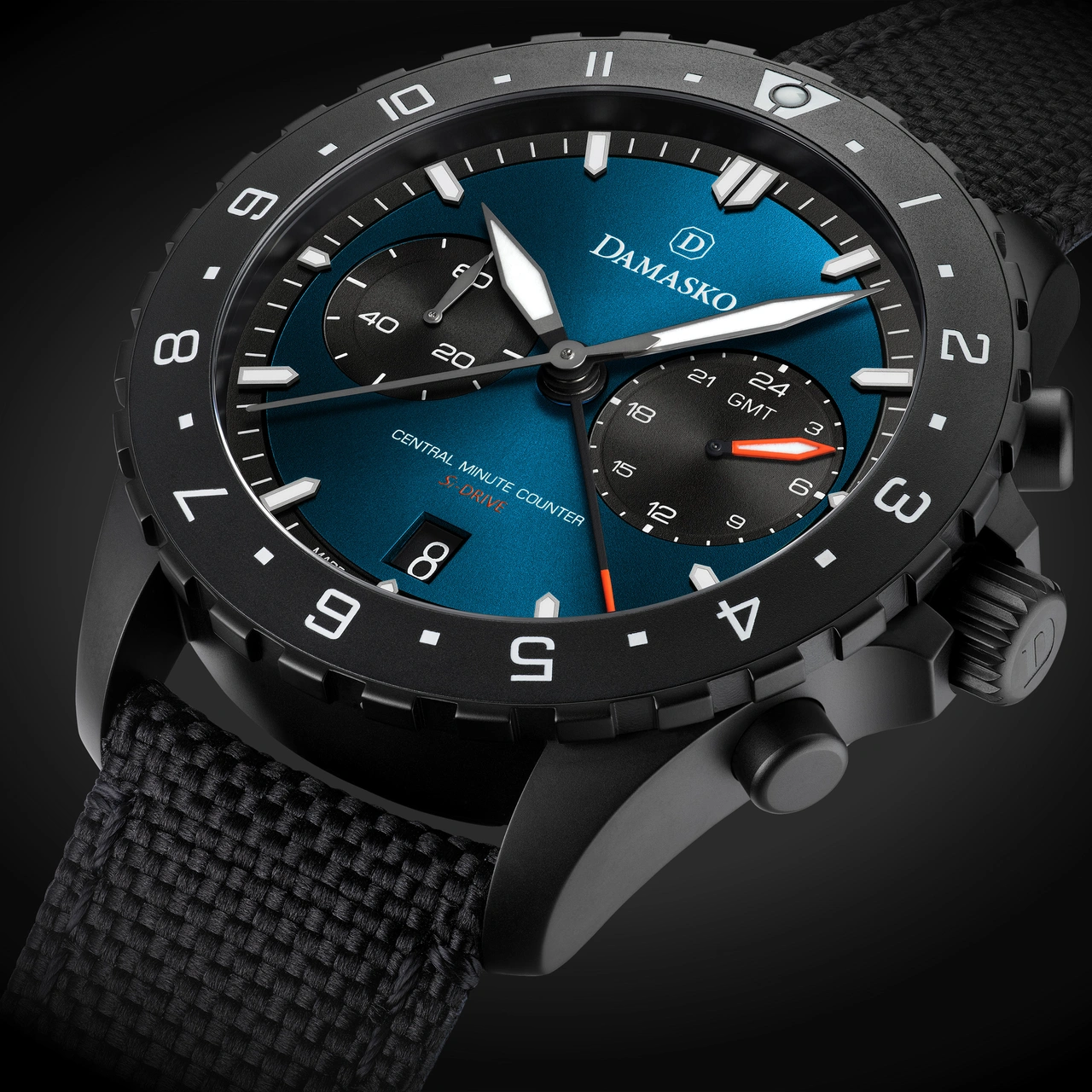
The starting point for both models is a blue dial featuring a subtle sunburst finish. Damasko has chosen a relatively restrained treatment, allowing the surface to introduce depth and changing reflections without overwhelming the technical arrangement of hands and indicators. This is an important consideration because the DC89 contains considerably more information than a conventional three-hand watch.
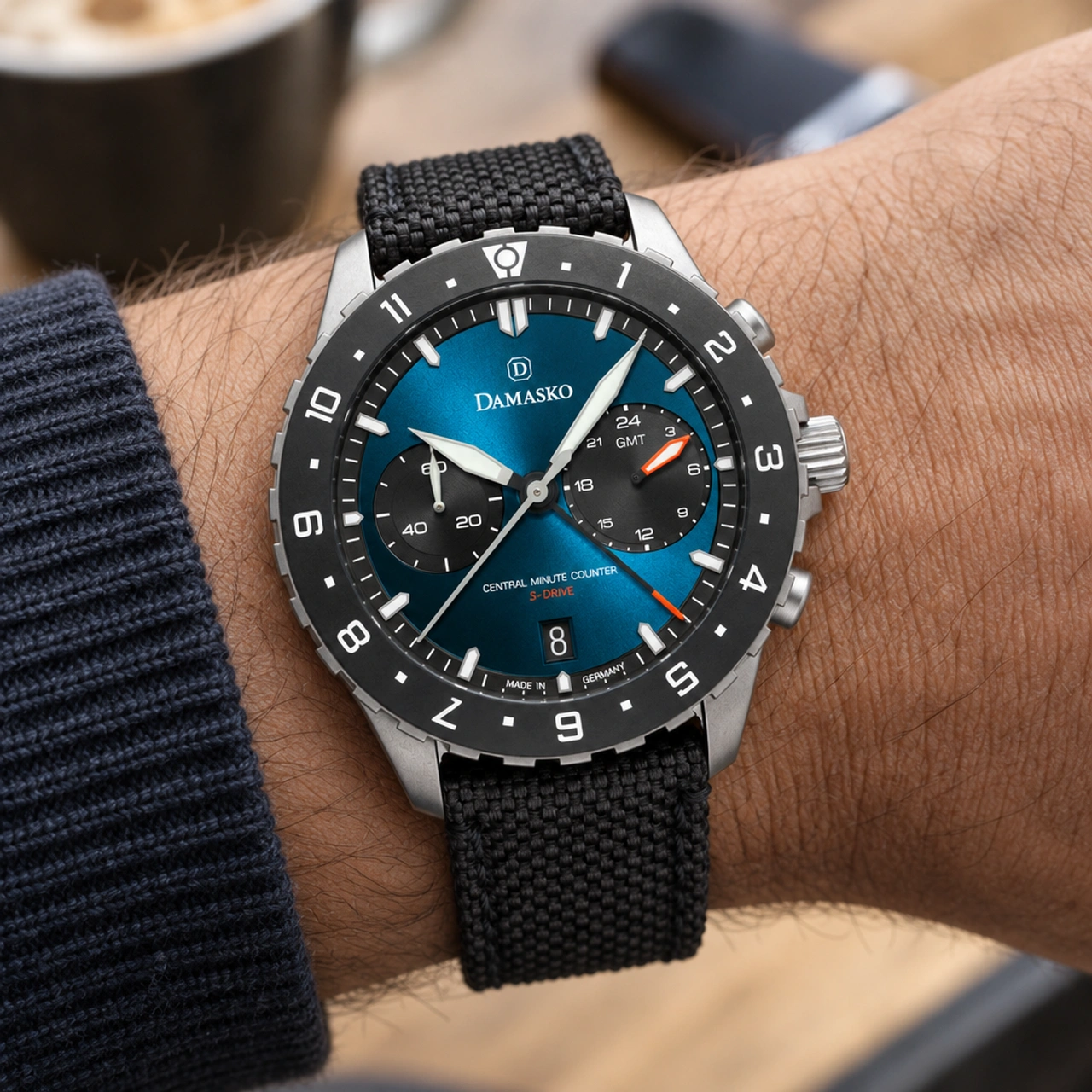
In the DC89 GMT Steel Blue, the natural appearance of the ice-hardened stainless steel case creates a balanced relationship with the blue dial. The metallic case provides a neutral framework, allowing the sunburst finish to introduce a more refined character to Damasko’s familiar instrument-watch styling. It is an appealing combination for collectors who appreciate the traditional appearance of a steel sports chronograph but want something more technically ambitious beneath the surface.
The DC89 GMT Black Blue approaches the same dial from a different direction. Its black DAMEST®-coated case and bezel create a darker frame, giving the blue surface greater visual prominence. The contrast is particularly effective alongside the white sword-shaped hands and carefully placed orange accents. Where the Steel Blue emphasises the natural relationship between stainless steel and a coloured dial, the Black Blue introduces a more dramatic, instrument-inspired appearance.
Neither model fundamentally changes the way the dial operates, and that is what makes the comparison interesting. The same hands, timing indications and mechanical functions take on a different visual character simply through the surrounding case finish. It demonstrates how thoughtfully selected materials can influence the personality of a watch without altering its essential design.
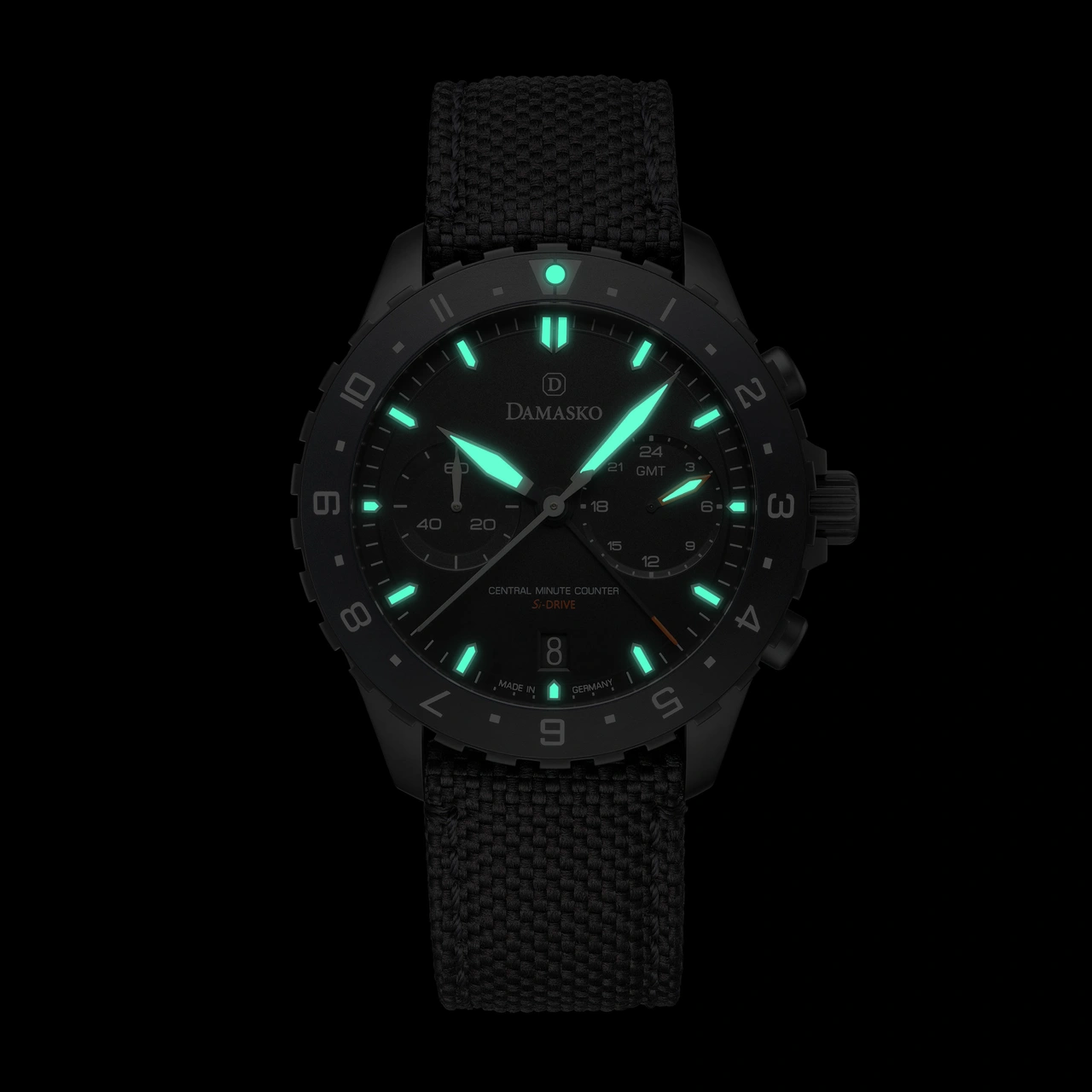
Both versions use white sword-shaped hour and minute hands with silver edging, creating clear contrast against the blue background. Portions of the hands are treated with Luminova X1 C1, while the GMT hand incorporates Super-LumiNova. Orange highlights identify the chronograph minute counter and GMT indication, helping separate these functions from the primary time display.
The use of orange is particularly appropriate here. Rather than decorating the dial indiscriminately, Damasko has applied colour to indications where it serves a practical purpose. With multiple timing functions sharing the same display, this distinction becomes an important part of the watch’s legibility.
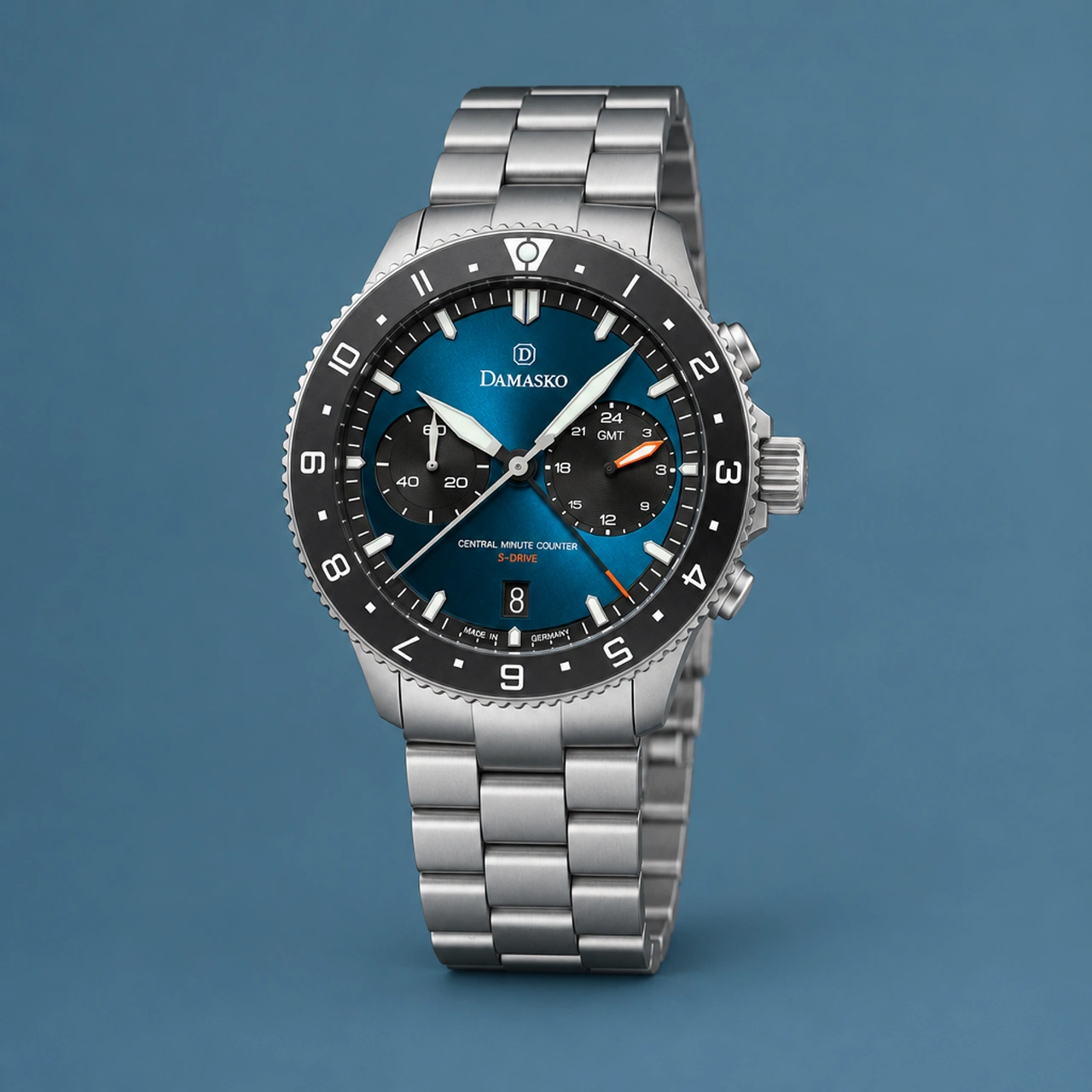
Although the contrasting case finishes are the most obvious distinction between these two releases, the shared movement is arguably the more significant development. At the heart of both is Damasko’s C51-7 Si chronograph calibre, incorporating an unusual combination of central elapsed-time measurement and a separately adjustable GMT indication.
Chronographs have traditionally relied on subsidiary registers to display elapsed minutes and hours. The arrangement is familiar, mechanically effective and has become an established part of sports watch design. However, smaller counters can require more attention when reading elapsed time, particularly when several different measurements are presented simultaneously.
Damasko’s approach places both chronograph seconds and elapsed minutes at the centre of the dial. The central minute counter advances in distinct jumps, providing a direct indication of completed elapsed minutes against the main dial scale. This makes the chronograph’s operation particularly interesting from both a functional and mechanical perspective.
The DC89 adds another complication to this arrangement through its sliding GMT indication at 3 o’clock. Damasko describes the combination of this continuously adjustable second time zone and the jumping central minute counter as a world-first development.
The significance is not simply that the watch contains a GMT function and a chronograph. That combination has existed for many years. What distinguishes the DC89 is the manner in which Damasko has integrated the additional time zone indication with its central minute counter architecture.
The resulting system allows up to three time zones to be displayed. More importantly, the GMT indication can be adjusted continuously and sequentially, including to accommodate half-hour time differences that conventional whole-hour GMT mechanisms may not represent accurately.
For Australian watch enthusiasts, this has particular relevance. South Australia and the Northern Territory use half-hour time offsets, creating situations where a conventional GMT watch may require the wearer to make an additional mental adjustment. Damasko’s system is designed to accommodate such differences mechanically.
This is a good example of technical complexity serving a practical purpose. The movement is certainly sophisticated, but its ingenuity lies in providing functionality that is genuinely useful rather than simply increasing the number of complications listed in the specifications.
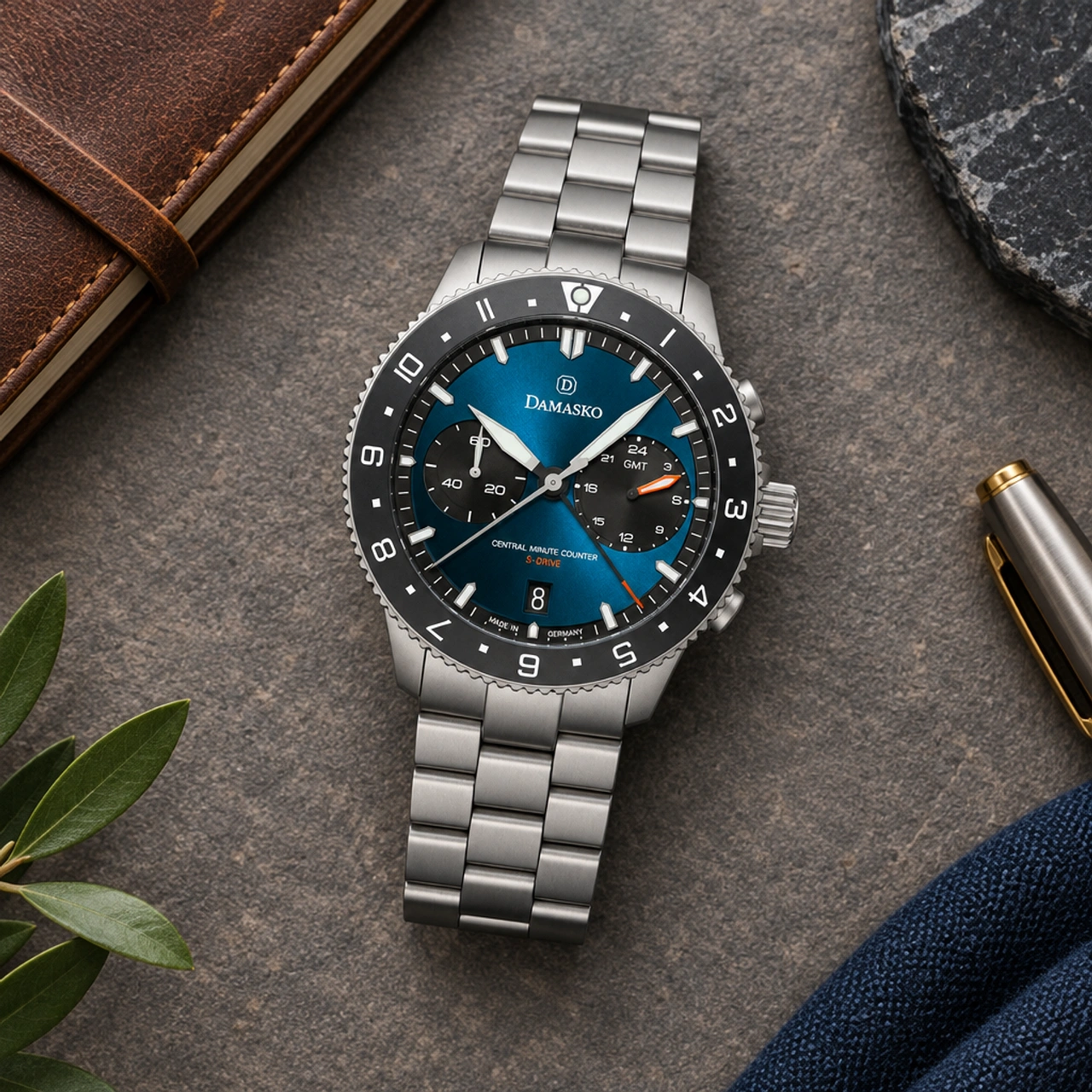
The C51-7 Si movement represents another important aspect of Damasko’s technical development. Both the Steel Blue and Black Blue incorporate the manufacturer’s latest SIC-Spring silicon assembly, consisting of a silicon balance spring and silicon escape wheel.
These components operate within one of the most important areas of a mechanical movement. The balance spring contributes to the controlled oscillation of the regulating organ, while the escape wheel participates in the precise transfer of energy through the escapement. Their behaviour has a direct relationship with the consistency and efficiency of mechanical timekeeping.
Silicon offers several useful properties in these applications. Its low mass, resistance to magnetic influence and capacity for extremely precise manufacturing make it particularly attractive for regulating components. It also allows manufacturers to approach component geometry and material behaviour differently from traditional metallic construction.
For Damasko, silicon technology has become a significant area of development. The manufacturer has invested in the production of specialised movement components alongside its longstanding expertise in case manufacturing and materials engineering. This is part of what makes the DC89 particularly interesting within independent German watchmaking.
Instead of relying primarily on decorative finishing to demonstrate craftsmanship, Damasko places considerable emphasis on the engineering of components that remain hidden within the movement. The balance spring and escape wheel may not provide the visual drama of an openworked mechanism, but the precision required to develop and manufacture them is substantial.
The C51-7 Si receives top-grade adjustment and provides a 50-hour power reserve. Its rhodium-plated plates feature perlage and Geneva stripe decoration, bringing elements of traditional movement finishing into a calibre defined by modern materials and unusual mechanical functionality.
Silicon does not eliminate the need for maintenance or guarantee perfect accuracy. Nevertheless, it represents a meaningful technological approach to improving the consistency and durability of mechanical components. In the DC89, that technology forms part of a broader philosophy of developing watches through careful engineering rather than relying on cosmetic innovation alone.
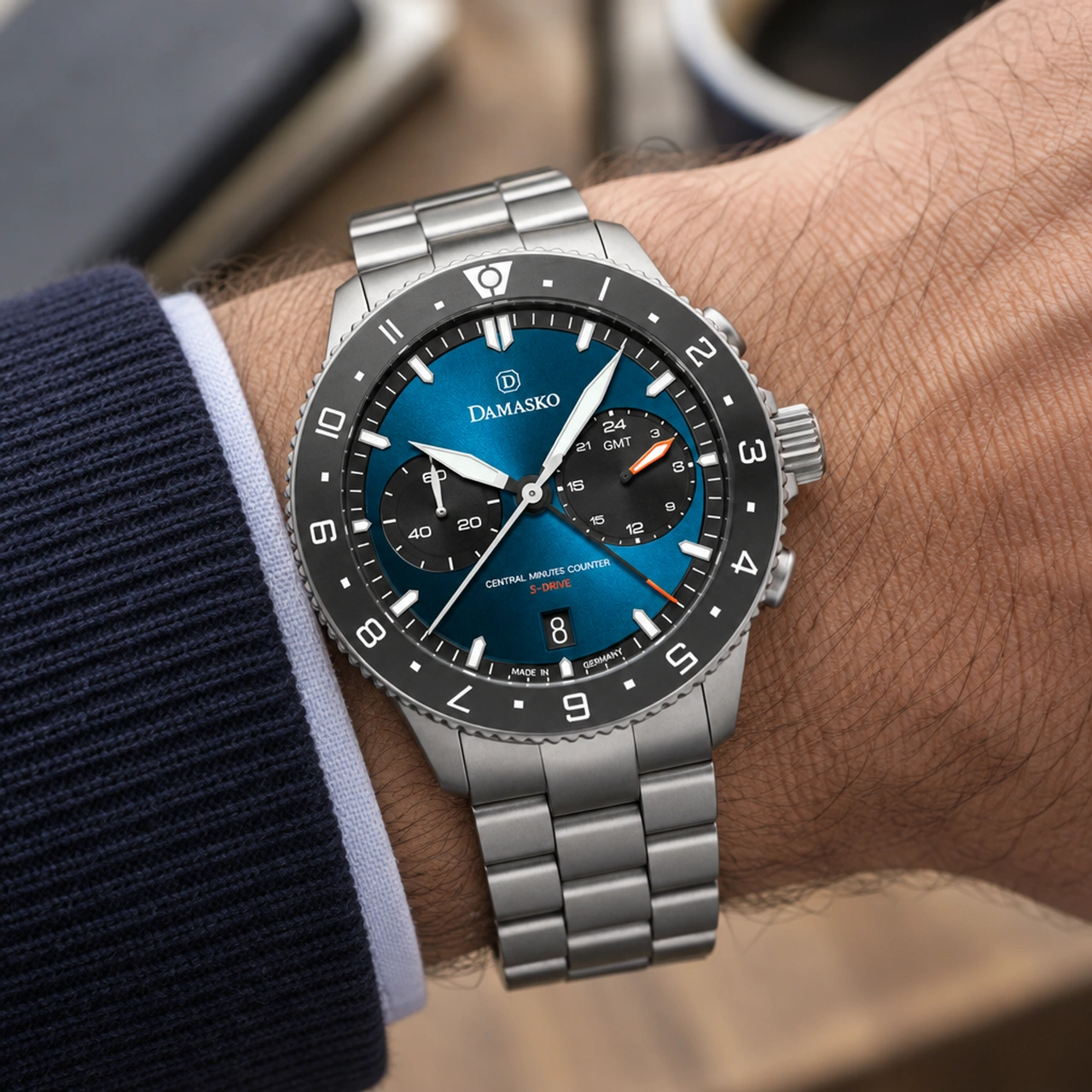
The Steel Blue is arguably the more traditional of the two models in appearance, but the stainless steel used in its construction is far from conventional. Damasko’s ice-hardening technology has been one of the manufacturer’s defining achievements, providing enhanced resistance to the scratches and surface damage associated with regular wear.
The case is manufactured from ice-hardened stainless steel, with the same specialised construction extending to the case back, crown and chronograph pushers. Rather than relying exclusively on a protective exterior finish, Damasko develops the properties of the steel itself to provide greater material durability.
This approach is particularly appealing to enthusiasts who appreciate the natural appearance of stainless steel. The Steel Blue retains the familiar metallic finish of a traditional mechanical chronograph, while benefiting from an unusually robust underlying construction.
The watch also demonstrates how technical materials can contribute to its visual identity. The natural steel case contrasts with the blue dial, while the dark bezel and orange timing accents add definition without making the overall design excessively busy.
An important detail is that the Steel Blue is not entirely free from Damasko’s protective coating technology. Its hardened rotating bezel and bezel insert already receive DAMEST® PVD treatment. The distinction between the two models is therefore not simply the presence or absence of a coated bezel. Instead, the Black Blue extends the black DAMEST® finish across the stainless steel case components, creating a much more comprehensive black exterior.
For collectors who favour the natural appearance of hardened steel, the DC89 GMT Steel Blue offers an appealing balance between conventional chronograph styling and modern technical innovation.
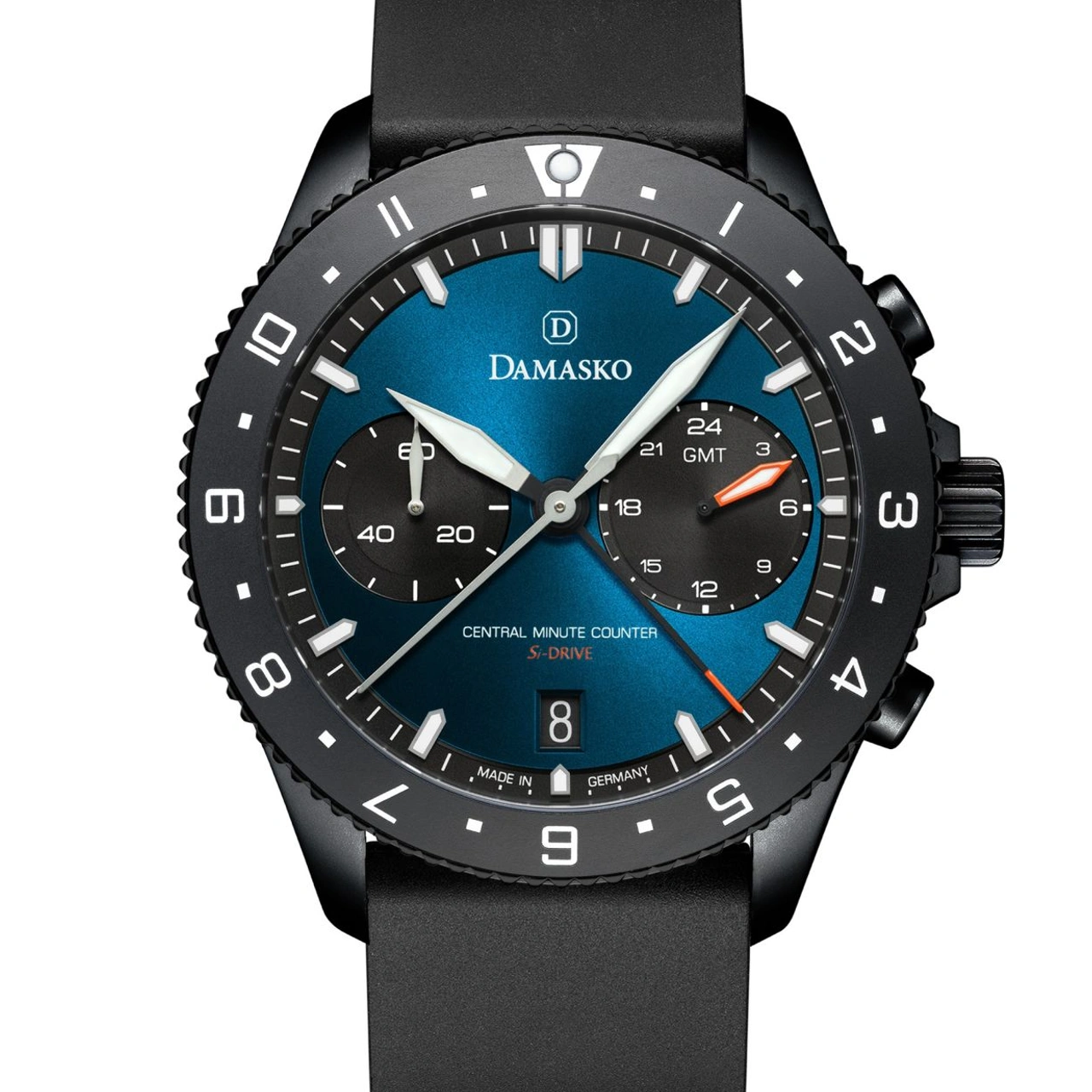
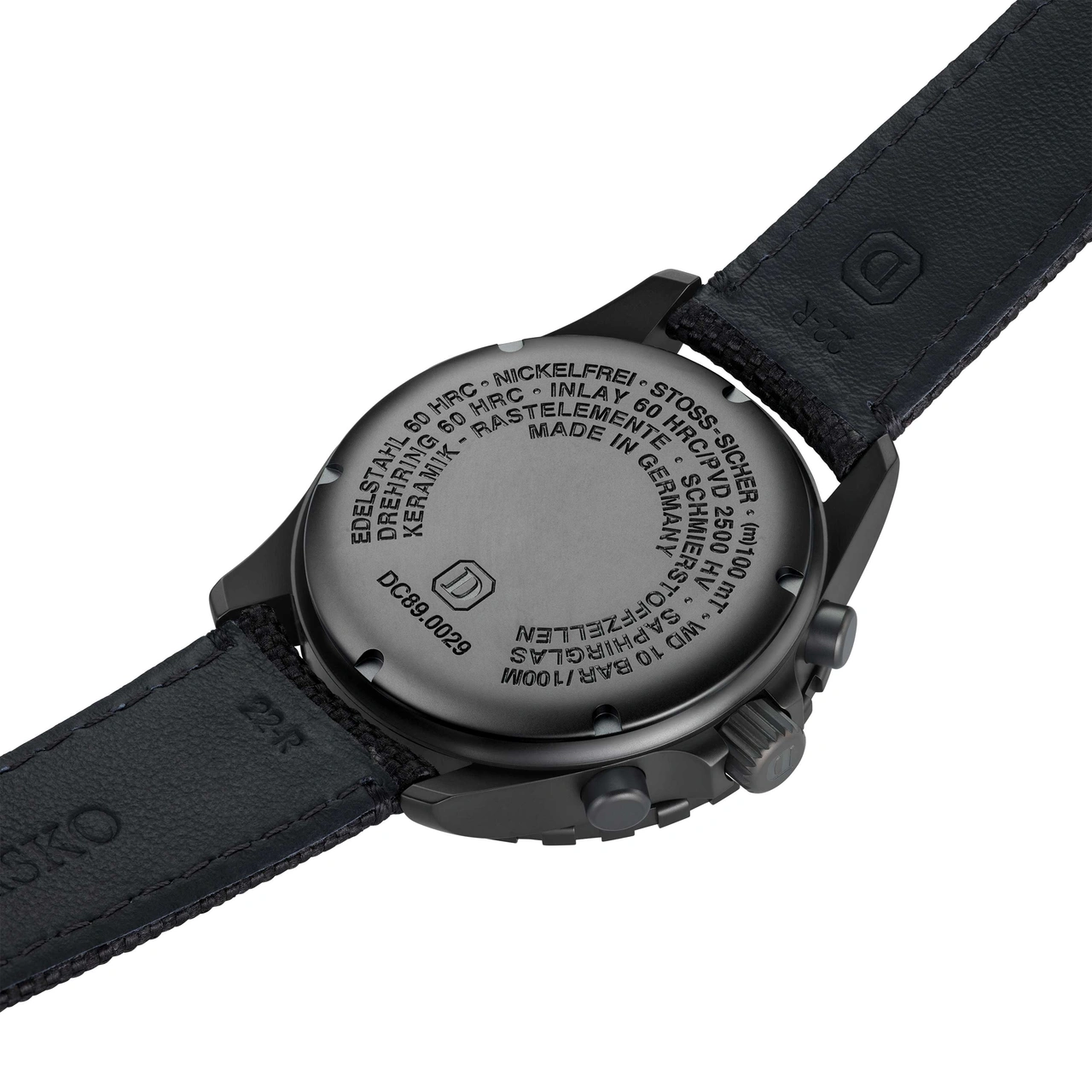
The Black Blue introduces another of Damasko’s specialised manufacturing technologies: its patented DAMEST® coating. Applied across the stainless steel components, including the case, case back, crown and pushers, this multi-layer treatment creates the model’s distinctive black appearance.
Black-coated watches can present an interesting durability challenge. A dark surface finish applied to relatively soft steel may become damaged if the underlying material deforms, while scratches that expose brighter metal beneath can be particularly noticeable.
Damasko addresses these concerns through a combination of specialised coating technology and an ice-hardened stainless steel foundation. The DAMEST® treatment uses a multi-layer structure approximately seven micrometres thick, with an ion implantation layer designed to anchor the coating securely to the hardened material beneath it.
The underlying steel provides a particularly important part of the system. With a specified hardness of approximately 710 HV, it offers a strong foundation intended to reduce deformation under mechanical stress. The coating itself is engineered to combine hardness, abrasion resistance and a degree of flexibility.
What makes this approach noteworthy is the relationship between the two materials. A coating’s performance depends not only on its own properties but also on the strength and behaviour of the surface supporting it. Damasko has developed these elements to work together rather than treating the black finish as an isolated decorative process.
No coating can make a watch completely immune to damage, and severe abrasion or impact can still affect the exterior. Nevertheless, DAMEST® represents a sophisticated effort to improve the durability of black-coated watches while retaining the appearance that makes them appealing.
On the DC89 GMT Black Blue, the result is a striking contrast between the dark case and the blue sunburst dial. The black exterior gives the watch a distinctly technical character, while the dial introduces enough colour to prevent the design from becoming entirely monochromatic.
The difference in appearance between the two models should not overshadow the considerable amount of engineering they share. Both are built around Damasko’s specialised hardened case construction and incorporate protective systems designed to support reliability in demanding conditions.
The screw-down crown follows the manufacturer’s established crown protection system, while the case back and external operating components are engineered for dependable operation. Water resistance is rated to 100 metres, and Damasko specifies resistance to positive and negative pressure conditions.
The manufacturer also states that functional reliability under vacuum and acceleration has been tested and certified according to military standards. These details reflect a longstanding commitment to mechanical durability extending beyond the typical expectations of a conventional sports chronograph.
Both models also incorporate a dedicated magnetic field protection cage surrounding the movement. This is an important complement to the silicon components within the C51-7 Si, since a mechanical movement still contains other parts that may be susceptible to magnetic interference.
Another shared feature is the bidirectional rotating bezel with a 60-minute countdown scale. It provides a straightforward timing function independent of the mechanical chronograph, allowing a selected interval to be referenced quickly without engaging the central stopwatch hands.
The interchangeable bezel insert system adds further flexibility, while the double-domed sapphire crystal features a specialised anti-reflective coating on its inner surface. These may seem like relatively minor details beside the unusual GMT complication, but they contribute to the overall functionality of the finished watch.
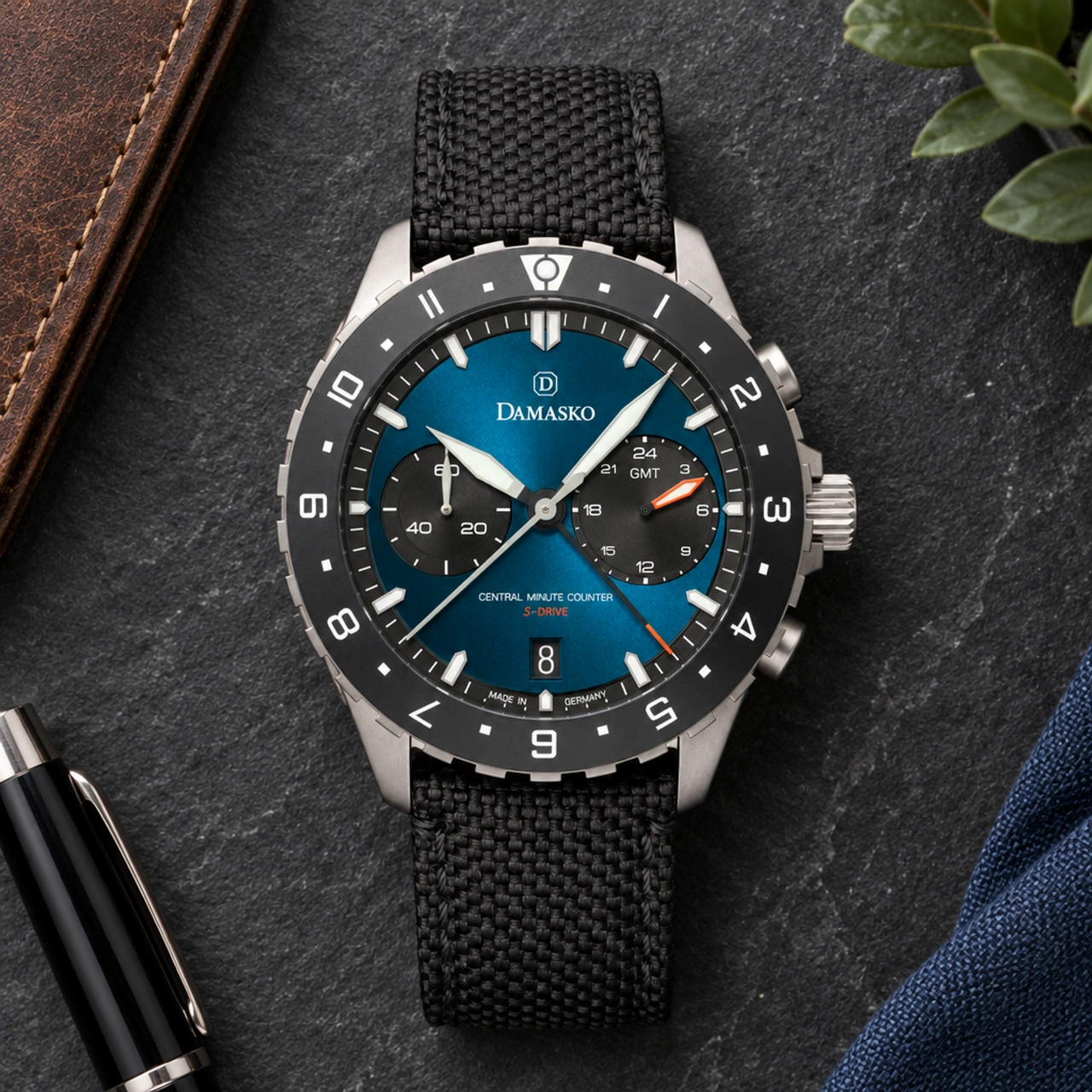
The Steel Blue and Black Blue share the same fundamental case dimensions. Both measure 42 mm in diameter, with a rotating bezel diameter of 43.8 mm. The height excluding the crystal is 13.8 mm, increasing to 14.4 mm with the double-domed sapphire fitted.
A lug-to-lug measurement of 50.14 mm and a lug width of 22 mm complete the proportions, while the specified weight is 103 grams without a strap.
These dimensions place both watches firmly within the category of substantial mechanical sports chronographs. They are not especially compact, and the height is worth considering for enthusiasts accustomed to slimmer watches.
However, the proportions also need to be understood in the context of the mechanical complexity involved. The C51-7 Si movement incorporates a chronograph, jumping central minute counter and adjustable GMT mechanism, while the case is developed around Damasko’s specialised protective systems.
The external finish may change how each version is perceived, but neither is physically smaller or mechanically simpler than the other. Choosing between them is therefore primarily a question of preferred appearance and case treatment rather than a compromise in movement capability.
Perhaps the most interesting aspect of these two releases is that neither requires the other to justify its existence. They share the same movement, complications and fundamental construction, yet offer different approaches to the exterior design.
The DC89 GMT Steel Blue will appeal to collectors who prefer the natural appearance of stainless steel and the balance it provides with a coloured dial. Its combination of hardened steel, blue sunburst finishing and traditional chronograph proportions creates a relatively restrained interpretation of Damasko’s technical design language.
The DC89 GMT Black Blue is more visually assertive. Its black-coated case creates a darker, more purposeful appearance, while the contrast with the blue dial gives the watch a distinctly contemporary character. The comprehensive DAMEST® treatment also offers an additional technical distinction through its specialised protective surface.
For enthusiasts interested primarily in the movement, there is little to separate the two. Both provide the same sophisticated GMT chronograph functionality, silicon-equipped C51-7 Si calibre and 50-hour power reserve. The choice becomes more personal when considering how each watch presents those mechanical qualities on the wrist.
There is no need to regard one as the definitive interpretation of the DC89. The Steel Blue expresses Damasko’s expertise in hardened stainless steel with a more traditional exterior, while the Black Blue demonstrates how the manufacturer’s protective coating technology can alter both the appearance and surface characteristics of the same design.
Damasko occupies an interesting position within modern independent watchmaking. While many smaller manufacturers concentrate on traditional movement decoration or visually elaborate complications, Damasko has developed a reputation for treating materials science and mechanical engineering as essential parts of its identity.
The DC89 GMT Steel Blue and Black Blue demonstrate that philosophy particularly well. Their movement offers an unusual mechanical solution to multi-timezone chronograph functionality, while the C51-7 Si’s silicon components reflect ongoing development in precision manufacturing.
The cases reveal another side of the same expertise. Ice-hardened stainless steel forms the basis of both watches, with the Black Blue demonstrating the additional possibilities created by the manufacturer’s patented coating technology.
These innovations are not always as immediately visible as elaborate movement decoration, but they are central to understanding what makes Damasko different. Much of the craftsmanship lies in specialised manufacturing processes, the behaviour of advanced materials and the precision required to integrate mechanical systems successfully.
It is also worth acknowledging that these are purposefully substantial watches with relatively complex displays. The design will not appeal to every collector, particularly those who prefer the simplicity of a traditional three-hand watch or the proportions of a slim dress chronograph.
Yet that specialised character is also one of the DC89’s strongest qualities. Damasko has developed a watch with a clear mechanical identity, rather than attempting to satisfy every expectation of contemporary luxury watchmaking.
Final Thoughts: Two Blue Dials, One Extraordinary Mechanical Concept
The Damasko DC89 GMT Steel Blue and Black Blue provide two compelling interpretations of a technically ambitious German chronograph. Their blue sunburst dials, white sword-shaped hands and orange timing accents create a shared visual identity, while the contrasting case finishes give each model its own character.
The Steel Blue highlights the natural appearance and durability of Damasko’s ice-hardened stainless steel. The Black Blue introduces a darker aesthetic through the extensive use of the manufacturer’s patented DAMEST® coating, adding another layer of materials engineering to the already robust construction.
Beyond those differences, both watches share the features that make the DC89 particularly interesting. The C51-7 Si movement, silicon balance spring and escape wheel, jumping central minute counter and unusual three-timezone GMT complication demonstrate Damasko’s willingness to develop mechanical solutions that extend beyond established conventions.
For collectors who appreciate the engineering behind independent watchmaking, these two releases offer considerably more than an attractive new dial colour. They represent different expressions of the same technical philosophy, one centred on precision, durability and the intelligent development of mechanical components.
The choice between Steel Blue and Black Blue ultimately comes down to how that philosophy is best expressed on the wrist. One celebrates the character of hardened stainless steel, while the other embraces the purposeful presence of an extensively black-coated case. Both are unmistakably Damasko, and both demonstrate why the DC89 is such an intriguing addition to contemporary German watchmaking.