There is something particularly satisfying about a complicated mechanical watch that doesn’t immediately announce how complicated it is. Some watches rely on exposed mechanisms, oversized cases or crowded dials to communicate their technical achievements. Others take a quieter approach, leaving the owner to appreciate the engineering rather than making every complication the centre of attention. The Habring² Chrono Felix Perpetual – Blue belongs very much to the latter category.
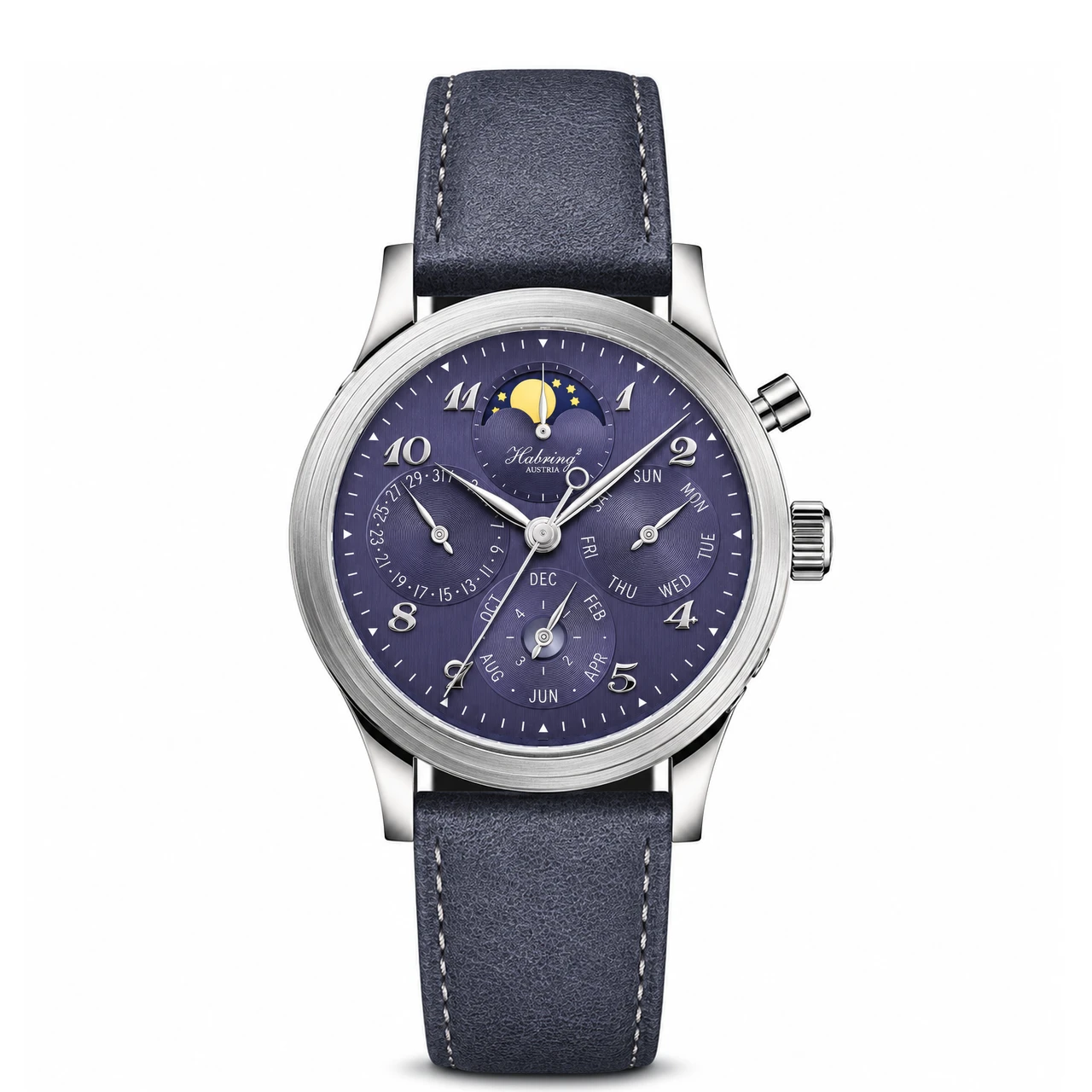
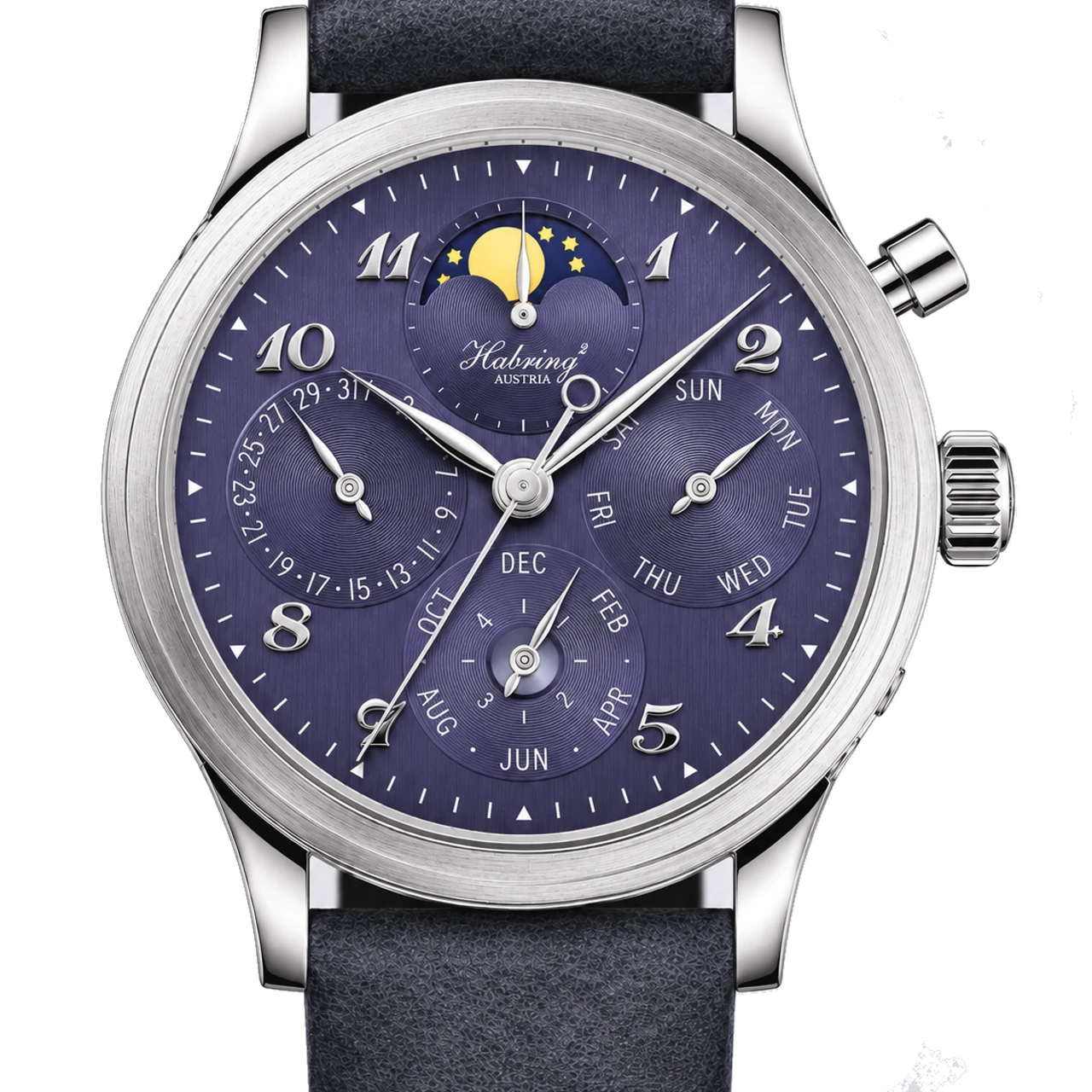
At first glance, it presents as an elegantly proportioned chronograph with a beautiful blue dial, silver Breguet-style numerals and a distinctly classical character. Look a little closer, however, and the mechanical ambition becomes apparent. This is not simply a chronograph with a calendar added for convenience. It combines a monopusher chronograph, perpetual calendar, leap-year indication and moon-phase complication within a stainless steel case measuring just 38.5mm across.
For a watch offering this level of functionality, those dimensions are an achievement in themselves. It is also what makes the Chrono Felix Perpetual such an interesting piece from an independent manufacturer. Rather than pursuing complexity for its own sake, Maria and Richard Habring have created something that feels carefully considered, technically sophisticated and refreshingly wearable.
The blue dial version adds another layer of personality to a watch that already has plenty of mechanical interest. It retains the appealing restraint of the Chrono Felix family while introducing a richer, more expressive appearance. For collectors who appreciate traditional design but want something slightly outside the usual silver and black dial options, it strikes an attractive balance.
The Habring² Approach to Complicated Watchmaking
Based in Austria, Habring² has established a reputation among independent watch enthusiasts for producing watches with interesting complications and distinctive mechanical solutions. The company’s character comes through particularly clearly in the Chrono Felix Perpetual. Rather than following the familiar path of creating an elaborate case to accommodate an elaborate movement, Habring² has concentrated on making the mechanics work within a practical format.
The watch has a close relationship with the larger Habring² Perpetual Doppel, a particularly ambitious creation combining a split-seconds chronograph with a perpetual calendar. At approximately 43 to 44mm, the Perpetual Doppel offers a considerable mechanical presence on the wrist. It is an impressive watch, but its size and additional chronograph complexity are not necessarily what every collector is looking for.
The Chrono Felix Perpetual takes a different direction. By removing the split-seconds mechanism and retaining a conventional monopusher chronograph, Habring² was able to reduce the overall dimensions while preserving the calendar functions that make the larger model so technically compelling.
Maria and Richard Habring have affectionately referred to this creation as the “King of all Chrono Felixes”, a description that makes sense when considering just how much functionality has been incorporated into the familiar Felix format.
What makes this approach appealing is that it doesn’t feel like a compromise simply made to achieve a smaller watch. The reduced size actually becomes one of the design’s greatest strengths. The result has a very different character from the larger Perpetual Doppel, with an emphasis on subtlety rather than mechanical spectacle.
A Blue Dial That Gives the Watch Its Own Identity
The blue dial is arguably the first feature to attract attention, and rightly so. Blue is a familiar colour in watchmaking, but its success depends heavily on the details surrounding it. On the Chrono Felix Perpetual, the galvanised blue surface provides a rich foundation for the silver numerals, hands and calendar indications.
The Breguet-style numerals are an especially fitting choice. Their elegant shapes bring a traditional quality to the dial without making the watch feel old-fashioned. Combined with the matching silver hands, they give the watch a distinctly European character that suits its mechanical architecture.
There is also something pleasing about the relationship between the relatively formal numerals and the technical calendar displays. They represent two different aspects of classical watchmaking, decorative refinement and mechanical ingenuity, yet neither feels out of place.
Perhaps the most impressive part of the dial is the amount of information it communicates without becoming unnecessarily crowded. Perpetual calendars require several indications, and combining those with chronograph functionality often leads to a busy arrangement of registers, scales and hands.
Habring² has chosen to limit the number of displays and arrange them intelligently. The result is a dial that offers plenty to examine while retaining a sense of order.
The stepped bezel is another worthwhile detail. It provides a subtle connection to vintage chronograph design, when stepped case profiles and layered bezels were common features. It is not an exaggerated retro treatment, but a small architectural element that adds interest to the case without distracting from the dial.
That distinction matters. The Chrono Felix Perpetual doesn’t attempt to recreate a particular historical watch. Instead, it borrows elements of traditional design and incorporates them into something unmistakably contemporary in its engineering.

The Clever Relationship Between the Chronograph and Moon Phase
One of the more unusual elements of the Chrono Felix Perpetual is the arrangement at 12 o’clock, where the moon-phase display and 30-minute chronograph counter share the same area of the dial.
This is a clever solution to a problem that regularly confronts watchmakers designing complicated timepieces. Every additional indication needs somewhere to live, and the available space becomes increasingly limited as the number of complications grows.
Instead of introducing another separate subdial, Habring² integrates the chronograph minute counter with the moon-phase display. The arrangement allows two different functions to occupy the same visual territory, reducing the clutter that could otherwise overwhelm a relatively small dial.
It is also a good example of how the manufacturer’s mechanical decisions influence the design. The placement isn’t merely decorative. It reflects the way the movement and calendar module have been brought together to function as a single, coherent mechanism.
The chronograph itself uses a monopusher configuration, allowing its timing functions to be controlled through a single pusher. This is an appealing characteristic for anyone interested in traditional chronograph construction. It also helps maintain a cleaner case profile compared with the more familiar two-pusher chronograph arrangement.
There is a pleasing contrast between the two complications. The chronograph measures short intervals, with its minute counter recording up to 30 minutes. The perpetual calendar, meanwhile, is concerned with the passage of days, months and years. One function measures moments, while the other follows the longer rhythms of time.
Bringing those two ideas together within a single watch gives the Chrono Felix Perpetual a distinctive identity beyond the impressive list of complications.
Inside the Habring² A11CP Calibre
At the heart of the watch is the manually wound Habring² A11CP movement, measuring 30mm in diameter and 7.3mm in height. It operates at 28,800 vibrations per hour, or 4Hz, and provides a power reserve of approximately 48 hours.
These figures are worth considering in the context of the complications being driven. A chronograph mechanism already introduces additional mechanical requirements, while a perpetual calendar adds a separate system responsible for tracking and displaying calendar information. Accommodating both within a movement of these dimensions demonstrates a considerable degree of engineering discipline.
The A11CP is built around Habring²’s own chronograph architecture, with the perpetual calendar functionality provided by a specialist module. This combination allows the Austrian manufacturer to retain control over the fundamental movement while drawing on established expertise for one of watchmaking’s more demanding calendar complications.
The movement incorporates 21 jewels, fine regulation through a tangential screw and an anti-magnetic escapement with a Carl Haas balance spring of chronometer quality. KIF shock protection provides additional protection for the delicate regulating assembly.
These details are not necessarily the first things most people consider when choosing a watch, but they reveal something important about the manufacturer’s priorities. The technical specifications suggest an emphasis on robust construction, dependable operation and precise regulation rather than complications alone.
The movement finishing deserves attention as well. Polished bevels, decorative graining and perlage add a traditional decorative quality to the mechanical components, and the sapphire crystal caseback allows the owner to appreciate these details.
There is a particular charm to a manually wound movement in a watch like this. It creates a small daily interaction between the owner and the mechanism. With its approximately two-day power reserve, regular winding becomes part of the ownership routine, a characteristic many enthusiasts continue to appreciate in an era of increasingly convenient automatic watches.
The Swiss Connection: Dubois-Dépraz and the Vallée de Joux
Although the Chrono Felix Perpetual is proudly made in Austria, its mechanical story reaches into one of Switzerland’s most historically significant watchmaking regions.
The perpetual calendar module comes from Dubois-Dépraz, a specialist complications manufacturer based in the Vallée de Joux. The company has a long history of producing sophisticated mechanical modules for watch manufacturers, making it a natural partner for a project of this complexity.
The module used in the Chrono Felix Perpetual measures approximately 1.6mm in height. Its compact construction is particularly significant given the overall dimensions of the watch. By integrating this calendar mechanism with the A11CP chronograph movement, Habring² has managed to preserve much of the compact character associated with the Felix collection.
There is also a wonderful historical connection involving the Lac de Joux, the lake that sits within the valley. On one side was the movement manufacturer Valjoux, whose chronograph designs helped inspire the development of Habring²’s own chronograph calibre. On the other side is Dubois-Dépraz, providing the calendar complication that makes this watch possible.
That geographical relationship offers a fitting way to understand the Chrono Felix Perpetual. It combines the influence of historical Swiss chronograph engineering with a proven Swiss calendar mechanism, brought together through the independent thinking of an Austrian watchmaker.
For enthusiasts who appreciate the story behind a movement, this is more interesting than a simple description of an in-house calibre with an additional module. It demonstrates how specialist knowledge, accumulated over generations and across different manufacturers, continues to play a role in contemporary mechanical watchmaking.
A Perpetual Calendar Designed to Be Used
The perpetual calendar is undoubtedly one of the watch’s most impressive features. It displays the day of the week, date, month, leap-year information and moon phase, taking into account the differing lengths of months and the four-year leap-year cycle.
Unlike a conventional date display that requires adjustment at the end of shorter months, a correctly set and continuously running perpetual calendar can mechanically account for those calendar changes. It is a remarkable achievement when considering that the calculations are being performed through gears, levers and other precisely shaped mechanical components.
Of course, a manually wound perpetual calendar introduces a practical consideration. If the watch is left unwound for an extended period, the calendar will eventually need to be brought forward to the correct date. It is an unavoidable characteristic of this type of mechanical complication, and one that prospective owners should consider.
Habring² has approached calendar adjustment with practicality in mind. Three recessed correctors allow the date, month and moon phase to be adjusted, while the day of the week can be advanced through the hands. This avoids the need for a fourth calendar corrector and leaves room for the chronograph pusher.
The arrangement keeps the case relatively uncluttered, although operating a perpetual calendar will naturally require more care than setting a simple three-hand watch. As with other complex calendar mechanisms, correct adjustment procedures and the manufacturer’s instructions are important to avoid unnecessary strain on the movement.
This attention to operation reflects the philosophy behind the Chrono Felix Perpetual. Its complications are mechanically impressive, but they are intended to remain functional aspects of the watch rather than decorative displays.
Proportions, Practicality and Everyday Wearability
With a diameter of 38.5mm and a case height of approximately 12mm, the Chrono Felix Perpetual offers proportions that will appeal to enthusiasts who prefer smaller, traditionally sized watches.
These dimensions are particularly noteworthy because of the complexity inside. A perpetual calendar chronograph could easily justify a much larger case, yet Habring² has resisted the temptation to give the watch unnecessary visual bulk.
The three-part stainless steel case is complemented by a domed sapphire crystal with anti-reflective coating on both sides. The stepped bezel adds some architectural definition, while the double-sealed stainless steel crown contributes to the practical construction.
Water resistance is rated to 30 metres. This is appropriate for a traditionally styled complicated watch intended primarily for everyday dry-land wear, but it should not be mistaken for the capability of a dedicated sports or diving watch. Swimming and other water activities are best left to watches designed for those conditions.
Likewise, the movement incorporates shock protection, but that does not make the Chrono Felix Perpetual a watch to treat carelessly. Its delicate calendar architecture and chronograph components still deserve the consideration expected of a fine mechanical timepiece.
What stands out is that Habring² has made a serious effort to balance complexity with usability. The case is modest, the dial remains relatively restrained, the chronograph is straightforward to operate and the movement is constructed with practical servicing considerations in mind.
For a watch containing this level of mechanical sophistication, that is an admirable combination.
What Makes the Blue Version Particularly Appealing?
Among the most interesting aspects of this blue-dial configuration is the way it changes the personality of the watch without altering its underlying philosophy.
In a more conventional silver or black finish, the Chrono Felix Perpetual can appear especially restrained, allowing its unusual complications to provide most of the visual interest. The blue version brings the dial itself further into the conversation.
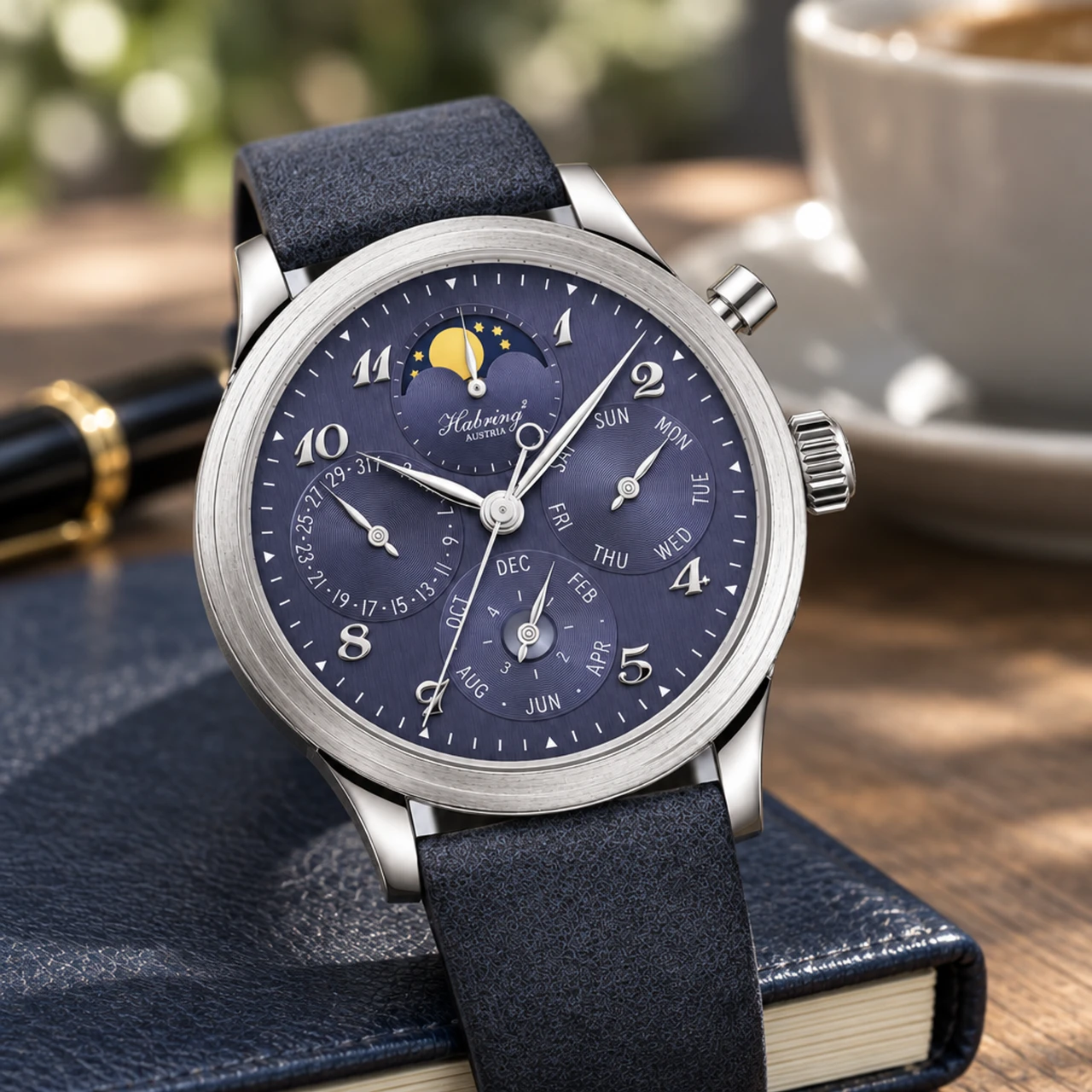
The contrast between the blue galvanised surface and silver Breguet-style details is elegant without being excessively formal. The blue also provides a pleasing background for the moon-phase indication, helping to connect the celestial complication with the overall dial design.
There is enough colour to give the watch a distinctive character, but not so much that the calendar functions become difficult to appreciate. This matters on a watch where small indications and carefully positioned hands play such an important role in the overall appearance.
For collectors who already own conventional chronographs or simpler calendar watches, the blue Chrono Felix Perpetual offers something meaningfully different. Its appeal is not based on a radical case shape or unusual material. Instead, it comes from the combination of established watchmaking traditions, clever mechanical packaging and a dial with genuine personality.
A Considered Alternative to Conventional High Complications
There is no shortage of technically impressive watches in the upper reaches of mechanical watchmaking. Many feature extraordinary finishing, elaborate case designs and complications that represent astonishing feats of engineering.
The Chrono Felix Perpetual approaches the subject from a different perspective. Its mechanical achievements are significant, but the watch doesn’t seem particularly interested in competing for attention through size or extravagance.
That restraint is perhaps its greatest quality. The movement has an interesting technical background, the calendar is sophisticated, and the chronograph introduces another layer of mechanical interest. Yet the finished watch still has the proportions and visual character of something that could sit comfortably alongside more conventional timepieces in a collection.
It is not a watch without compromises. A hand-wound perpetual calendar requires attention to its running state, its displays are naturally more involved than those of a simple watch, and its 30-metre water resistance places reasonable limits on where it should be worn.
For the right collector, however, these considerations are unlikely to diminish its appeal. They are part of the ownership experience of a finely constructed mechanical complication, and the watch offers plenty of technical interest in return.
Its individually numbered case also adds a personal detail to the finished piece. While this should not be confused with a specific limited-edition production number, the engraved serial number provides a direct connection to the individual watch and its manufacture.
Final Thoughts: Small in Size, Substantial in Character
The Habring² Chrono Felix Perpetual – Blue is a fascinating example of what independent watchmaking can achieve when mechanical creativity and practical thinking are given equal importance.
Its impressive combination of monopusher chronograph and perpetual calendar functions is reason enough to pay attention. The fact that these complications have been incorporated into such an attractive and modestly sized watch makes the achievement even more satisfying.
The blue dial adds warmth and character to the otherwise disciplined design, while the Breguet-style numerals, stepped bezel and carefully arranged indications reinforce its classical influences. Beneath the surface, the A11CP movement and Dubois-Dépraz calendar module demonstrate the value of combining independent engineering with specialist complication expertise.
What ultimately makes the Chrono Felix Perpetual appealing is that none of these elements feels included simply for effect. The mechanics serve a purpose, the design supports the functions, and the overall proportions remain remarkably sensible.
For enthusiasts who appreciate the quieter side of haute horlogerie, there is a great deal to admire here. It is the sort of watch that becomes more interesting the longer it is studied, particularly when its mechanical architecture and historical influences are considered alongside the finished design.
The Habring² Chrono Felix Perpetual – Blue may be compact, but its horological character is anything but small. It is a thoughtfully engineered, beautifully restrained and thoroughly engaging example of modern independent watchmaking.
For further information about the Habring² Chrono Felix Perpetual – Blue, including availability and enquiries, contact Define Watches.