There is something rather predictable about the way most watchmakers approach a calendar complication. The date sits neatly in a window, the day and month occupy symmetrical subdials, and the moon phase provides a small decorative flourish somewhere near the bottom of the dial. It is an arrangement that has served traditional watchmaking well for generations. But predictability has never been particularly interesting to Alexander Shorokhoff.
The newly released Alexander Shorokhoff Cadamomo 3 takes one of mechanical watchmaking’s most established complications and presents it through a wonderfully unconventional design. A richly textured grey dial, contrasting geometric displays, brightly coloured calendar markings and an unapologetically yellow leather strap combine to create a watch that looks almost as though its individual components belong to different artistic movements. Somehow, they come together to form a surprisingly cohesive whole.
What makes the Cadamomo 3 particularly interesting is that its personality does not come at the expense of mechanical substance. Behind the striking design is a complete calendar mechanism capable of displaying the date, day of the week, month and moon phase. Its automatic movement receives the decorative attention expected from the German manufacture, while the case provides enough space for its numerous displays to be appreciated individually.
Produced in an edition of just 30 watches, the Cadamomo 3 also marks another chapter in what has become one of the more recognisable collections in Alexander Shorokhoff’s Avantgarde range. It is an unusual watch, certainly, but that is precisely the point.
The original Cadamomo demonstrated that a traditional full calendar did not necessarily have to look traditional. Its combination of unusual calendar indicators, vivid colours and animated dial design attracted considerable attention, with the first edition selling out. Rather than abandon the concept after its initial success, Alexander Shorokhoff continued developing the collection, allowing each interpretation to take on a different visual personality.
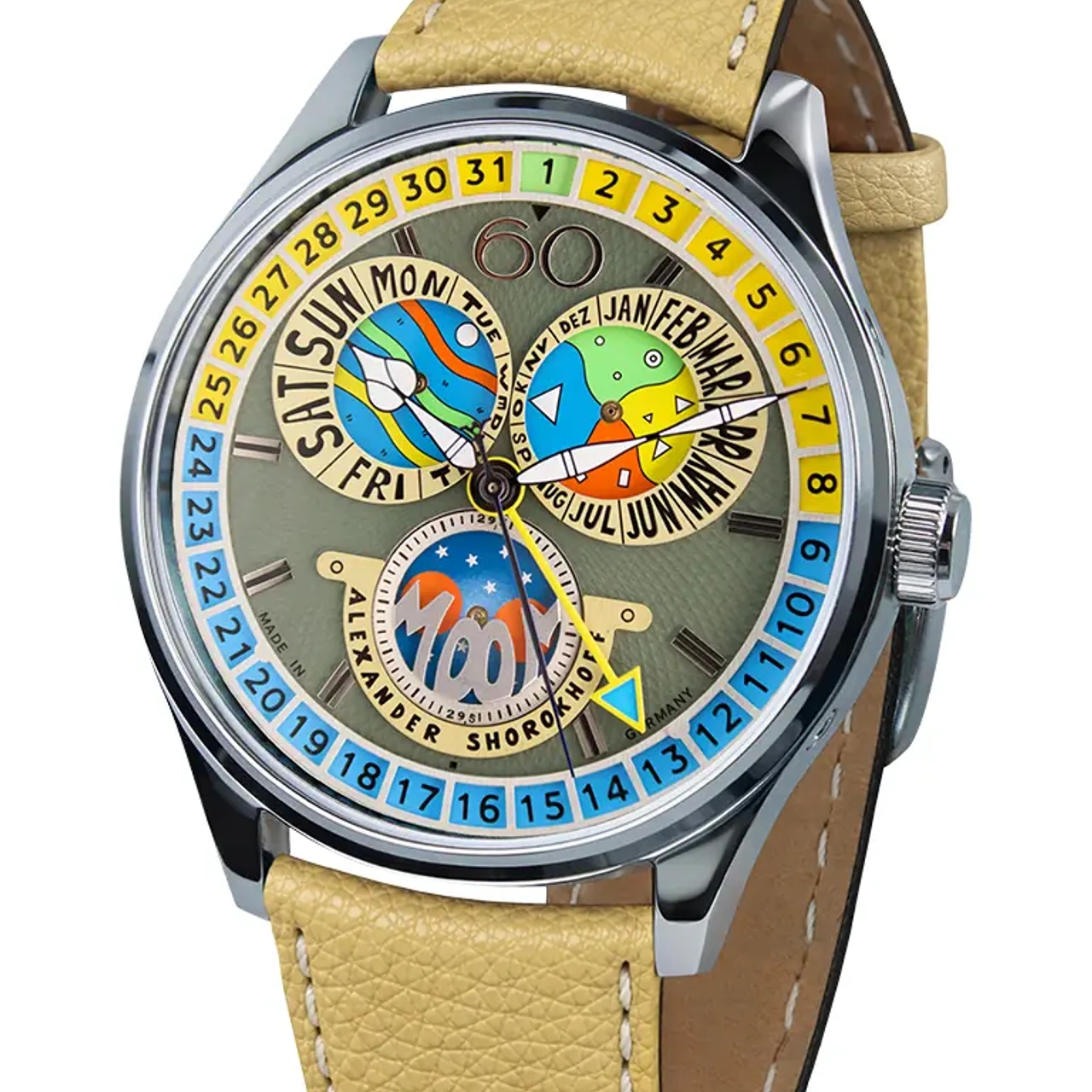
The Cadamomo 3 retains the characteristic layout that defines the series but introduces a notably different atmosphere through its grey guilloché dial and carefully selected colour palette. Where many calendar watches rely on classical design references to communicate their complexity, the Cadamomo family seems more interested in making that complexity visually entertaining.
Even the name is an example of the manufacturer’s distinctive approach. CADAMOMO is formed from four pairs of letters: CA for Calendar, DA for Day, MO for Month and MO for Moon. It is an almost humorous piece of wordplay, but it also communicates exactly what the watch does.
This balance between light-hearted design and serious mechanical watchmaking is central to Alexander Shorokhoff’s identity. The brand’s philosophy of producing art for the wrist encourages an unconventional approach to colour, proportion and decoration, without losing sight of the engineering required to make a mechanical watch function reliably.
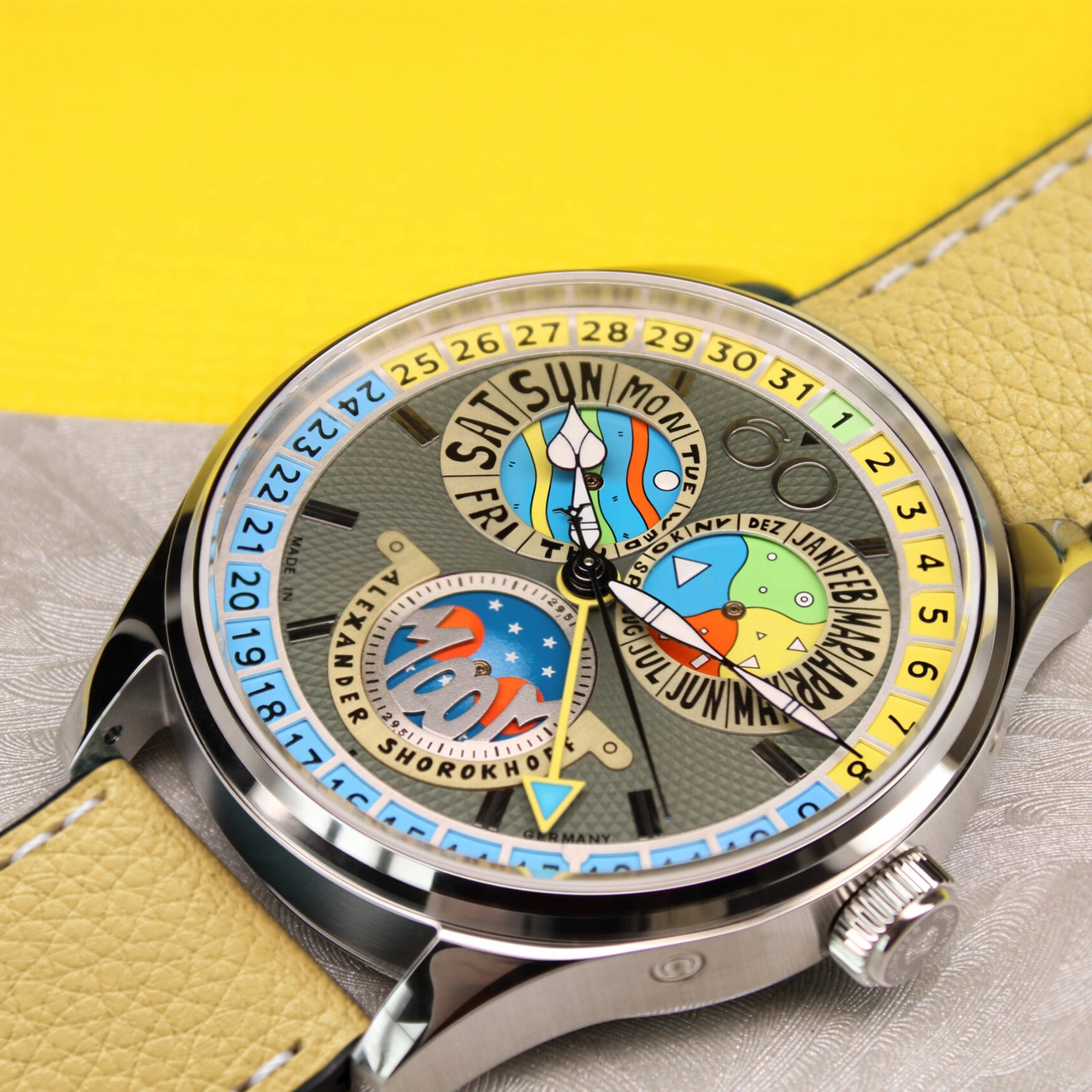
Perhaps the most significant visual development in the Cadamomo 3 is the introduction of its grey guilloché dial. It is an interesting choice because grey is rarely the first colour associated with Alexander Shorokhoff’s more expressive designs. Yet here, it provides exactly the right foundation for the colourful calendar displays.
Guilloché decoration introduces texture and visual depth to a dial through carefully formed repeating patterns. In a traditional dress watch, this might be used to create an understated sense of refinement. On the Cadamomo 3, it plays a different role, adding detail to the background while allowing the unusual subdials and bright calendar indicators to remain the dominant visual features.
The grey surface creates a degree of restraint that would be difficult to achieve with a more saturated background. Against it, the yellow, blue and green markings become considerably more expressive. Their placement is not simply decorative, either. The contrasting colours help establish distinctions between the various calendar functions, making the dial easier to interpret despite the amount of information it contains.
There is also a pleasing tension between the intricate surface decoration and the unconventional shapes of the calendar subdials. The guilloché pattern belongs to a long tradition of classical watchmaking, while the AVG-style displays introduce a completely different graphic language. Instead of attempting to reconcile these elements through symmetry, the design allows them to coexist.
The result is a dial that rewards closer attention. At a glance, it presents a lively arrangement of shapes and colours. Look more carefully, and the purpose of each element becomes apparent.
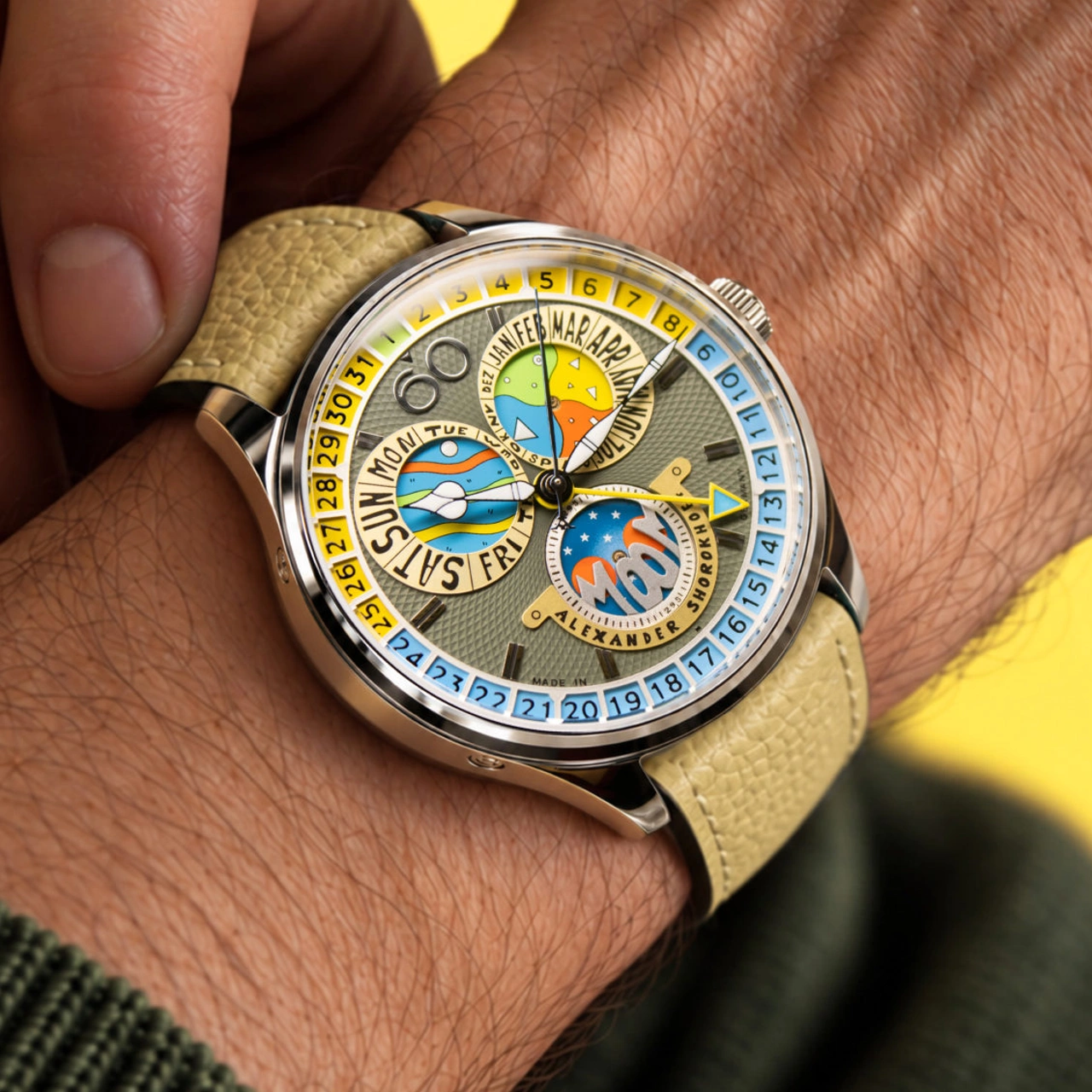
The most fascinating aspect of the Cadamomo 3 is how it distributes its calendar indications across the dial. Rather than grouping all the information within matching registers, each function is given its own distinctive presentation.
The date is indicated by a centrally mounted yellow hand with a blue tip, which extends towards the numbered calendar scale around the outer circumference. This pointer-date arrangement is particularly effective because it separates the date from the main timekeeping hands without requiring an additional window. The bright yellow hand is immediately recognisable against the grey dial, while its contrasting tip provides a precise visual reference for reading the date.
At approximately 10 o’clock sits the day-of-the-week display, positioned opposite the month indication at 2 o’clock. Their artistic subdial designs are noticeably different from the conventional circular registers found on many calendar watches. They bring an almost illustrative quality to the composition, turning functional indications into individual graphic features.
The moon phase occupies the 6 o’clock position, providing a more traditional point of reference within the unconventional arrangement. A rotating disc represents the changing appearance of the moon throughout its lunar cycle. Moon phase displays have always held a particular fascination in mechanical watchmaking because they record something beyond the ordinary passage of hours and minutes. They connect the movement of the watch to a rhythm found in the natural world.
It is worth making the distinction that the Cadamomo 3 is a full-calendar watch rather than an annual or perpetual calendar. Its mechanism provides an extensive range of calendar information, but it does not automatically account for every variation in the length of the months. Occasional corrections are therefore part of ownership.
That distinction does little to diminish its appeal. The attraction is not merely the quantity of information displayed, but the character with which the information is presented. Very few full-calendar watches make the act of reading the date quite so visually interesting.
It would be easy for a watch with such an expressive dial to rely entirely on its appearance. Fortunately, the Cadamomo 3 has plenty to offer beneath the surface.
The watch is powered by the automatic calibre DD9000, a mechanical movement equipped to drive its timekeeping and full-calendar functions. It provides approximately 42 hours of power reserve, allowing the watch to continue running for a considerable period after being removed from the wrist.
While a 42-hour reserve is relatively modest compared with some contemporary movements offering extended running times, it remains entirely practical for a watch worn regularly. The real interest here lies in the integration of the calendar mechanism and the additional decorative work applied to the movement.
Alexander Shorokhoff has equipped the Cadamomo 3 with three specially designed subdial discs developed by ASUM. These customised components contribute directly to the watch’s distinctive dial presentation, demonstrating that its unusual appearance involves more than simply applying a different colour scheme to an existing calendar watch.
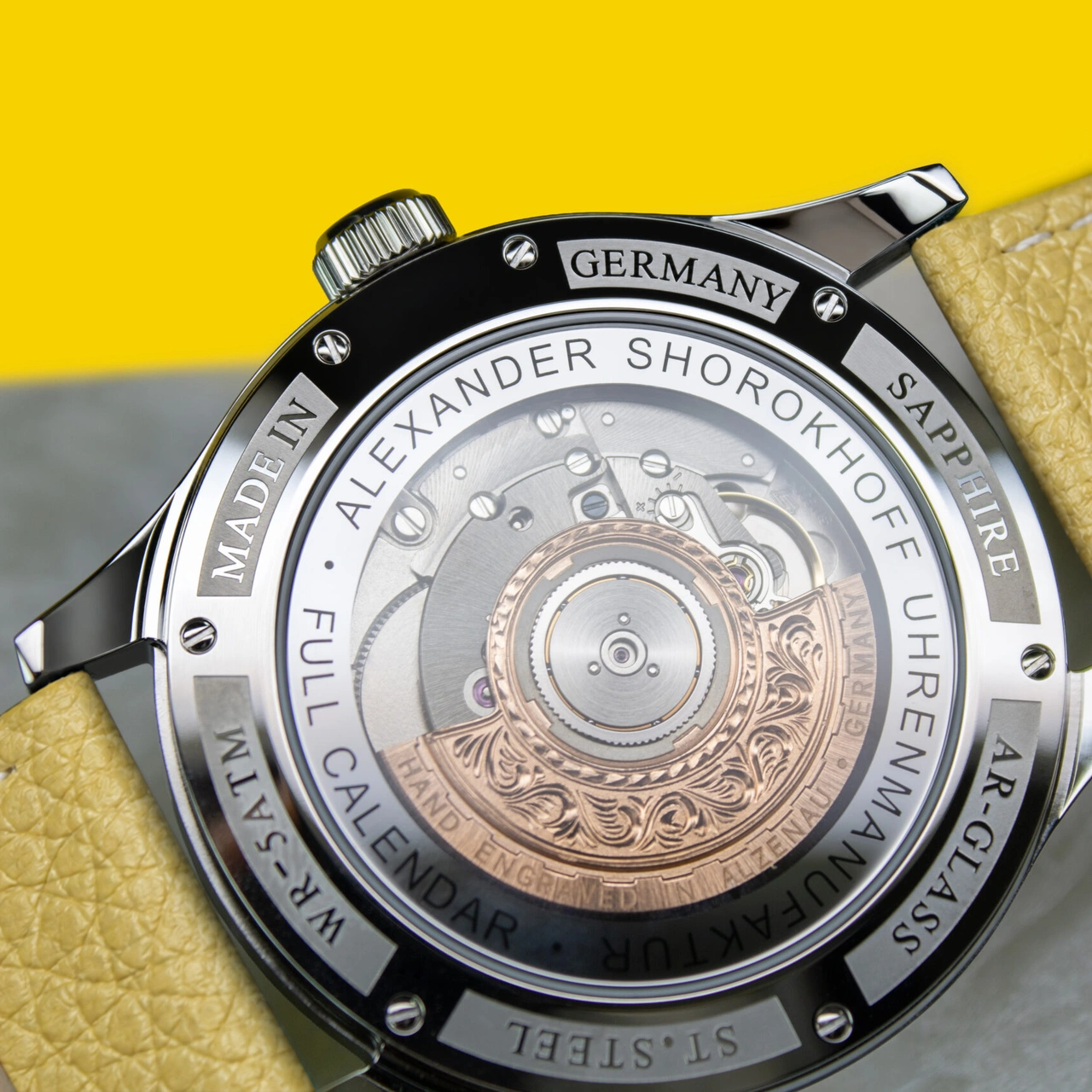
The finishing of the automatic winding system is another important detail. Its oscillating weight is hand-engraved and refined, continuing the manufacturer’s tradition of giving mechanical components an artistic identity of their own. Blued screws add further touches of colour and refinement to the movement, complementing the visual character established on the front of the watch.
A sapphire crystal case back provides a view of this work. There is something satisfying about a watchmaker giving attention to components that are ordinarily hidden from sight. For collectors who appreciate the mechanical aspects of watchmaking, the decorated movement adds another dimension to a watch already rich in visual detail.
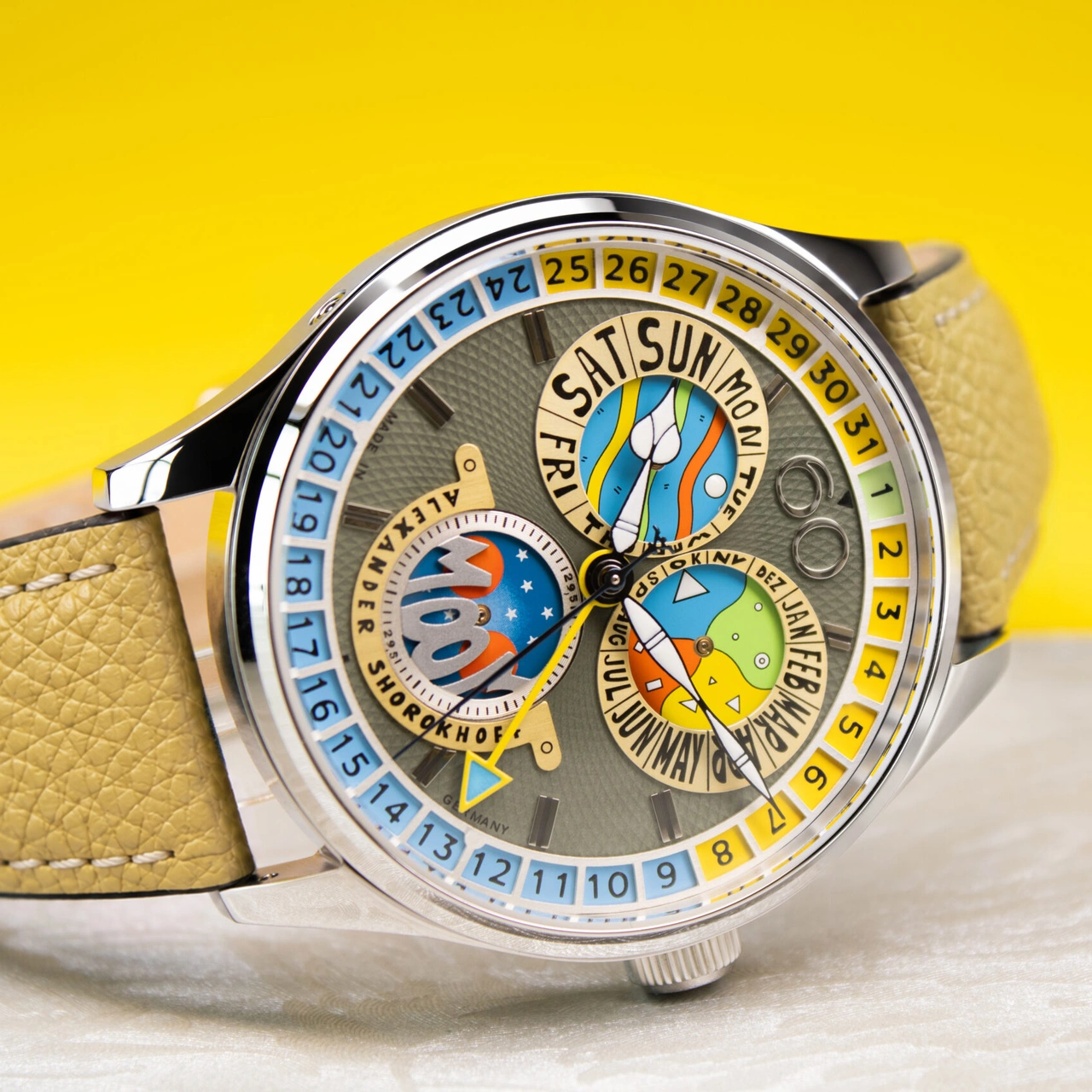
One of the more appealing qualities of the Cadamomo 3 is the contrast between its methods of construction and its finished appearance. Decorative techniques such as guilloché and hand engraving are deeply connected to the history of fine watchmaking, yet they are being used here to support a thoroughly contemporary design.
This is an important distinction. The Cadamomo 3 is not attempting to imitate an antique calendar watch, nor is it presenting complicated mechanics inside a conventional luxury-watch design. Instead, it draws on established horological techniques and places them within a deliberately unconventional aesthetic.
That willingness to reinterpret familiar elements is one of the reasons smaller independent manufacturers remain such an important part of the watch industry. Without the pressure to maintain a universally recognisable design language across millions of watches, a brand such as Alexander Shorokhoff has considerably more freedom to pursue unusual ideas.
Not every idea will appeal to every collector, but watches that challenge expectations often contribute something valuable to the wider discussion about what mechanical watchmaking can be.
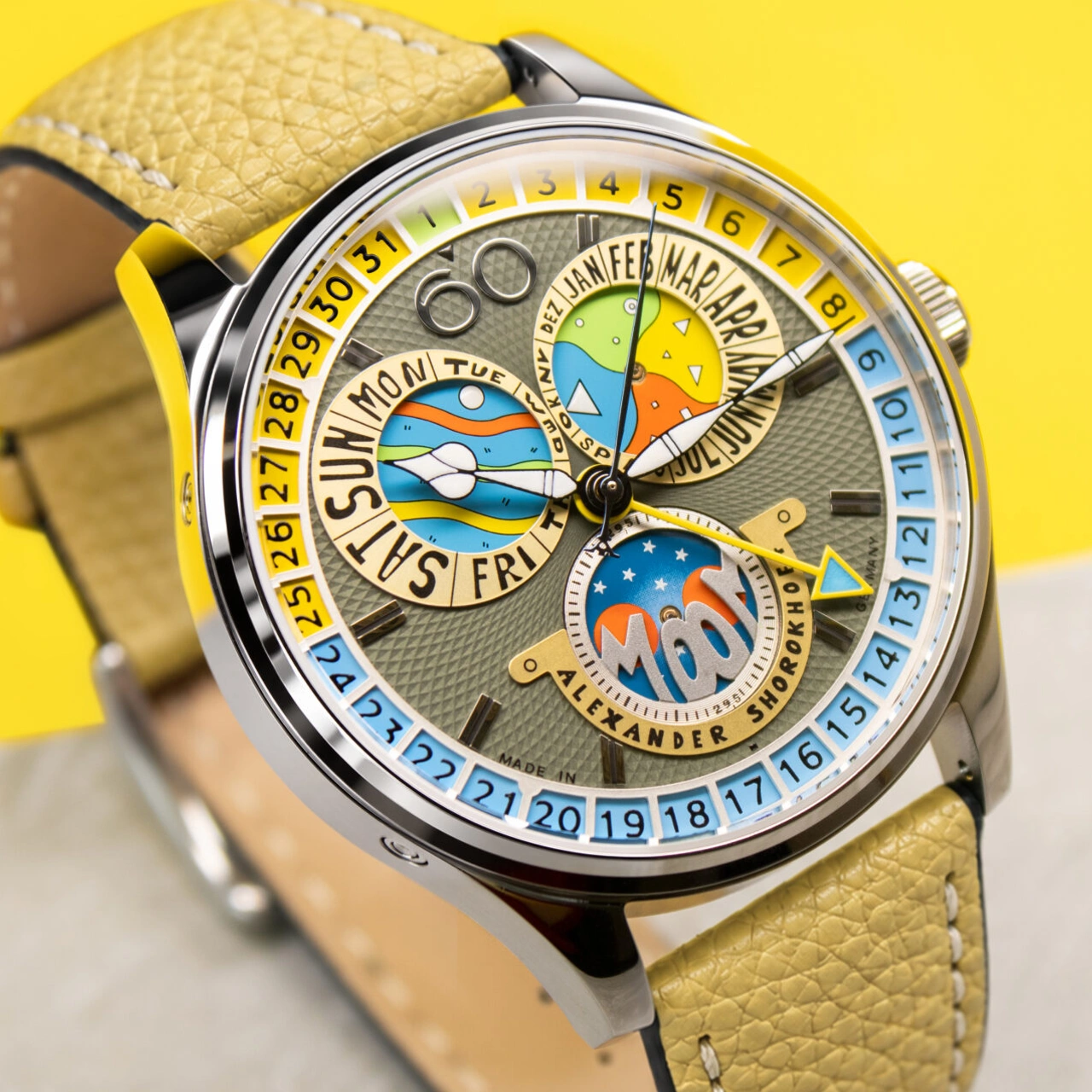
With a diameter of 43.5 mm, the Cadamomo 3 is not a particularly small watch. Its dimensions place it firmly within the category of watches intended to have a noticeable presence on the wrist. However, given the complexity of the dial, the larger diameter serves a practical purpose.
Four separate calendar indications, central timekeeping hands and a peripheral date scale require considerable room. Compressing those elements into a much smaller case could easily compromise their individual legibility or undermine the visual balance that makes the design interesting.
At 11.55 mm thick, the stainless steel case maintains a reasonably controlled profile for a mechanical watch carrying multiple calendar functions. It is not an ultra-thin dress watch, but neither does the case appear designed around exaggerated dimensions simply for their own sake.
Sapphire crystal is fitted to both the front and back, with an anti-reflective coating on the front helping to reduce distracting reflections when reading the dial. The case also offers water resistance to 5 ATM, appropriate for ordinary everyday exposure to moisture, although this is clearly not a watch intended for serious water-based activities.
The overall construction keeps the emphasis where it belongs, on the movement and the elaborate calendar presentation.
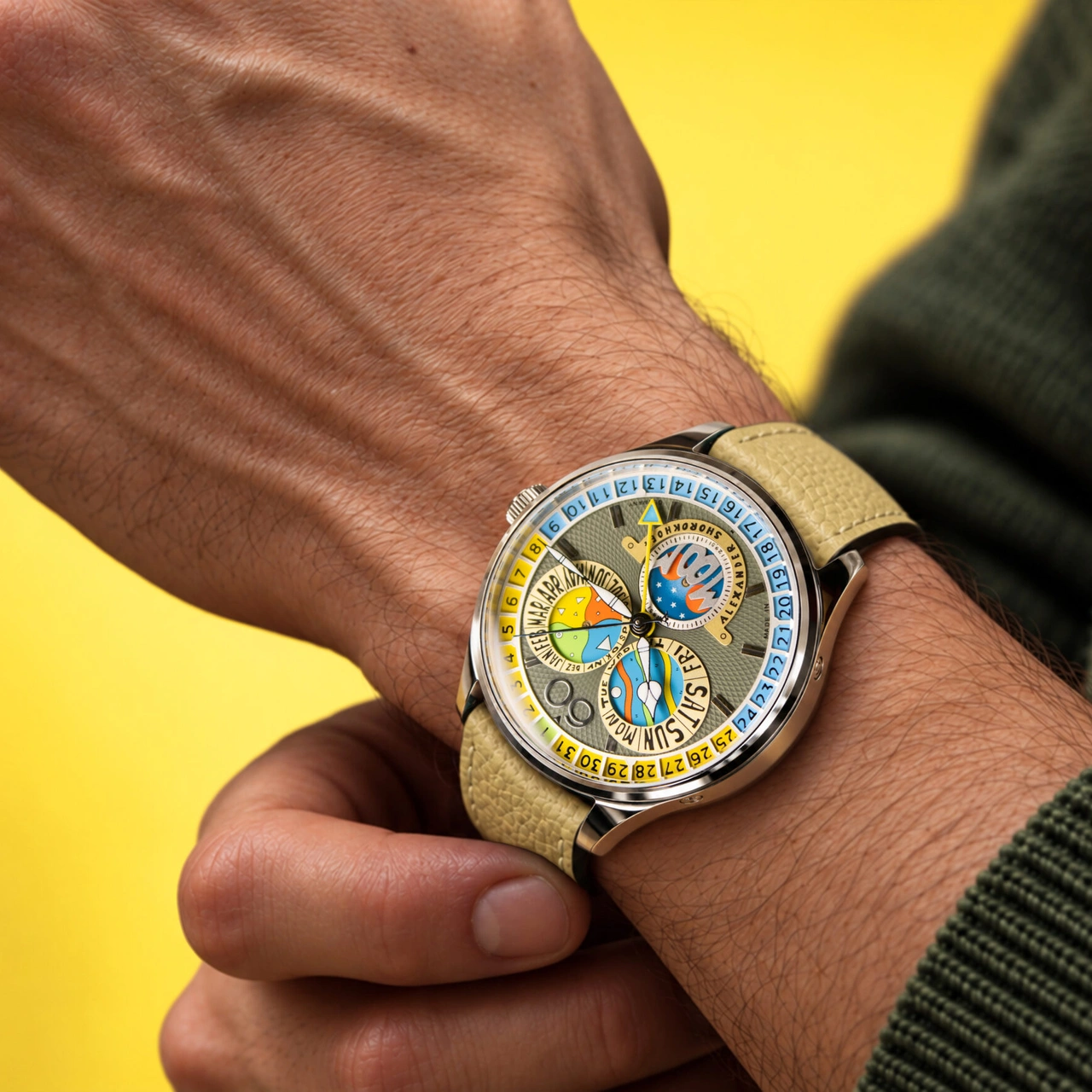
It is difficult to discuss the Cadamomo 3 without mentioning its light yellow calfskin leather strap. On a conventional grey-dial calendar watch, one might expect black, brown or perhaps dark blue leather. Alexander Shorokhoff has chosen something considerably more adventurous.
The yellow strap draws attention to the matching calendar accents, particularly the central date hand, and creates a stronger visual connection between the dial and the rest of the watch. Rather than treating the strap as a neutral accessory, the manufacturer has made it part of the overall composition.
This is a small detail with a surprisingly substantial effect. Remove the yellow strap from the equation, and the Cadamomo 3 would have a rather different personality. With it, the watch becomes a more complete expression of the colourful design philosophy behind the collection.
An engraved solid stainless steel pin buckle completes the strap, while the 22 mm lug width provides scope for alternative strap combinations should an owner eventually wish to change its appearance.
Is the Cadamomo 3 a Watch for Everyone?
Probably not, and there is nothing wrong with that.
Its 43.5 mm diameter, expressive subdials and bright yellow strap are all deliberate choices that will appeal to some enthusiasts far more than others. Collectors who favour restrained Bauhaus-inspired designs, uncomplicated three-hand watches or perfectly symmetrical calendar displays are unlikely to regard the Cadamomo 3 as an obvious next purchase.
There is also an element of visual complexity that requires some familiarity. Although the various calendar indicators are clearly distinguished through colour and position, they are not arranged in the most conventional manner. Reading the day, month and date may require a little more attention until the owner becomes accustomed to the layout.
Yet this is arguably part of the watch’s charm. Mechanical watches are no longer purchased solely because they provide the easiest possible way to tell the time. They are appreciated for their engineering, craftsmanship, heritage and ability to express something about the person wearing them.
The Cadamomo 3 approaches these qualities from a distinctly artistic perspective. Its complexity is something to engage with rather than something the designer has attempted to hide.
Thirty Pieces and the Appeal of Independent Watchmaking
The decision to limit the Cadamomo 3 to just 30 examples adds another layer to its identity. This is a genuinely small production run, particularly for a watch incorporating customised calendar displays and decorative movement finishing.
Limited production alone does not make a watch important, nor does it automatically guarantee future collectability or financial appreciation. What matters more is whether the watch offers a distinctive combination of design, mechanical interest and craftsmanship that is difficult to find elsewhere.
In that respect, the Cadamomo 3 has a convincing argument. It is immediately recognisable, carries a mechanically interesting complication and belongs to a collection with an established design identity. Its decoration and custom calendar components also provide points of interest beyond the limited-edition number.
For collectors who have developed an appreciation for smaller independent brands, these qualities can be far more rewarding than purchasing another variation of an already familiar design.
A Different Way to Appreciate a Mechanical Calendar
The Alexander Shorokhoff Cadamomo 3 succeeds because it is not trying to convince anyone that a full calendar needs to look more complicated, more luxurious or more technically imposing than it really is. Instead, it presents an established complication from an entirely different creative perspective.
The grey guilloché dial is an inspired choice, balancing traditional decorative craftsmanship with the striking colour combinations of the calendar displays. The customised subdial discs and hand-engraved oscillating weight demonstrate that the artistic attention extends beyond surface decoration. Even the yellow leather strap has a clear purpose within the overall design.
There are practical considerations, of course. The case is relatively large, the dial demands attention and the power reserve is conventional rather than exceptional. But none of those characteristics seems particularly inconsistent with the watch’s intended character. The Cadamomo 3 is clearly designed for someone who finds pleasure in unusual details and values originality over restraint.
Perhaps its greatest achievement is making a familiar mechanical complication feel interesting again. The date, day, month and moon phase are hardly new developments in horology, but their presentation here encourages a different appreciation of how a watch can communicate information.
With only 30 pieces being produced, the Alexander Shorokhoff Cadamomo 3 will remain an uncommon sight. For enthusiasts drawn to the imaginative side of independent German watchmaking, that scarcity is simply an additional attraction. The real appeal lies in the originality of the design, the care given to its mechanical construction and the refreshing idea that serious watchmaking can still have a genuine sense of fun.