The Mühle-Glashütte Teutonia IV Moon Phase Black captures this duality with unusual clarity.
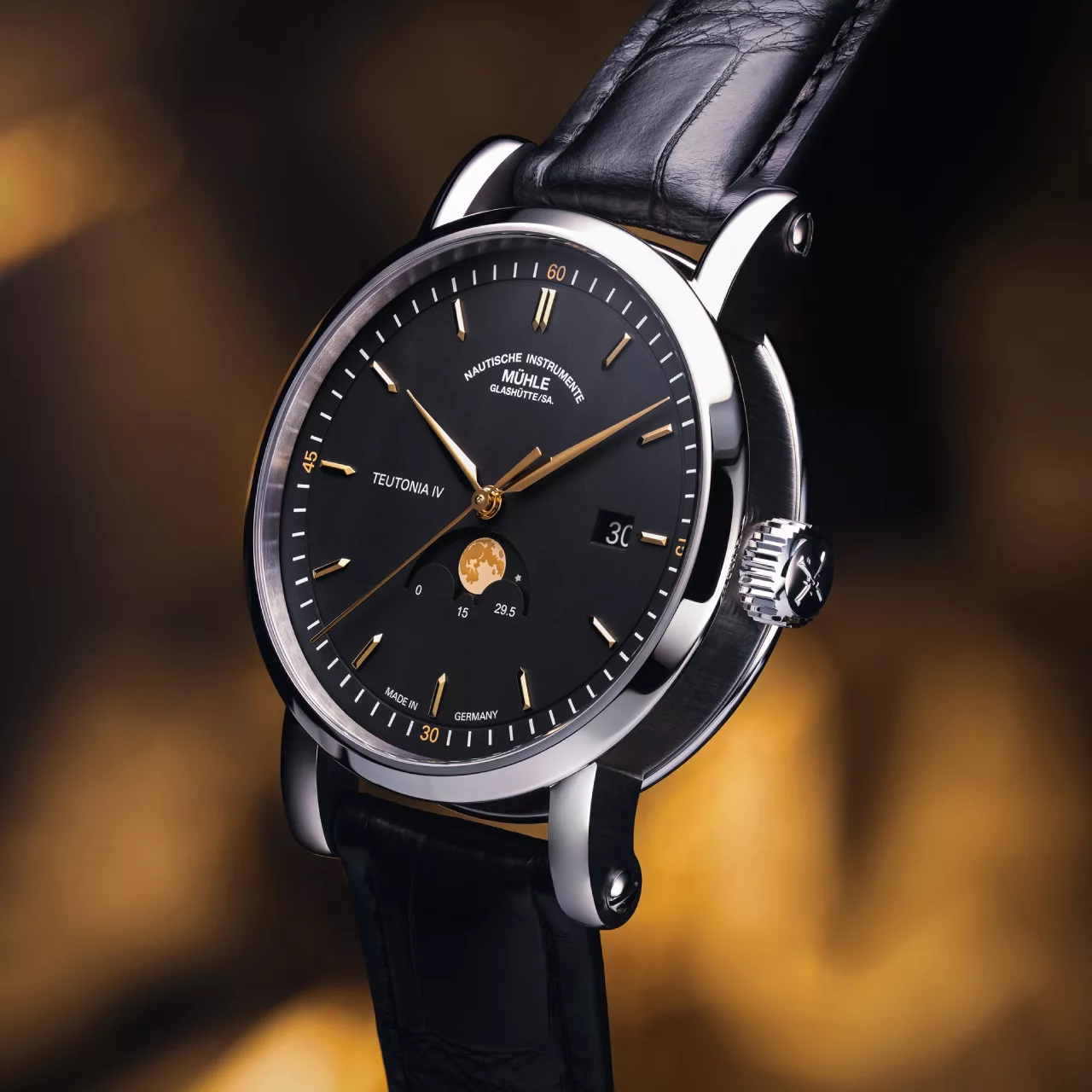
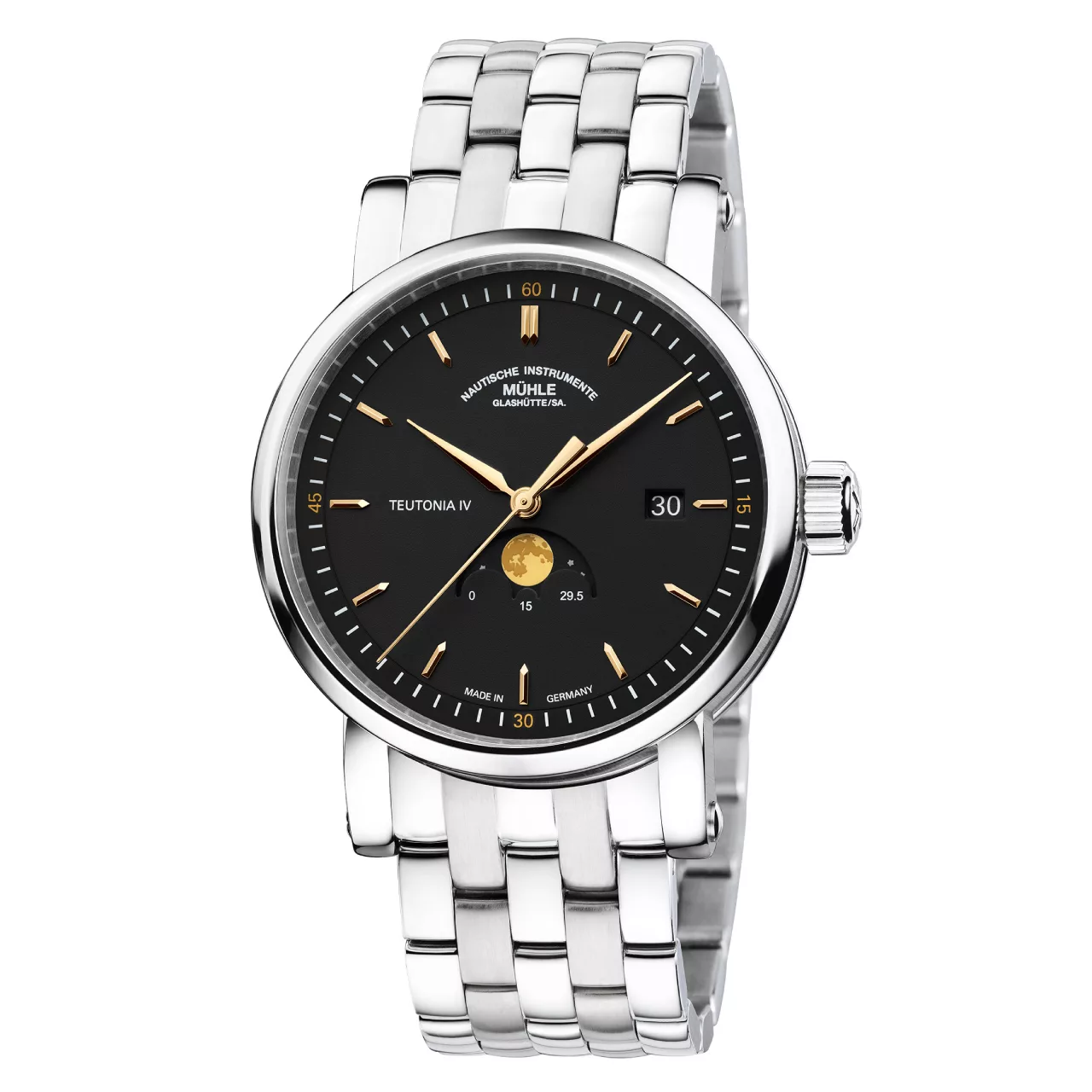
At first glance, the watch presents itself with restrained elegance. The anthracite dial forms a dark, refined canvas, punctuated by gold-plated applied indices and matching lancet-shaped hands. The minute track is clearly structured, with fine second and minute numerals rendered in a complementary gold tone. The visual balance is deliberate. Nothing is overstated, yet nothing feels secondary. The dial’s proportions are measured, classical and carefully resolved.
The focal point rests at 6 o’clock. Here, a specially shaped aperture reveals a ten-millimetre moon disc crafted specifically for Mühle-Glashütte. Unlike generic implementations, this disc displays two precisely rendered moons and rotates once every 59 days. This gearing allows the 29.5-day lunar cycle to be displayed in one-day increments, providing a faithful representation of the moon’s age. The surface of the moon itself is depicted with fine crater detail, large and small, set against a deep black sky scattered with stars. The effect is subtle rather than theatrical, yet deeply satisfying to observe.
The technical execution beneath this poetic display is equally important. The Teutonia IV Moon Phase Black is powered by the SW 280-1 automatic movement in Mühle’s proprietary configuration. While the base calibre is well regarded for reliability, Mühle-Glashütte’s contribution transforms it into something distinct. Central to this transformation is the woodpecker neck regulation system, a robust and highly shock-resistant fine adjustment mechanism developed to enhance stability under real-world conditions.
This regulation system is not decorative marketing language. It reflects the brand’s maritime heritage and its commitment to functional precision. The movement is regulated in six spatial positions, an approach more commonly associated with chronometer standards. Final adjustment is set between 0 and +8 seconds per day. While some brands chase symmetrical deviation figures, Mühle’s philosophy prioritises consistent forward rate, ensuring the wearer is never late because of their watch.
The 2026 edition introduces a further point of interest. In celebration of “Three Decades of Wrist Watches,” a special rotor has been created exclusively for models produced this year. Mühle-Glashütte began manufacturing wristwatches in 1996, following its earlier work with marine chronometers and ships’ clocks. This anniversary rotor is visible through the exhibition case back, reinforcing the brand’s sense of continuity and heritage without resorting to nostalgia.
The case itself measures 41.0 mm in diameter and 12.6 mm in height, proportions that strike a confident yet wearable balance. Alternating brushed and polished surfaces add subtle depth, while a domed, anti-reflective sapphire crystal ensures clarity across the dial. Water resistance to 10 bar is a reminder that this is not merely a formal dress piece. It is designed for everyday reliability.
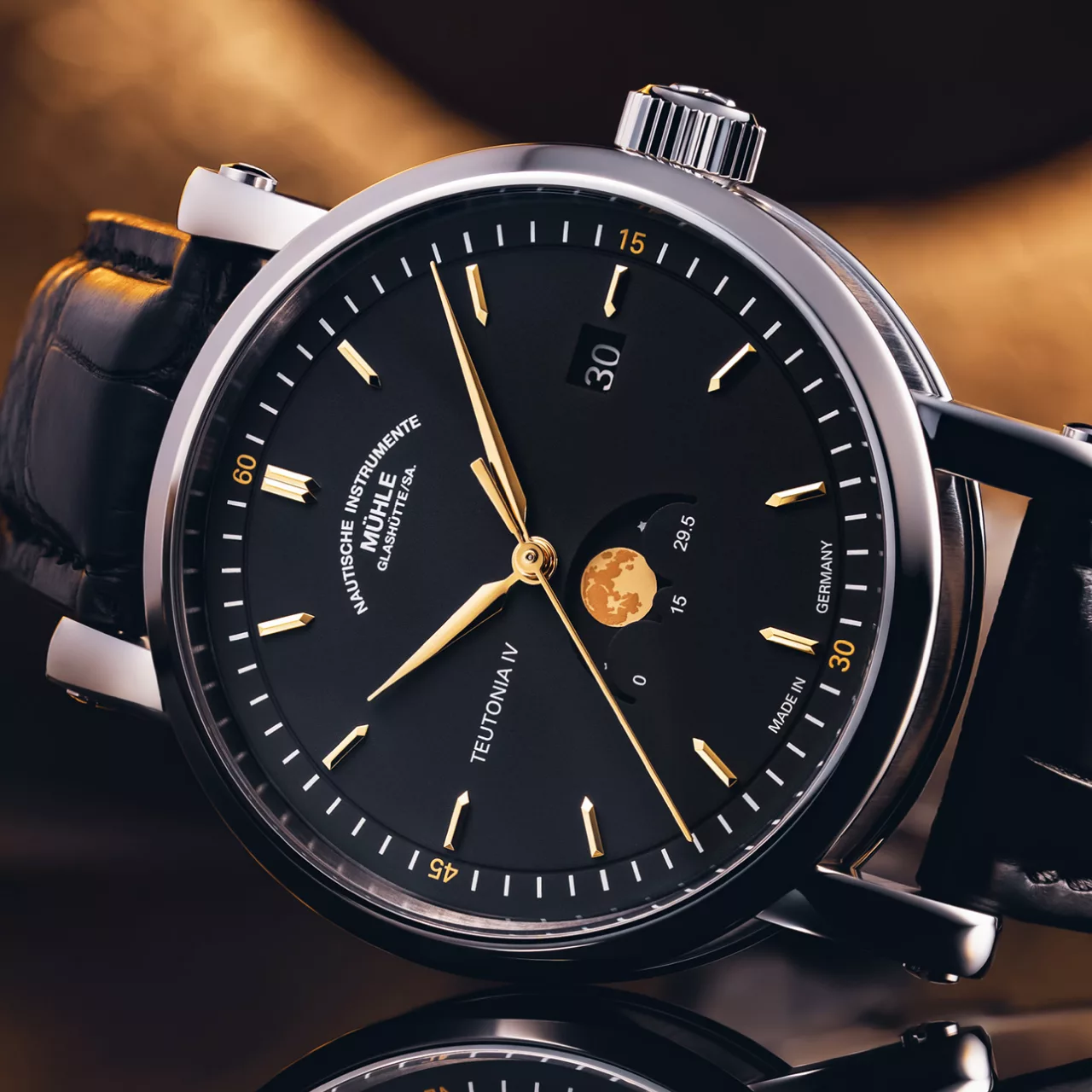
Wearability is enhanced by a choice of stainless steel bracelet, Alcantara or leather strap, each secured with a stainless steel double folding clasp and fitted via screwed strap bars. This practical detail underscores the watch’s blend of refinement and durability.
What ultimately defines the Teutonia IV Moon Phase Black is its refusal to separate beauty from engineering. The moon phase is not an ornamental afterthought. It is integrated into a framework of disciplined regulation, careful finishing and thoughtful design. The anthracite and gold colour palette may draw initial admiration, but it is the mechanical integrity that sustains long-term appreciation.
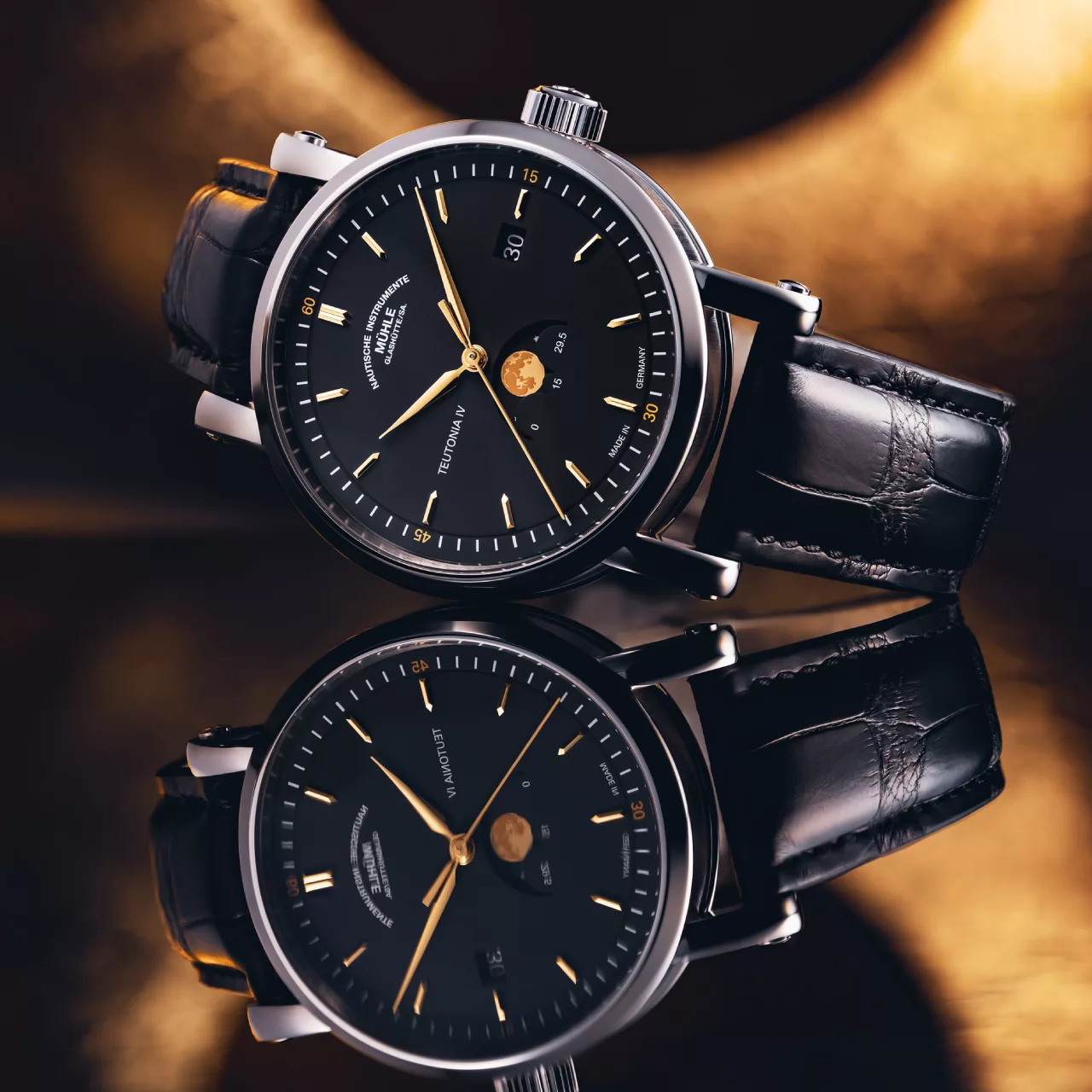
For collectors and enthusiasts who gravitate towards independent German watchmaking, this model represents a compelling synthesis. It honours traditional complication, acknowledges three decades of wristwatch production and upholds a standard of precision rooted in maritime history.
The Teutonia IV Moon Phase Black is not loud. It does not seek to dominate attention. Instead, it rewards close observation. It invites reflection on rhythm and reliability, on celestial motion and mechanical control. In doing so, it demonstrates that true elegance in watchmaking lies not in excess, but in balance.