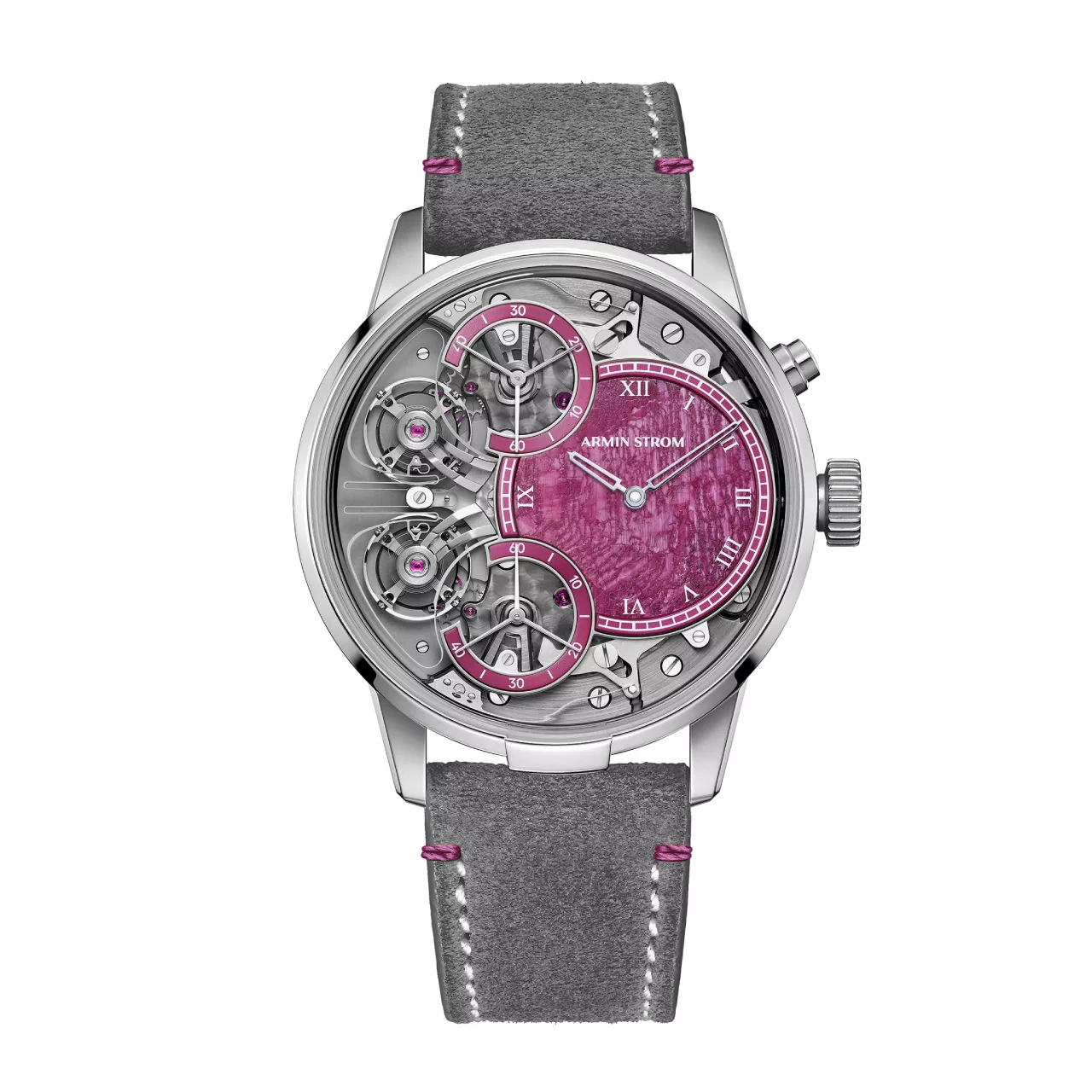
When a brand is known for mechanical architecture, it takes confidence to introduce a dial that can compete for attention. Armin Strom has built its modern identity around transparency: movements designed to be seen, understood, and appreciated not only for what they do, but for how they are built. With the Mirrored Force Resonance Ruby, the brand adds a second kind of transparency, not visual, but conceptual. The dial is cut from natural ruby, a material shaped by geological time rather than industrial process, and the result feels like a deliberate conversation between nature and engineering.
Most watches, even very high-end ones, treat the dial as a controlled surface. Colour, texture, finishing, and reflectivity are designed to behave predictably under light. Ruby does not behave that way. Natural stone carries its own internal narrative: inclusions, tonal shifts, microscopic structures that catch and scatter light in ways that cannot be fully standardised. That is exactly the point here. Armin Strom is not chasing perfection in the sterile sense. The brand is using authenticity as a design ingredient. Each dial is cut from genuine ruby and chosen for the depth of its red, but no two stones can ever be identical. In this context, the variations are not tolerated, they are celebrated. They are the evidence that the material is real.
That choice lands differently when the watch itself is already an argument for rarity. This edition is limited to five pieces, which makes the dial’s natural individuality more than a poetic detail. It means each watch is, in a literal sense, its own version of the release. For collectors who already own technically remarkable watches, that kind of one-by-one character can matter as much as a complication. It is the difference between having a reference and having a piece.
Ruby also carries a deeper resonance, no pun intended, within watchmaking culture. Synthetic ruby has long been essential to mechanical movements. Those tiny jewels reduce friction, resist wear, and help preserve accuracy over time. They are usually hidden, functional, and unromantic in appearance, even if their role is critical. The Mirrored Force Resonance Ruby turns that tradition outward. Ruby is not only inside the movement as engineered performance, it is also on the dial as a natural statement. In one watch, the same material is present in two forms: one shaped by science for function, the other shaped by the earth for beauty and meaning. That duality feels very “Armin Strom” in spirit, because it frames mechanics and aesthetics as inseparable parts of the same whole.
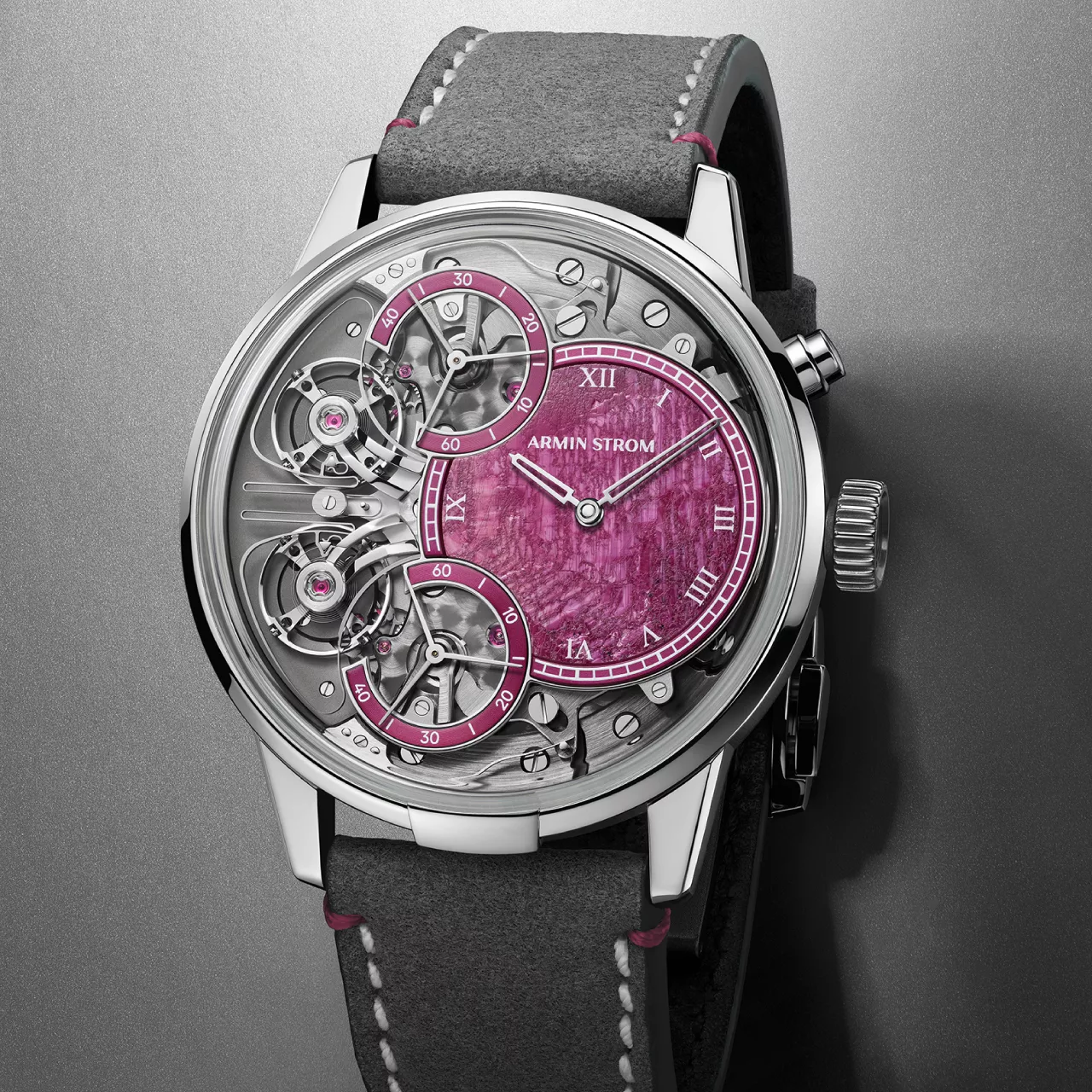
The watch is built around the manual-winding manufacture Calibre ARF21, developed and produced in-house. The Mirrored Force Resonance line has always been about making resonance visible and intelligible, not just technically present. Resonance itself is an old idea in horology, famously explored in different ways across history, but it remains exceptionally difficult to execute reliably in a wristwatch. The challenge is not only making two oscillators influence each other, but doing so in a controlled and repeatable manner, in a format that is subjected to constant motion, shocks, temperature changes, and varying positions.

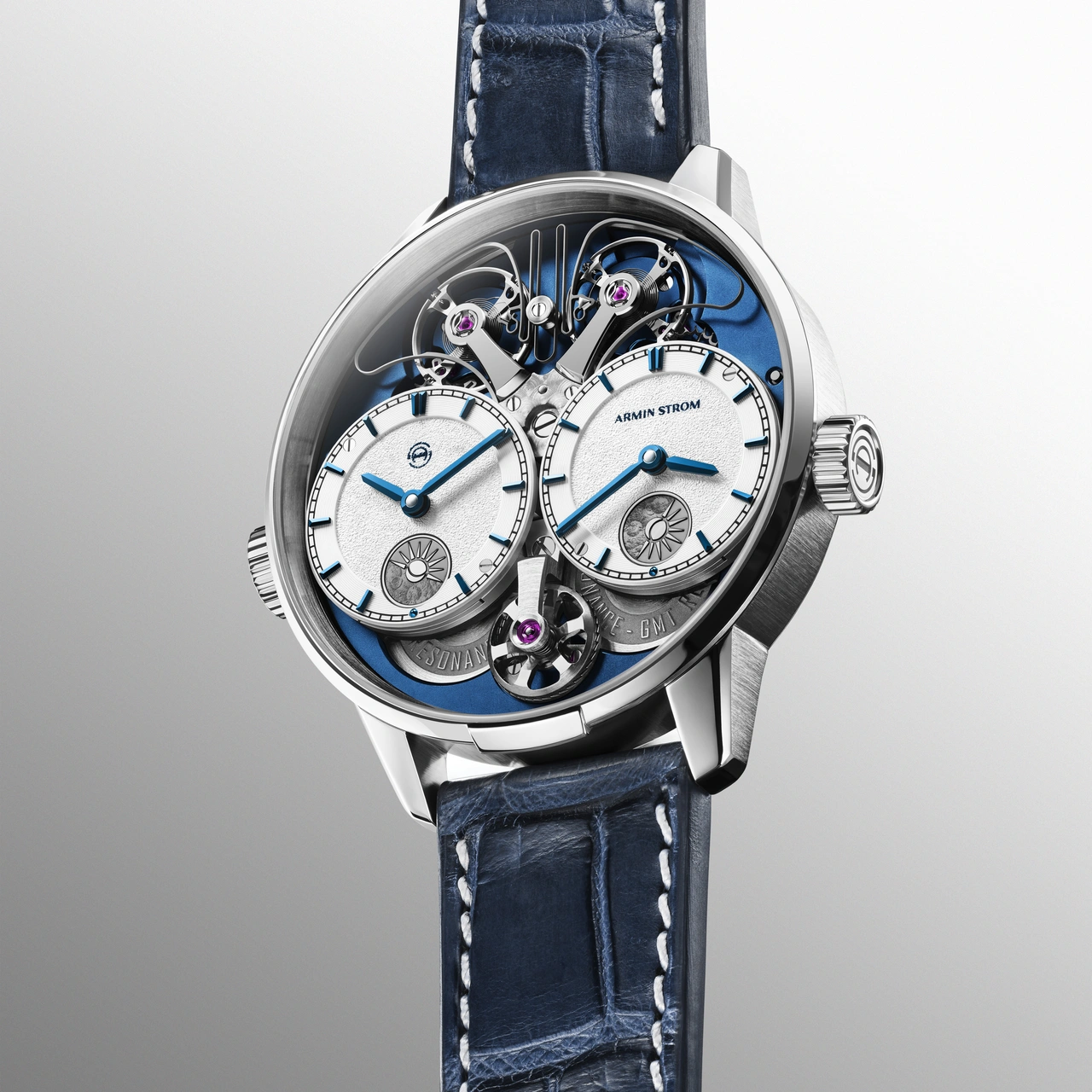
Armin Strom’s answer is the patented Resonance Clutch. Rather than relying on traditional approaches that can be extremely sensitive to adjustment, the Resonance Clutch connects the two independent regulating systems in a way that encourages synchronisation. The goal is harmonic resonance, where the twin balance wheels oscillate together. In practice, the appeal is twofold. First, there is the theoretical promise of enhanced chronometric stability over the long term. Second, there is the immediate, visual satisfaction of watching the twin balances breathe in unison, a mechanical performance that reads like living sculpture.

The Mirrored Force Resonance Ruby makes that theatre even more compelling by framing it with the stone dial. The ruby’s mineral intensity does not sit quietly in the background. It adds warmth to the watch’s structural symmetry, creating a tension between organic variation and engineered alignment. The resonance layout is famously mirrored: two balances, two seconds displays, and a visual logic that feels architectural and intentional. Against that order, the ruby brings a reminder that not everything valuable is perfectly repeatable.
One of the more engaging details in this release is the pusher at 2 o’clock, which resets both seconds counters simultaneously. This is not a conventional chronograph function, even though the word “flyback” appears in the specification set. In the context of the Mirrored Force Resonance, it is best understood as a demonstrative mechanism: a way to bring both seconds indications back to zero in unison, letting the observer watch how the system returns to synchrony. It turns an abstract phenomenon into something tangible. For anyone who enjoys the idea of a watch that teaches as it entertains, this is a small feature with outsized impact.

The rest of the watch’s construction supports the central idea without distracting from it. The case is stainless steel, 43 mm in diameter, with a height of 11.55 mm and a lug-to-lug measurement of 49.60 mm. On paper, that reads as contemporary and present, but the openworked display and the dial’s off-centre layout help it wear more like a purposeful instrument than a bulky statement piece. Water resistance is 3 ATM, which is consistent with a watch focused on mechanical refinement rather than all-terrain intent.
Armin Strom pairs the watch with a dark grey Alcantara strap with white stitching and a stainless steel pin buckle. It is a smart choice. Alcantara adds a tactile softness and a modern tone that does not compete with the ruby’s colour. Leather could have introduced too much traditional warmth, while a bracelet might have pushed the look into a different category entirely. The strap keeps the attention where it belongs: on the dial and the movement.
The dial itself features printed Roman numerals in white, providing a classical counterpoint to the contemporary mechanics. Roman numerals can be polarising, but here they function as a stabilising element. The watch is full of motion and depth, and the numerals create an immediate sense of legibility and tradition. It is another example of Armin Strom balancing opposites: classical time display language alongside a thoroughly modern interpretation of resonance.
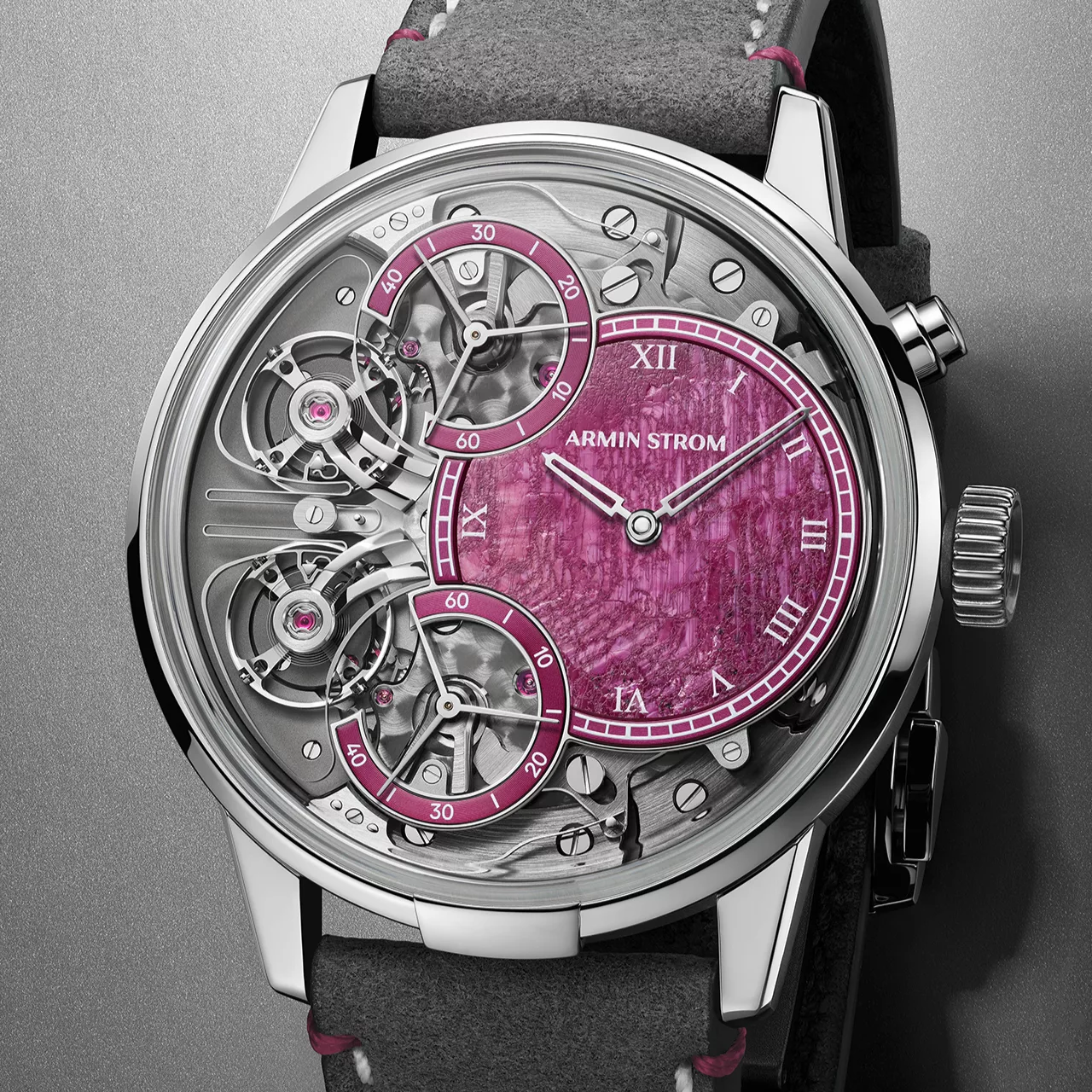
Then there is the finishing, which is where this release quietly asserts its standing. It is easy to be distracted by the ruby dial and the resonance mechanism, but the watch needs to hold up under close inspection, especially at this level. Armin Strom’s hand-finishing is not treated as a decorative afterthought. Hand-polished bevels catch the light along edges and bridges. Black-polished screws add a sharp, mirror-like punctuation. Perlage and circular graining build texture and depth on the surfaces that would otherwise feel purely technical. On the reverse, Geneva stripes enhance the sense of structure through the sapphire case back, giving the movement a composed, deliberate look from every angle.
A detail worth noting is the brand’s assembly approach. Each watch is assembled twice, a process intended to ensure that the mechanical performance and the finishing quality meet the standard expected of a piece like this. In practical terms, it speaks to an important point about independent high watchmaking: the goal is not just to create a concept, but to execute it at a level where the concept remains convincing after years of ownership. That is where many “interesting” watches fail. They impress at first glance, then slowly reveal compromises. The Mirrored Force Resonance Ruby is designed to avoid that trap.
For collectors, the appeal is layered. On one level, it is a rarity play: five pieces, natural stone dial, and a resonance system that remains uncommon even among high-end independents. On another level, it is a philosophical piece. It makes a case for material meaning, not only through preciousness, but through authenticity and narrative. Ruby is precious, yes, but the watch does not rely on gem-setting or surface glamour. It uses ruby as a raw, natural medium, letting it stand beside the mechanics rather than overwhelm them.
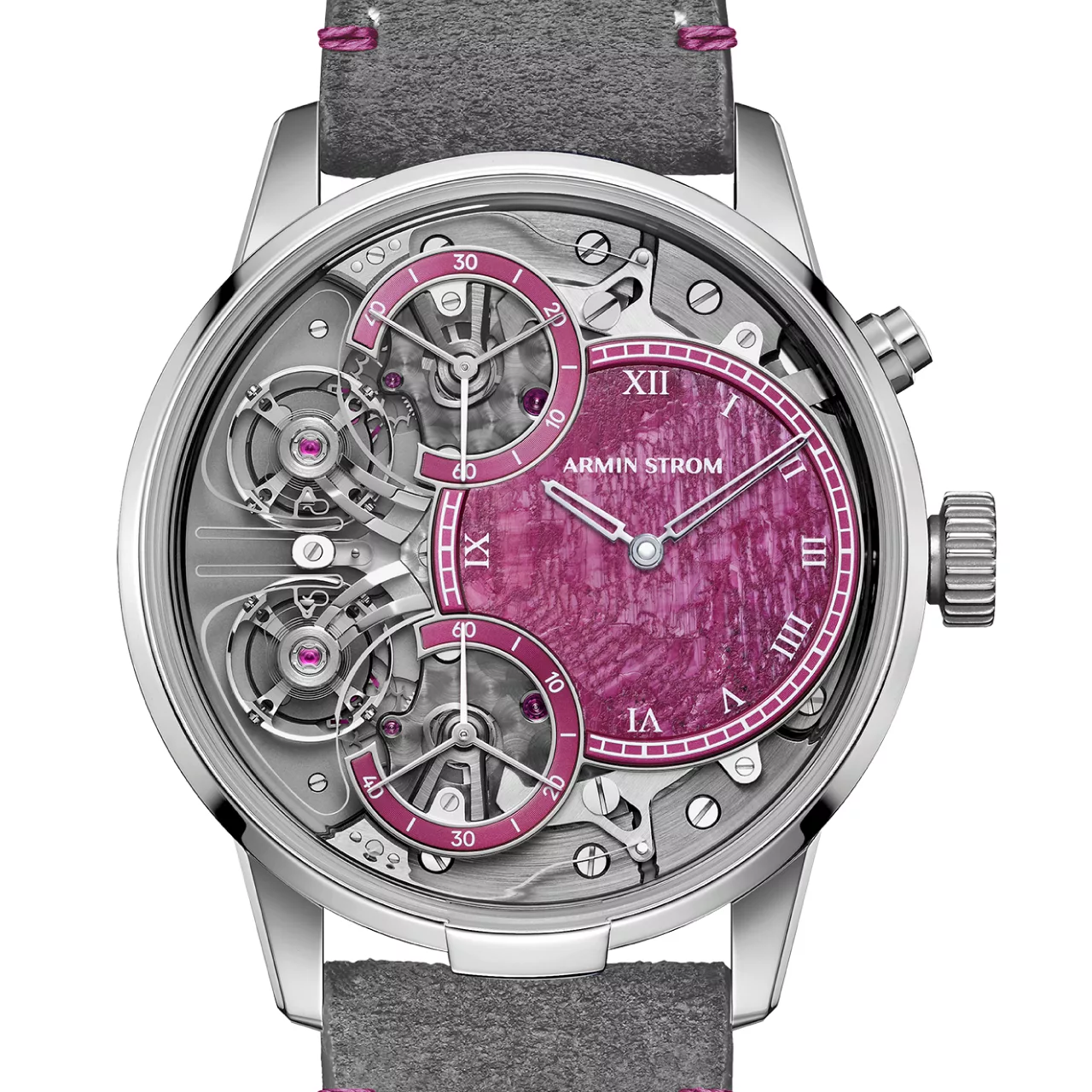
That approach aligns with Armin Strom’s broader identity. The brand does not make watches that hide their effort. It makes watches that show their work, in the truest sense, and that transparency becomes part of the pleasure of ownership. With the Ruby edition, the brand extends that honesty into the dial material itself. The inclusions and tonal variations are not edited out, they are part of the point. It is a release that understands what many collectors want at the top end of the market: not just excellence, but character.
The Armin Strom Mirrored Force Resonance Ruby is special because it feels coherent. The natural ruby dial could have been a gimmick if the movement were ordinary, or if the finishing did not hold up. The resonance movement could have felt clinical if the dial were too uniform or too safe. Instead, the two elements reinforce each other. Nature brings variation and warmth. Engineering brings symmetry and precision. Together, they create a watch that reads like a complete idea rather than a collection of expensive parts.
For the enthusiast who gravitates toward independent watchmaking, that completeness is often the deciding factor. This is not a watch designed to win on specifications alone, even though its specifications are serious. It is designed to reward attention, to reveal detail over time, and to stand apart in a world where “limited” often means “plentiful.” With five pieces, genuine ruby on the dial, and a resonance system executed with modern clarity, the Mirrored Force Resonance Ruby feels like a release that will be remembered, not just collected.