Erwin Sattler Lunaris II Review – When a Moon Dial Meets Serious German Mechanics
There are certain makers in the German-speaking world that do not chase attention, and Erwin Sattler sits comfortably in that camp. The brand’s best pieces do not rely on bold colour, oversized proportions, or novelty complications to announce themselves. Instead, they win in a quieter way, through proportion, clarity of function, and a kind of finishing discipline that suggests the object was built to be kept, serviced, and used for decades. The Lunaris II fits neatly into that philosophy. It is not a radical reinvention, but it is not a token update either. It feels like a second chapter written by the same hand, just with sharper editing and a more modern sense of material presence.
What makes the Lunaris II “special” is not a single headline feature, but the way its elements support one another. The moon-inspired concept is genuinely structural to the design, not merely decorative. The acoustic passing strike adds a layer of interaction that is felt as much as it is heard. And the decision to place the winding, setting, moon phase adjustment, and regulation on the rear keeps the dial side calm and uninterrupted, which in turn makes the front view feel more architectural, almost gallery-like. It is a table clock that reads as an object of design, but behaves like a serious instrument.
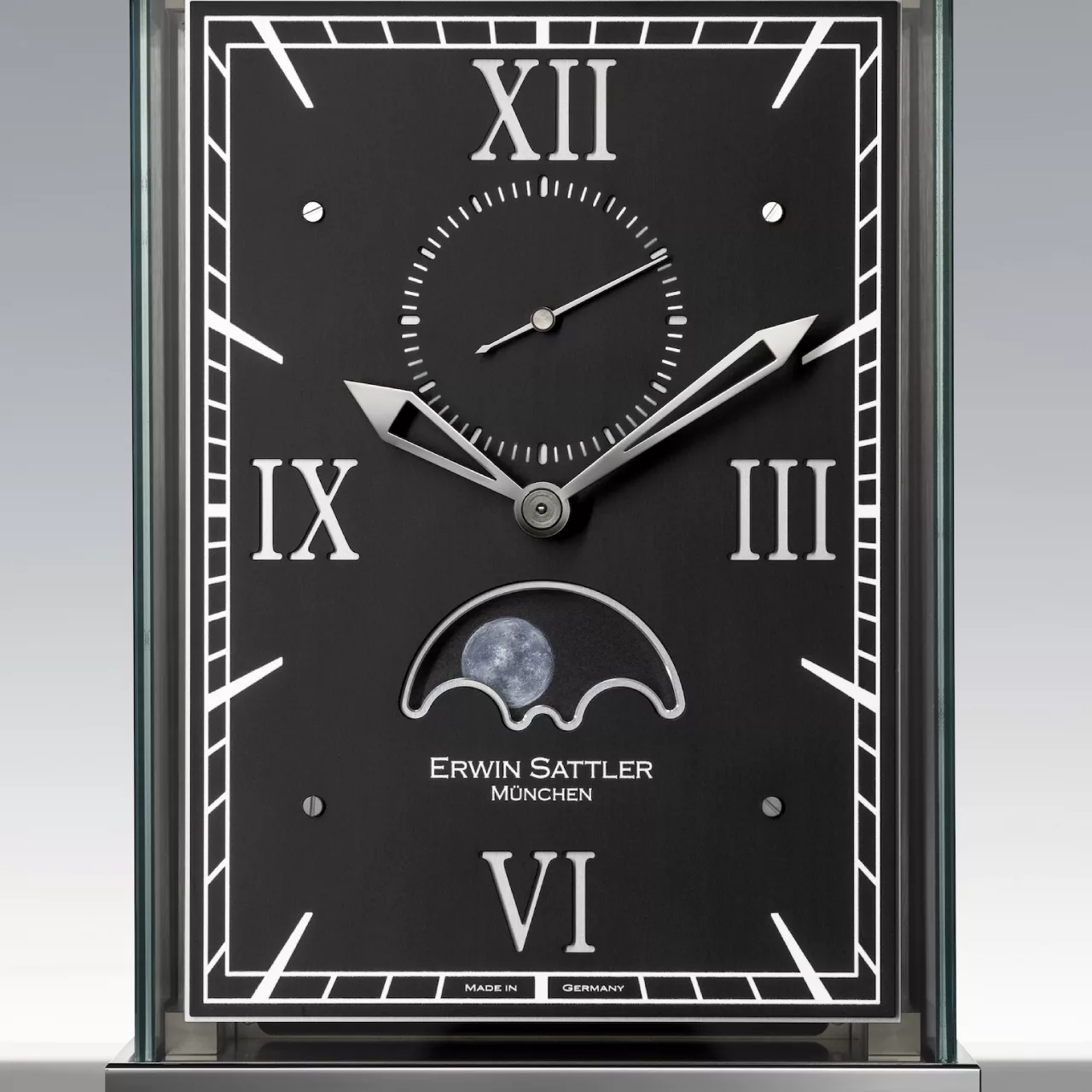
A Dial Built in Layers, Not Graphics
The first place the Lunaris II signals its “new generation” status is the dial. The construction is two-piece, which matters because it changes how the clock wears light and shadow. Roman numerals are not printed or applied. They are milled out of the dial’s top layer, exposing the second layer beneath. The result is a subtle, controlled three-dimensional effect. It improves readability in a way that is hard to photograph properly, because it is less about contrast and more about depth. Under shifting natural light, the numerals and surfaces develop a quiet sense of movement, which is exactly what a desk clock should do when it is part of a lived-in space rather than a static display.
That layered approach also gives the moon phase a stronger visual “anchor”. A moon display can sometimes feel like a separate element added for charm. Here, it sits naturally within a dial that already treats depth and structure as the primary design language. The moon disc itself is hand-painted, and that single detail changes the emotional tone of the piece. Milling and machining can be breathtaking, but they can also feel clinical. The hand-painted moon introduces a human signature, a reminder that even in high-precision clockmaking, the most memorable objects usually contain a trace of the maker’s hand.
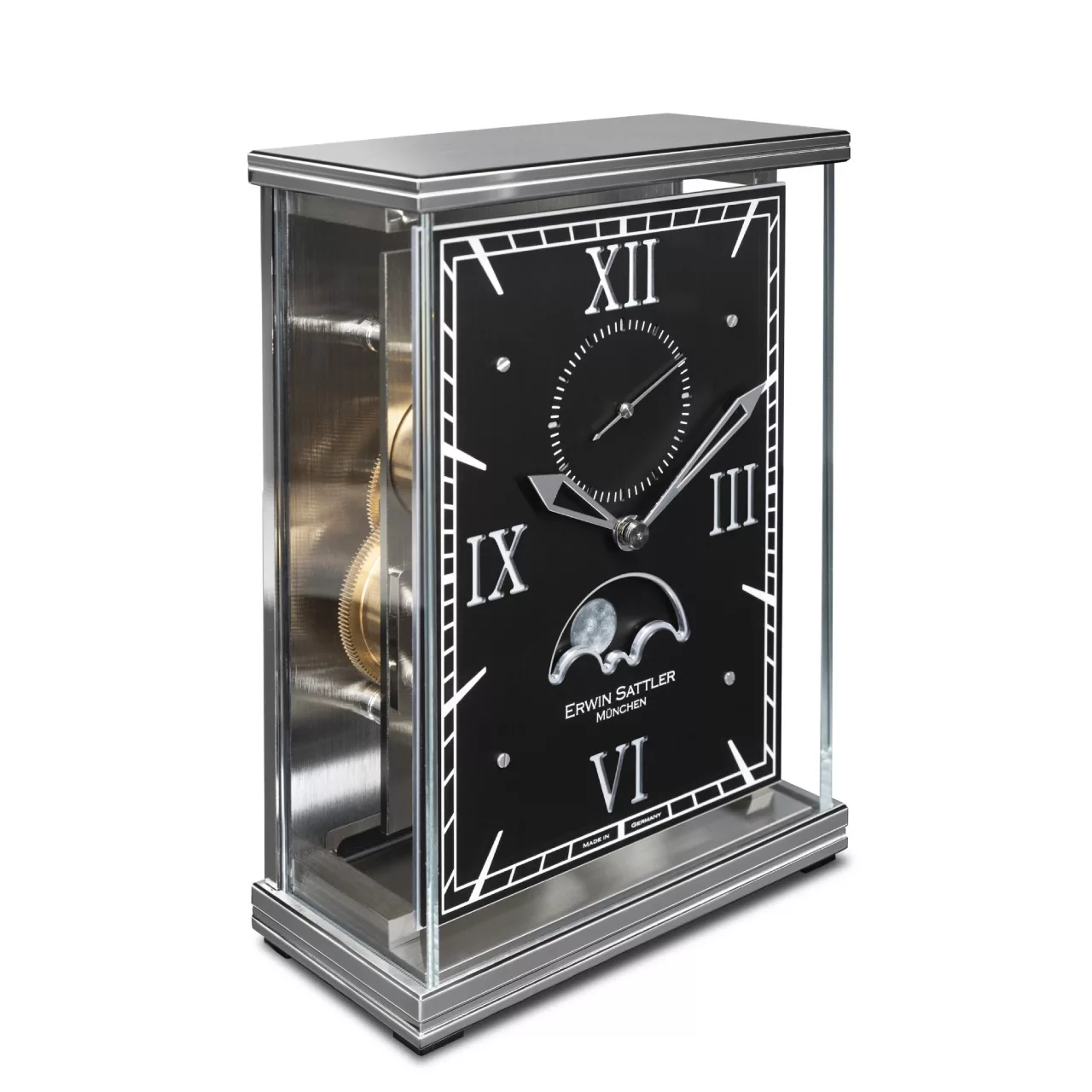
The Case: Frameless Glass, Now with Sharper Metalwork
The Lunaris line is defined by its frameless glass case. It creates the sensation that the dial is suspended in space, almost floating. That architectural effect is not just “nice to look at”, it changes how the clock interacts with its surroundings. Glass makes the Lunaris II feel lighter than it actually is, even though the clock carries a substantial 6 kg weight. It is a clever tension: visually airy, physically grounded. On a desk, sideboard, or shelf, it feels stable and intentional, not delicate.
In the Lunaris II, the top and base have been redesigned in brushed stainless steel. This is one of those updates that might sound minor on paper but is significant in the hand. Brushing gives the metal a contemporary, tool-like honesty, while still allowing the piece to sit comfortably in refined interiors. The standout detail is the decorative groove, precisely milled and then polished. It is restrained, but it matters, because it adds a crisp highlight that breaks up the brushed surfaces and gives the profile a new level of definition. It is the kind of detail that communicates quality without resorting to shine-for-shine’s-sake.
The Hands: Cleaner, Lighter, More Intentional
The hands have been updated with a skeletonised shaft and a filled tip. On many clocks, hands are treated as an afterthought. Here, the hand design supports the broader theme: clarity without heaviness. Skeletonising reduces visual mass, which suits the glass architecture, while the filled tip keeps the display practical. It is a functional choice dressed as an aesthetic one, which is often where the best design decisions live.
The combination of updated hands and the milled dial also keeps the Lunaris II from drifting into “decorative object” territory. The clock remains very readable at a glance. This might seem like an obvious point, but it is surprisingly easy for high-end desk clocks to prioritise artistry over usability. The Lunaris II manages both, which is exactly why it feels like a mature design rather than a concept piece.
Sound as a Feature: The Passing Strike
The passing strike is one of the Lunaris II’s most charming features, and it is also one of the easiest to misunderstand if it is only read in a spec list. “Passing strike” can sound dramatic. In practice, what the Lunaris II delivers is a clear, delicate chime on a bell once every full hour. It is not an aggressive announcement. It is a gentle punctuation, the kind of sound that can make a room feel more settled rather than more noisy. For many enthusiasts, this is where mechanical timekeeping becomes emotional. Sound makes time tangible. It turns the clock from a silent object into a companion that subtly participates in the day.
Importantly, the chime does not compete with the design. It complements it. A glass-architectural clock with an hourly bell strike could easily feel theatrical. The Lunaris II avoids that trap by keeping the execution refined. It is a reminder that in traditional clockmaking, acoustic design is part of the craft, not an extra feature to tick a box.
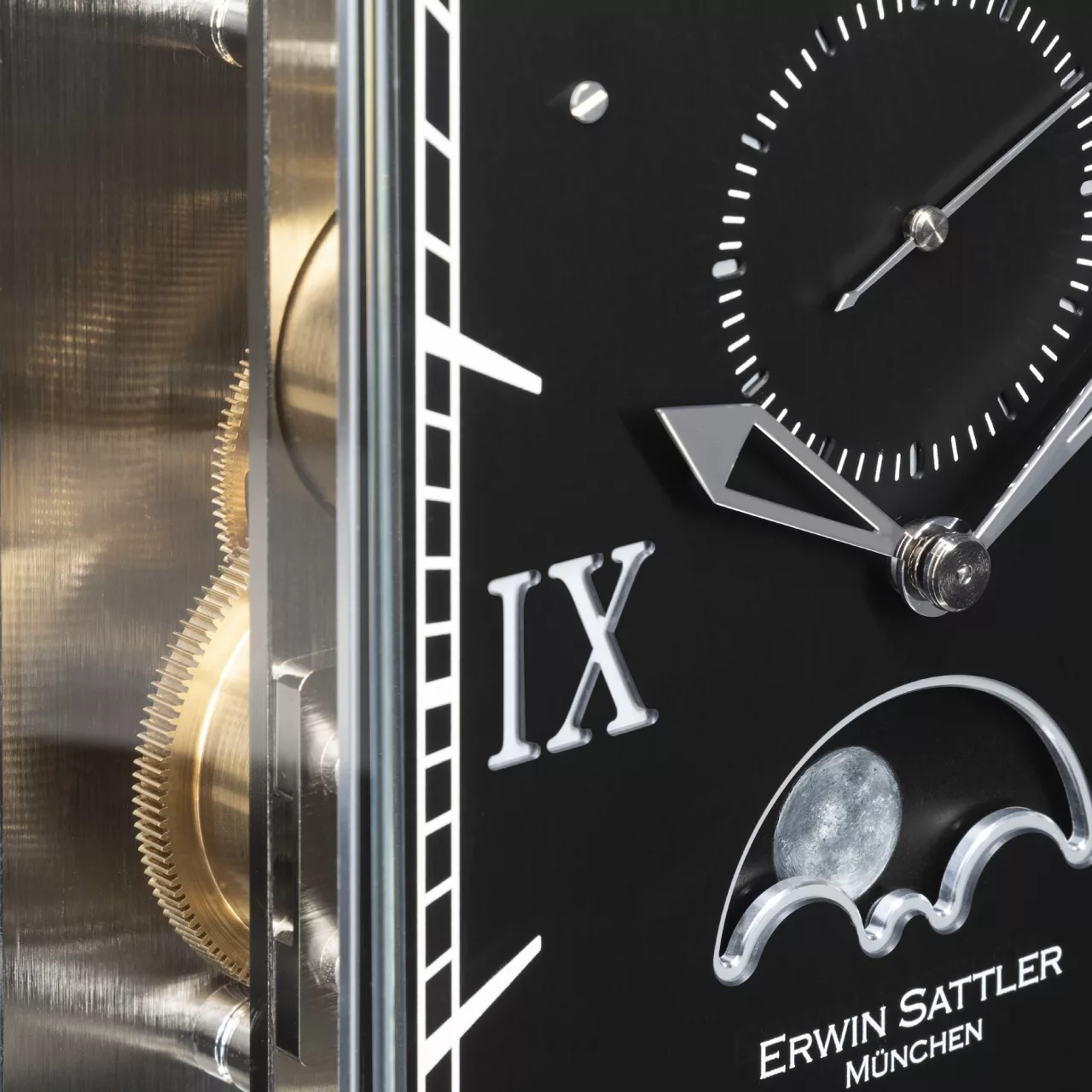
Under the Glass: Sattler Calibre 2004
At the heart of the Lunaris II is the Sattler Calibre 2004, an 8-day movement that prioritises stability and long-term daily practicality. Eight-day duration suits a table clock perfectly: it invites interaction through winding, but does not demand constant attention. It also reinforces that this is a mechanical object meant to be maintained like a precision instrument, not treated as an appliance.
The technical architecture includes a tension spring with force compensation through position, as well as a Swiss escapement with a screw balance. The movement runs at 18,000 vibrations per hour (300 per minute), which sits in a traditional, mechanically expressive range for clocks of this character. Supporting the train are 12 precision ball bearings and 11 rubies, practical choices that contribute to longevity, efficiency, and consistent performance over time. In other words, the movement spec reads like a maker that expects its work to be serviced and enjoyed far into the future.
Rear Controls: A Clean Dial and a Practical Ritual
One of the most satisfying aspects of the Lunaris II is the way it handles interaction. Winding, time setting, moon phase adjustment, and regulation are all clearly arranged on the back. This does two things at once. First, it protects the dial from visual clutter, leaving the front as a pure expression of the moon theme and layered architecture. Second, it creates a practical, almost ritualised way of living with the clock: the “instrument side” is on the rear, and the “display side” is on the front.
For enthusiasts, this matters because it separates appreciation from operation. The dial remains a calm focal point in a room, while the back becomes the place where the owner engages with the mechanics. It is a thoughtful division, and it reinforces the idea that the Lunaris II is not only a beautiful object, but also a tool that invites hands-on ownership.
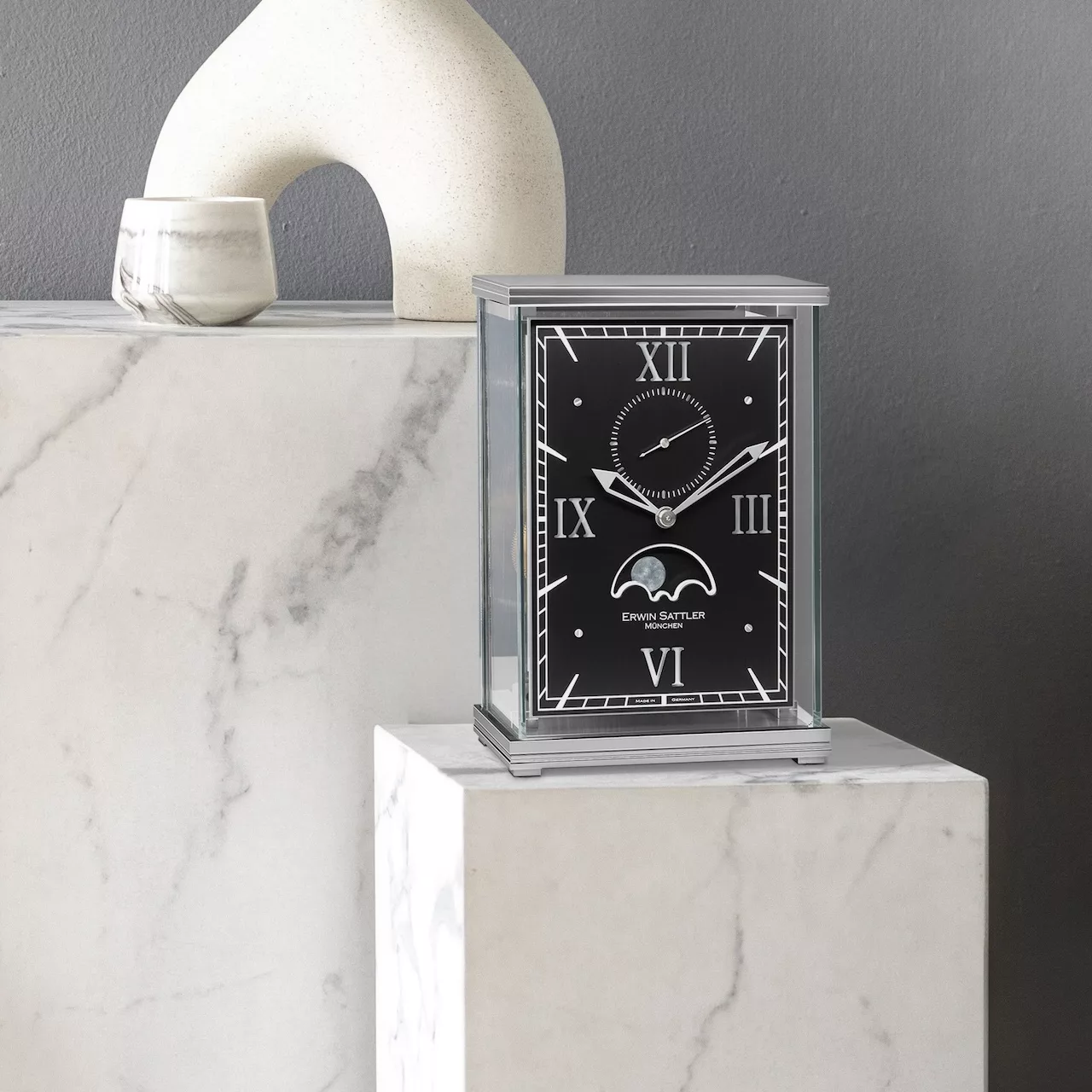
Why the Lunaris II Makes Sense for Collectors
The Lunaris II is best understood as a collector’s table clock, not simply a luxury desk accessory. It will appeal to people who are already drawn to independent makers, particularly those who appreciate German discipline in finishing and engineering. It is also a natural fit for watch enthusiasts who want something mechanical in their space that is not another wristwatch, but still scratches the same itch: precision, craft, and a story told through materials.
The “moon” inspiration is handled with restraint, which makes it more timeless. The passing strike adds personality without turning the piece into a novelty. The new brushed stainless steel top and base bring a more modern, confident stance to the design, while the milled dial construction and hand-painted moon disc keep the human element present. In a market where many high-end objects can feel either overly minimal or overly decorative, the Lunaris II feels balanced, considered, and quietly distinctive.
Conclusion
The Erwin Sattler Lunaris II is a refined continuation of an already distinctive concept. It keeps the signature frameless glass architecture and the moon-led identity, but strengthens the execution with a two-piece dial featuring milled Roman numerals, newly designed brushed stainless steel elements with a crisp decorative groove, and updated hands that improve clarity without adding weight. The passing strike gives the clock an acoustic heartbeat, chiming each full hour with a delicate bell tone that feels more comforting than performative.
For collectors and enthusiasts, the appeal is simple: the Lunaris II behaves like a serious mechanical instrument while presenting as a modern sculptural object. It is familiar in character, but refined in the places that matter, and that combination is often the clearest sign of a maker that understands longevity, not just novelty.