The Armin Strom Dual Time GMT Resonance Aventurine is the kind of watch that reminds collectors why independent watchmaking continues to matter. It is not simply rare because it is limited to 15 pieces, although that certainly places it in a very exclusive category. Its importance comes from the way it brings together several demanding ideas at once: resonance, dual time functionality, an open-worked in-house movement, high-level finishing and a dial material that changes the emotional character of the whole piece.
Aventurine has a particular presence in watchmaking. It can be dramatic if used too heavily, restrained if framed with care, and quietly hypnotic when paired with the right mechanical architecture. In this new Dual Time GMT Resonance, Armin Strom uses aventurine not as decoration for decoration’s sake, but as a visual counterpoint to the mechanical structure beneath it. The dial evokes a star-filled sky, yet the watch remains precise, architectural and balanced. That contrast is central to its appeal.
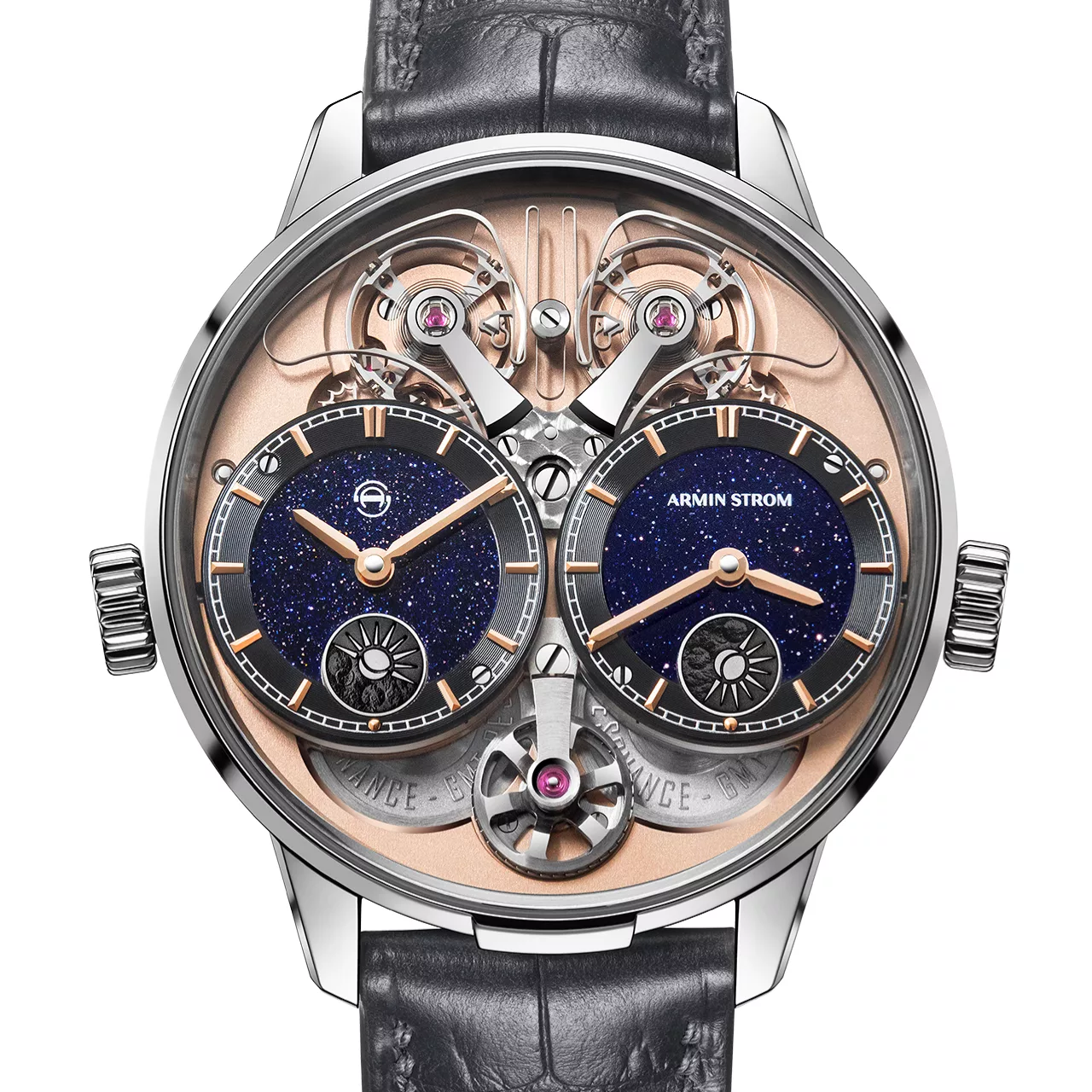
For a brand such as Armin Strom, this matters. The manufacture has built its modern reputation around visible mechanics, technical experimentation and what it calls the Science of Movement. The Dual Time GMT Resonance Aventurine continues that direction, but with a softer and more celestial face. It still feels unmistakably technical, yet the aventurine gives the watch a more contemplative quality. It is a watch about time zones, synchronisation and mechanical physics, but it also has the quiet romance of looking into the night sky.
Aventurine and the Language of Contrast
The defining visual feature of this release is, of course, the aventurine dial. Aventurine is made through a process that blends traditional glassmaking with precise control, resulting in a surface scattered with shimmering inclusions. On a dial, this creates a sense of depth that is difficult to replicate with conventional finishing. It is not a flat blue or black surface. It has movement, reflection and irregularity, which gives each glance a slightly different character.
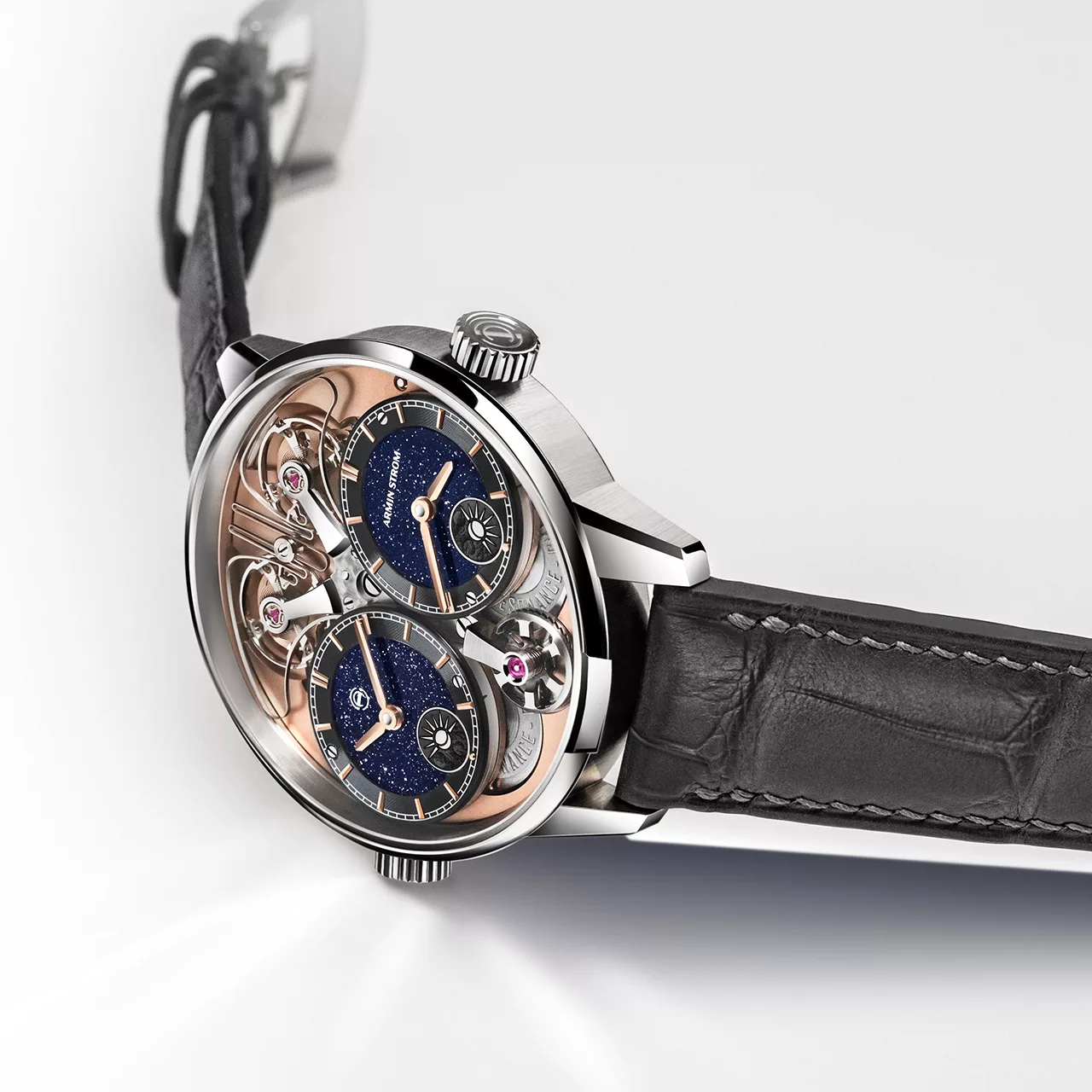
In the Dual Time GMT Resonance Aventurine, that star-like dial sits against a warm rose gold-coloured mainplate. This combination is particularly effective because it avoids the coldness that can sometimes accompany heavily technical open-worked watches. The cool luminosity of the aventurine is balanced by the warmth of the movement architecture. The rose gold-coloured hands and applied indexes then carry that warmth into the time displays, helping the whole design feel integrated rather than divided into separate visual zones.
The black azurage chapter rings add another layer of contrast. They give each time display definition and legibility while also reinforcing the symmetrical design of the watch. On paper, a dual time resonance watch could easily become visually complicated. Here, Armin Strom has kept the displays structured and readable. The aventurine gives the eye something poetic to settle into, while the chapter rings and polished indexes keep the practical side of the watch clear.
The Practical Intelligence of Dual Time
Dual time watches often sit in a useful middle ground between daily practicality and mechanical charm. They are especially appealing because they connect directly to how people live. A collector may use one time zone for home and another for travel, family, business or a favourite city across the world. In this Armin Strom, the dual time function is not treated as an afterthought. Each time zone has its own hours, minutes and day/night indicator, making the layout intuitive and mechanically complete.
This independent arrangement gives the watch a strong sense of purpose. It does not simply add a second hand or a small subsidiary indication. Instead, it presents two complete time displays, each with its own identity. That is part of what makes the watch feel so architecturally satisfying. The two sides speak to each other visually and mechanically, reflecting the underlying idea of resonance itself.
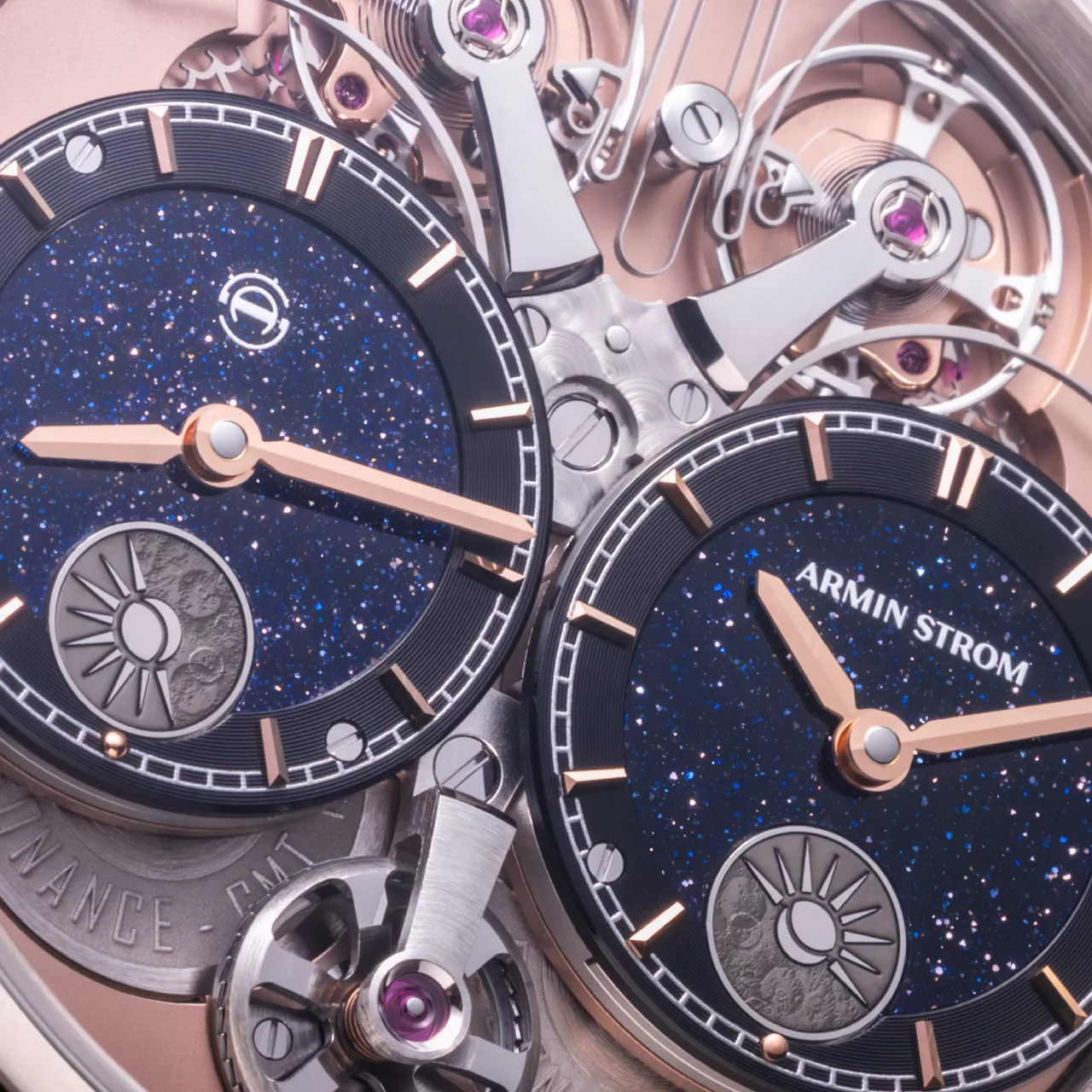
The day/night indicators are also important. In a dual time watch, knowing whether the second time zone is in daylight or night hours adds practical value. It keeps the complication grounded in real use, particularly for those who travel internationally or communicate regularly across time zones. Yet even these indicators are handled with refinement, using polished and blackened steel discs that contribute to the watch’s layered finishing.
The Calibre ARF22 and the Science of Resonance
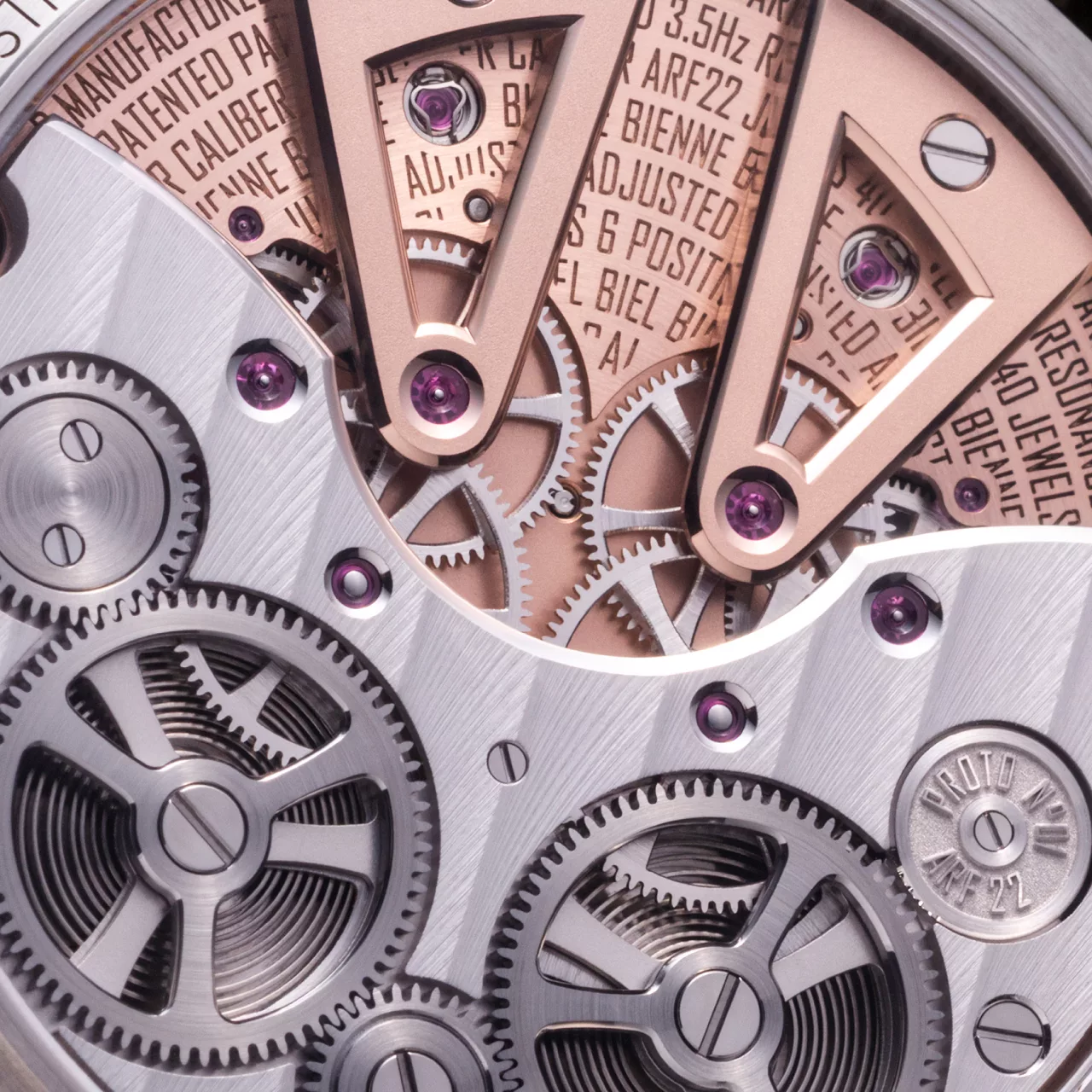
The calibre ARF22 is the heart of this watch, and it is where the piece moves from visually beautiful to genuinely significant. This manual-winding manufacture movement is designed, developed and produced in-house by Armin Strom. It contains 231 components, 40 jewels and operates at 3.5 Hz, or 25,200 vibrations per hour. It offers a 42-hour power reserve and measures 34.15 mm by 4.92 mm, which is impressively slim given the complexity of the mechanism.
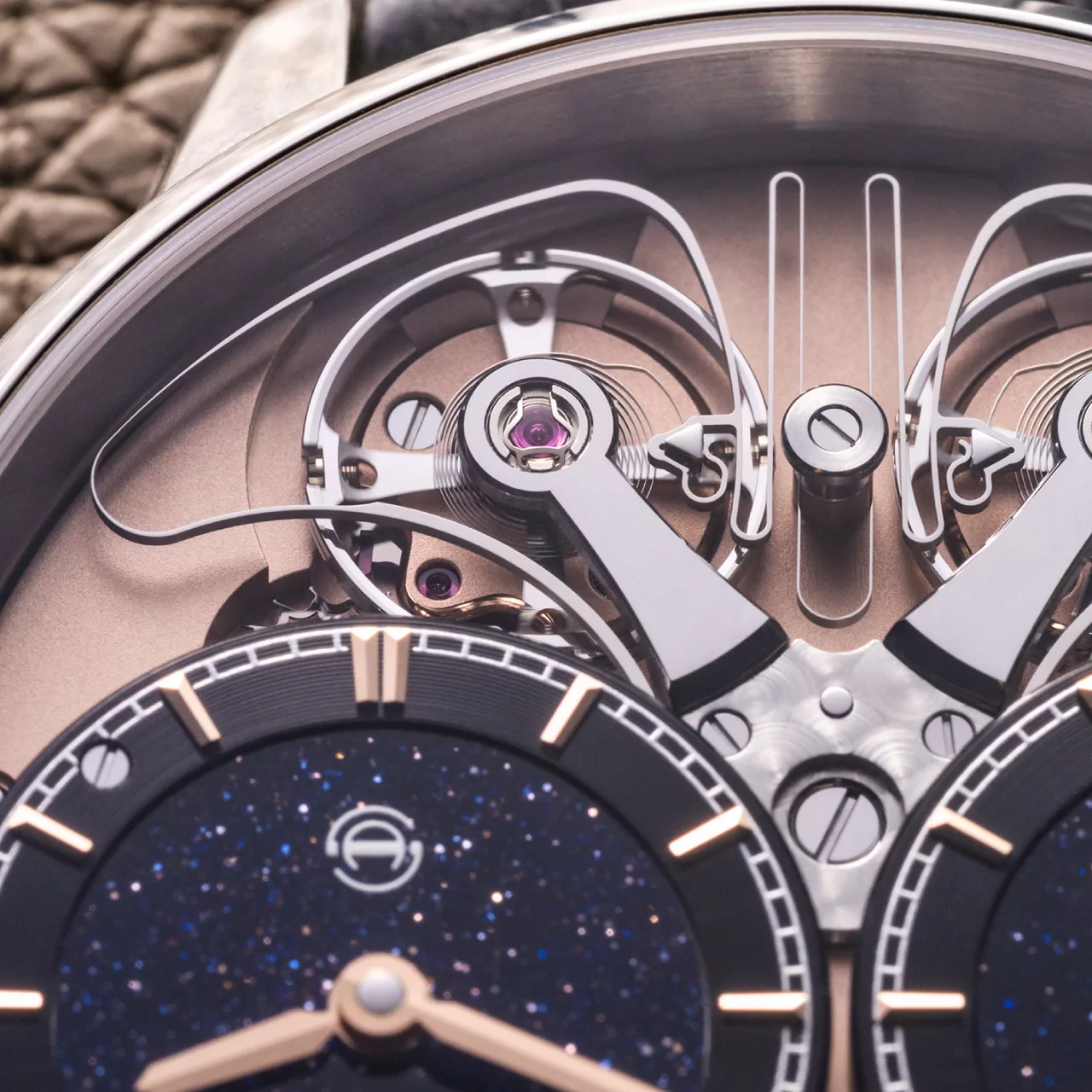
The most important feature is Armin Strom’s patented resonance clutch. Resonance in watchmaking refers to the phenomenon where two oscillating systems influence each other and eventually synchronise. It is an idea that has fascinated watchmakers for centuries because it offers the possibility of improved chronometric stability. The difficulty is not in describing the phenomenon, but in controlling it reliably inside a wristwatch.
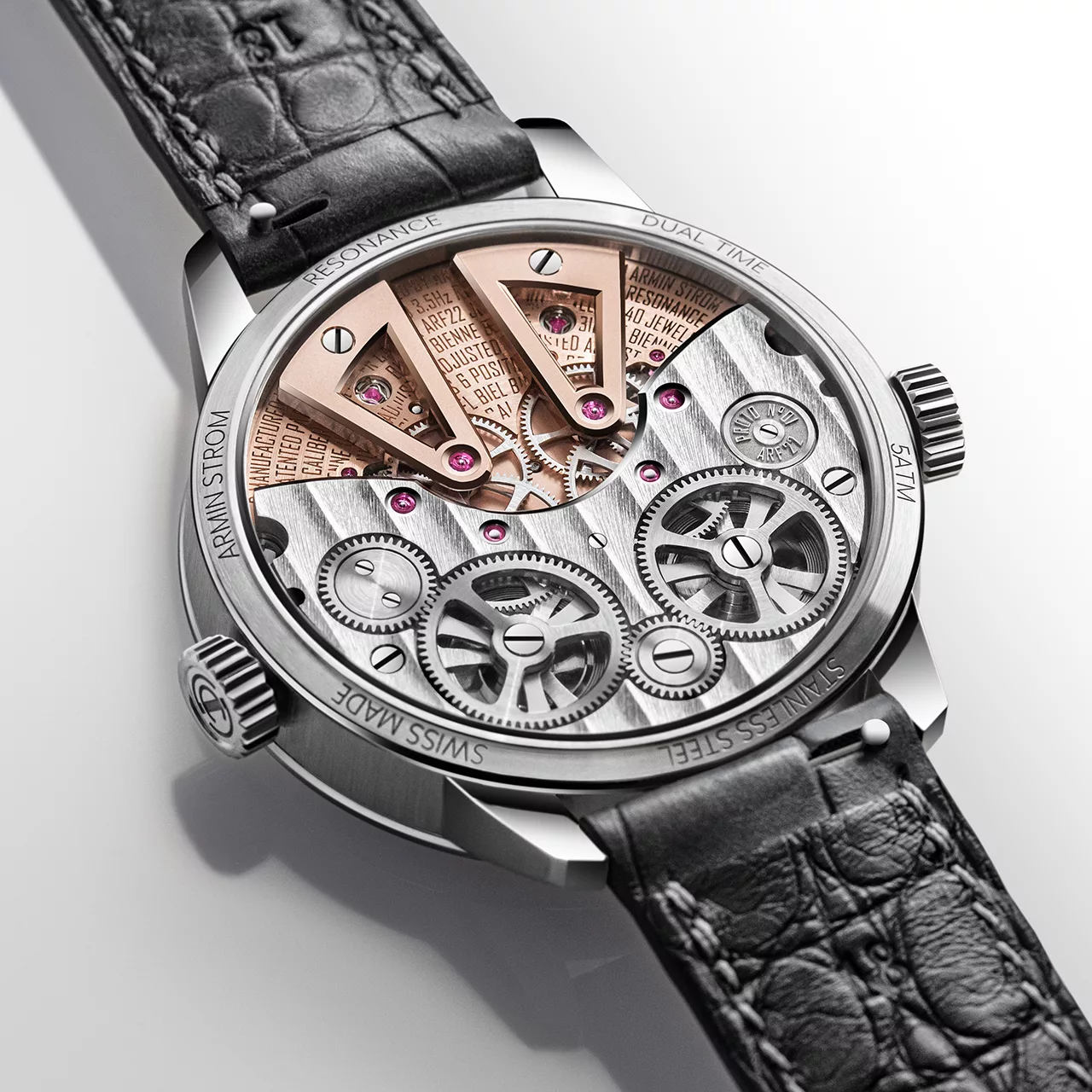
Armin Strom’s solution uses two independent regulating systems connected by the resonance clutch. The purpose of this system is to allow both balance wheels to oscillate in harmony, improving stability through constant interaction. This is not a decorative complication. It is mechanical science expressed through traditional watchmaking, and it sits at the centre of what makes this model so compelling.
There is also something visually satisfying about seeing two regulating systems at work. Many watches invite appreciation through finishing, complication or rarity. This one adds another dimension by making synchronisation itself part of the spectacle. The wearer is not only looking at a movement. The wearer is looking at two mechanical hearts finding harmony.
Finishing With Depth and Purpose
A watch of this level depends on finishing. Technical ambition alone is not enough, especially in the world of high-end independent horology. The Dual Time GMT Resonance Aventurine carries the expected Armin Strom attention to detail, with finishing that supports both the movement architecture and the overall colour palette of the watch.
On the dial side, the rose gold-coloured mainplate gives warmth and depth beneath the aventurine and time displays. The mirror-polished balance bridge is one of the most striking elements, catching the light against the surrounding structure. Its hand-bevelled edges reinforce the sense that this is not merely machine-made complexity, but hand-finished mechanical craft.
Rhodium-coated and steel components introduce cooler metallic tones, while black-polished elements create sharp points of contrast. Circular graining and perlage enrich the visual texture, particularly when the watch is viewed at close range. On the reverse side, the movement continues the same level of care, with rose gold-coloured gear-train bridges and Côtes de Genève adding refinement and continuity.
One of the more important details in Armin Strom’s process is that each watch is assembled twice. This is a demanding approach, but it speaks to the brand’s commitment to both performance and presentation. The first assembly allows the movement to be checked and adjusted, while the second ensures the final piece meets the expected standard of cleanliness, finishing and mechanical reliability. For a watch built around resonance, that discipline feels especially appropriate.
The Case and Wearability
Although the movement is complex and the concept is ambitious, the case dimensions are surprisingly restrained. The stainless steel case measures 39 mm in diameter, 9.05 mm in height and 44.50 mm lug-to-lug. These proportions give the watch a refined presence rather than an oversized technical footprint. It is a serious high horology piece, yet it remains wearable in a way that many complicated watches are not.
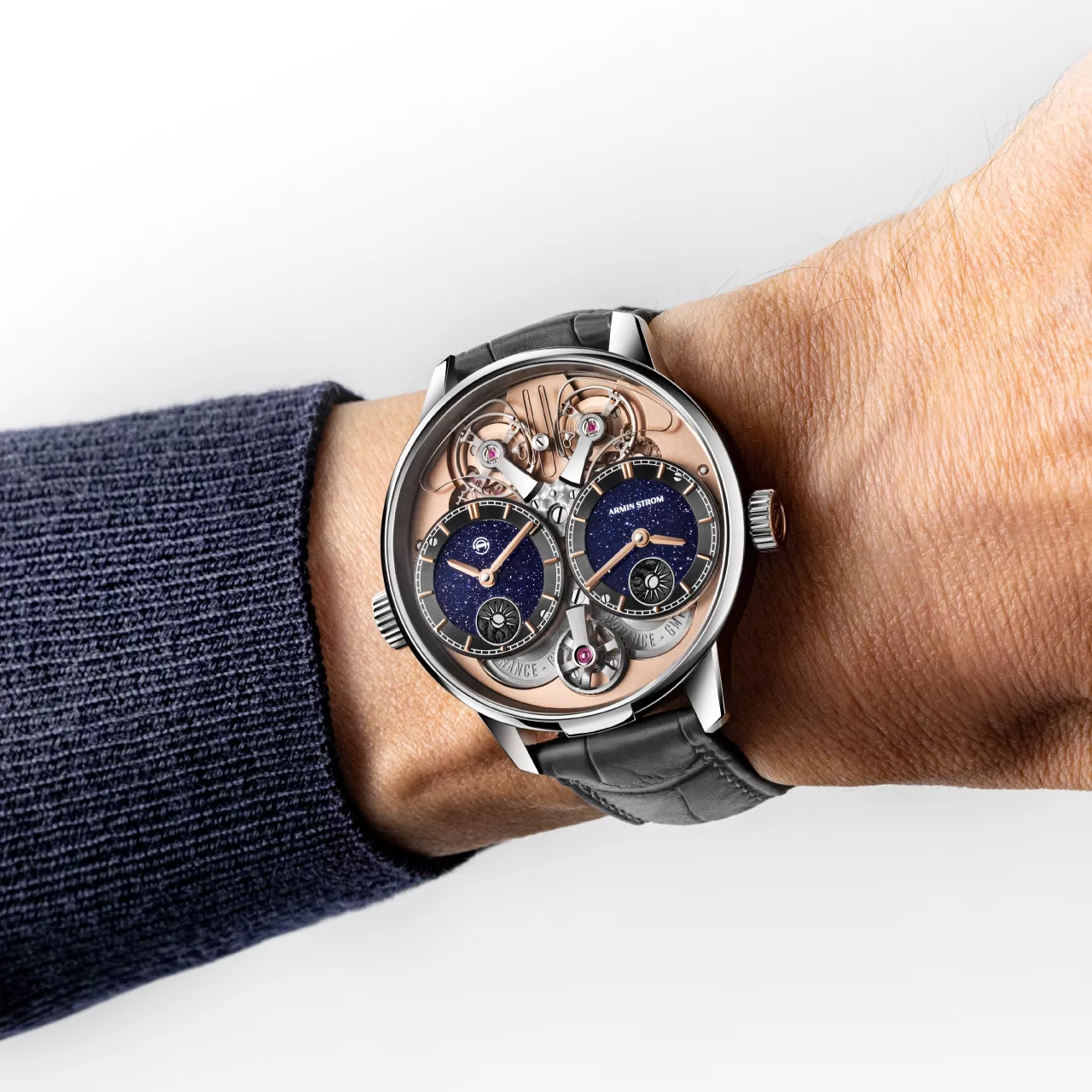
The use of stainless steel also suits the character of the watch. A precious metal case may have pushed the design further into opulence, but steel gives the Aventurine edition a more contemporary and focused frame. It allows the dial and movement to carry the emotional and technical weight. The case is not competing for attention. It is holding the composition together.
The sapphire crystal and sapphire case back, both treated with anti-reflective coating, are essential to the experience. This is a watch that needs to be viewed from both sides. The front offers the relationship between aventurine, dual time displays and resonance architecture. The back reveals the finishing, gear-train bridges and further evidence of the calibre’s construction. The 5 ATM water resistance is appropriate for a refined mechanical watch of this kind, while the matte grey alligator strap with grey stitching adds a calm, elegant finish.
A Watch for Collectors Who Value Ideas
The Armin Strom Dual Time GMT Resonance Aventurine will naturally appeal to collectors who appreciate rarity, but its stronger appeal lies in the ideas it brings together. Aventurine dials are admired for their beauty. Dual time watches are valued for their usefulness. Resonance movements are respected for their technical ambition. Open-worked independent watchmaking is loved for its honesty and mechanical transparency. This watch does not rely on one of those strengths. It combines all of them.
That combination gives the piece its unusual character. It can be appreciated as a travel watch, but it is far more specialised than a typical GMT. It can be admired as a decorative aventurine watch, but it has far greater mechanical depth. It can be studied as a resonance watch, yet its visual design gives it warmth and poetry. It is both intellectually engaging and visually atmospheric.
For Define Watches, a release like this sits firmly within the world of independent watchmaking at its most rewarding. It is not made to follow mainstream design habits. It is not a watch that needs mass-market recognition to justify its importance. Its value is found in the details: the synchronised regulating systems, the dual time architecture, the finishing, the restraint of the case and the celestial quality of the dial.
Final Thoughts
The Armin Strom Dual Time GMT Resonance Aventurine is a rare and deeply considered release. It has the mechanical seriousness expected from Armin Strom, but the aventurine dial gives it a different emotional register. There is still the precision, openness and technical intensity that define the brand, yet the watch feels more poetic than industrial, more contemplative than purely analytical.
Limited to only 15 pieces, it is likely to speak to a very specific collector. This is someone who values independent manufacture, mechanical experimentation and design with genuine purpose. It is also for the enthusiast who enjoys a watch that can be understood in layers. At first glance, the aventurine captures attention. With more time, the dual time layout reveals its practicality. Look deeper, and the resonance system becomes the true centre of gravity.
In that sense, the Dual Time GMT Resonance Aventurine is not just a new dial variation. It is a meaningful reinterpretation of one of Armin Strom’s most fascinating concepts. It brings the night sky into conversation with mechanical synchrony, balancing beauty and science in a way few watches can. For collectors of rare independent watchmaking, it is a compelling reminder that the most interesting watches are often those that make time feel both measurable and mysterious.