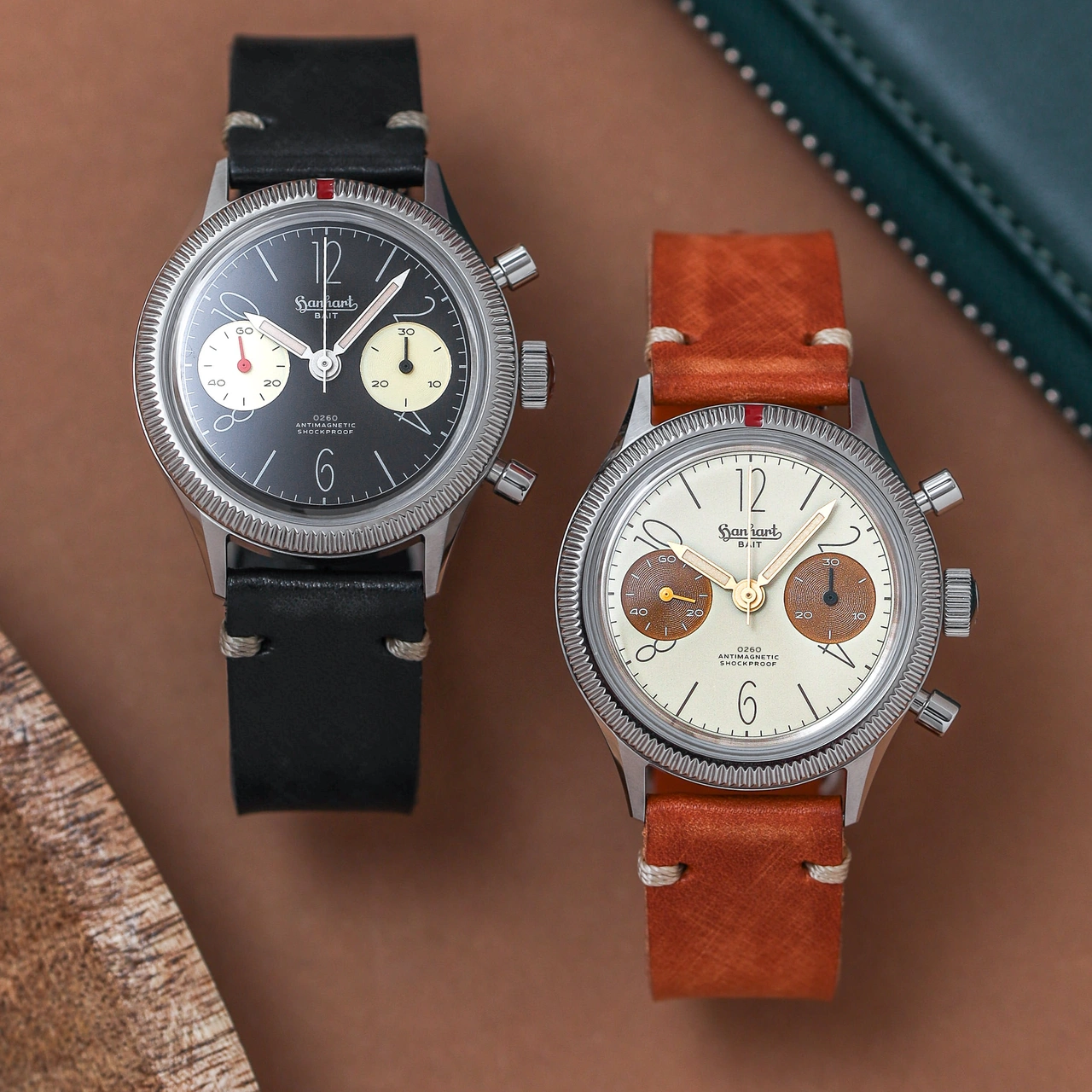
Black dials, white numerals and stainless steel cases have dominated the design of pilot’s chronographs for decades, and for perfectly good reason. Legibility was once a professional necessity rather than a design preference. So what happens when a manufacturer with genuine aviation credentials starts playing with cream, copper-coloured bronze and warmer vintage tones? In Hanhart’s case, the result is a rather intriguing chronograph called the 417 C Panna Flyback.
Produced in collaboration with Rob Nudds and Alon Ben Joseph of The Real Time Show podcast, the Panna is limited to 100 pieces. It is arguably one of the more visually interesting interpretations of the 417 in recent years, largely because it ventures outside the aesthetic boundaries normally associated with Hanhart. There is almost a Mediterranean warmth to this decidedly German chronograph, yet underneath the unusual colour scheme lies the same purposeful mechanical watch that has earned the 417 such a loyal following.
Part of the fascination with Hanhart is that its historical credibility requires very little embellishment. The original 417 belongs to an era when a chronograph was purchased for what it could do, rather than what it represented. Its design was straightforward, its controls were functional and its proportions were dictated by practical requirements. The fact that those same characteristics are now considered desirable among collectors says a great deal about the enduring quality of the original design.
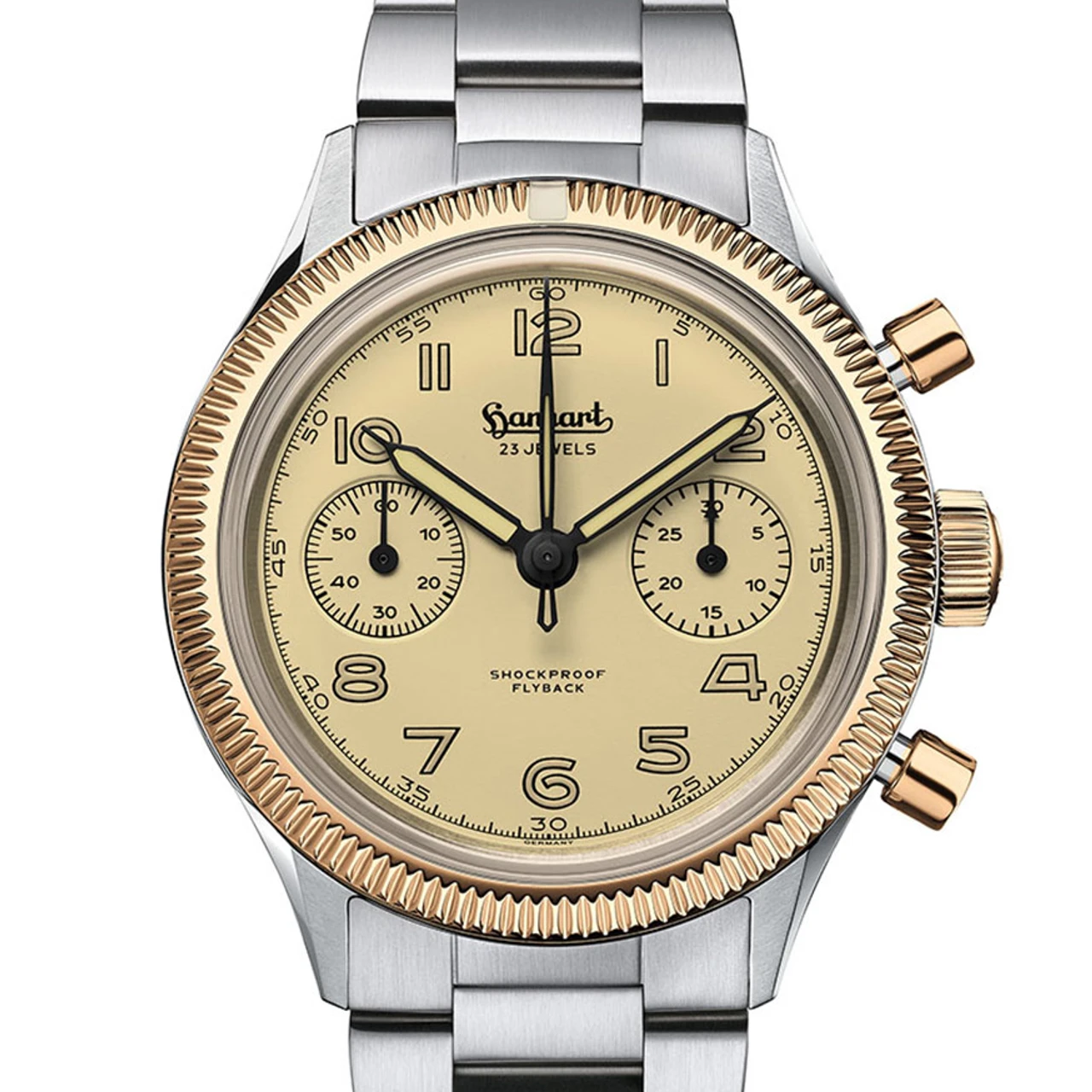
Hanhart has been particularly sensible in its modern interpretation of the 417. Rather than continually adding complications or increasing the size of the case, the company has recognised that much of the watch’s appeal lies in preserving its original architecture. The Panna retains the 39 mm diameter of its 1950s predecessor, along with the fluted rotating bezel, symmetrical pushers and familiar two-register dial.
What has changed is the atmosphere of the watch. Where the traditional black-dial 417 looks ready for the cockpit, the Panna feels equally at home alongside a collection of vintage sporting chronographs. It is less overtly military in appearance, without losing the functional qualities that made the original so successful.
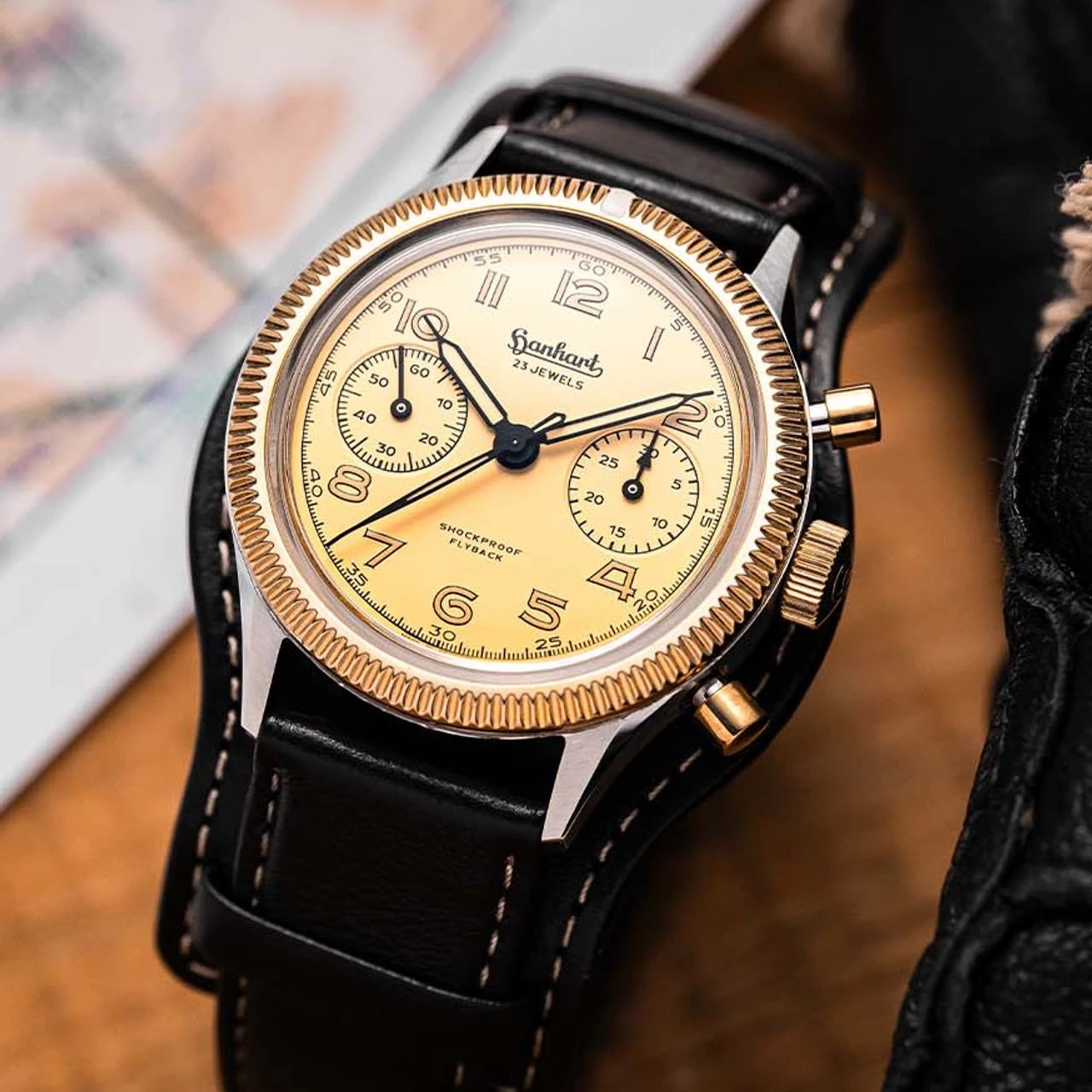
The name Panna, Italian for cream, is an appropriate choice for a watch whose personality is so heavily influenced by its dial. The C stands for Copperhead, referring to the bronze components that distinguish it from the regular stainless steel 417 ES models.
What is particularly interesting about the colour scheme is the relationship between the different materials. A cream dial in an entirely stainless steel case would have made for an attractive vintage-inspired chronograph, but the addition of aluminium bronze gives the design considerably more depth. The fluted bezel forms a warm metallic frame around the dial, while the bronze crown and pushers introduce an asymmetrical concentration of colour along the right-hand side of the case.
There is a temptation when working with bronze to make it the dominant feature of a watch. Hanhart has resisted that approach. The main case remains stainless steel, allowing the bronze components to provide contrast rather than overwhelm the design. It is a more restrained application of a material that can sometimes make watches look unnecessarily extravagant.
The signature red bezel marker deserves a mention, too. Against a conventional black dial and steel case, it provides a familiar flash of colour. On the Panna, surrounded by cream and bronze, it becomes part of a much warmer palette. Removing it might have produced a cleaner-looking watch, but it would also have sacrificed one of the most recognisable elements of a Hanhart chronograph.
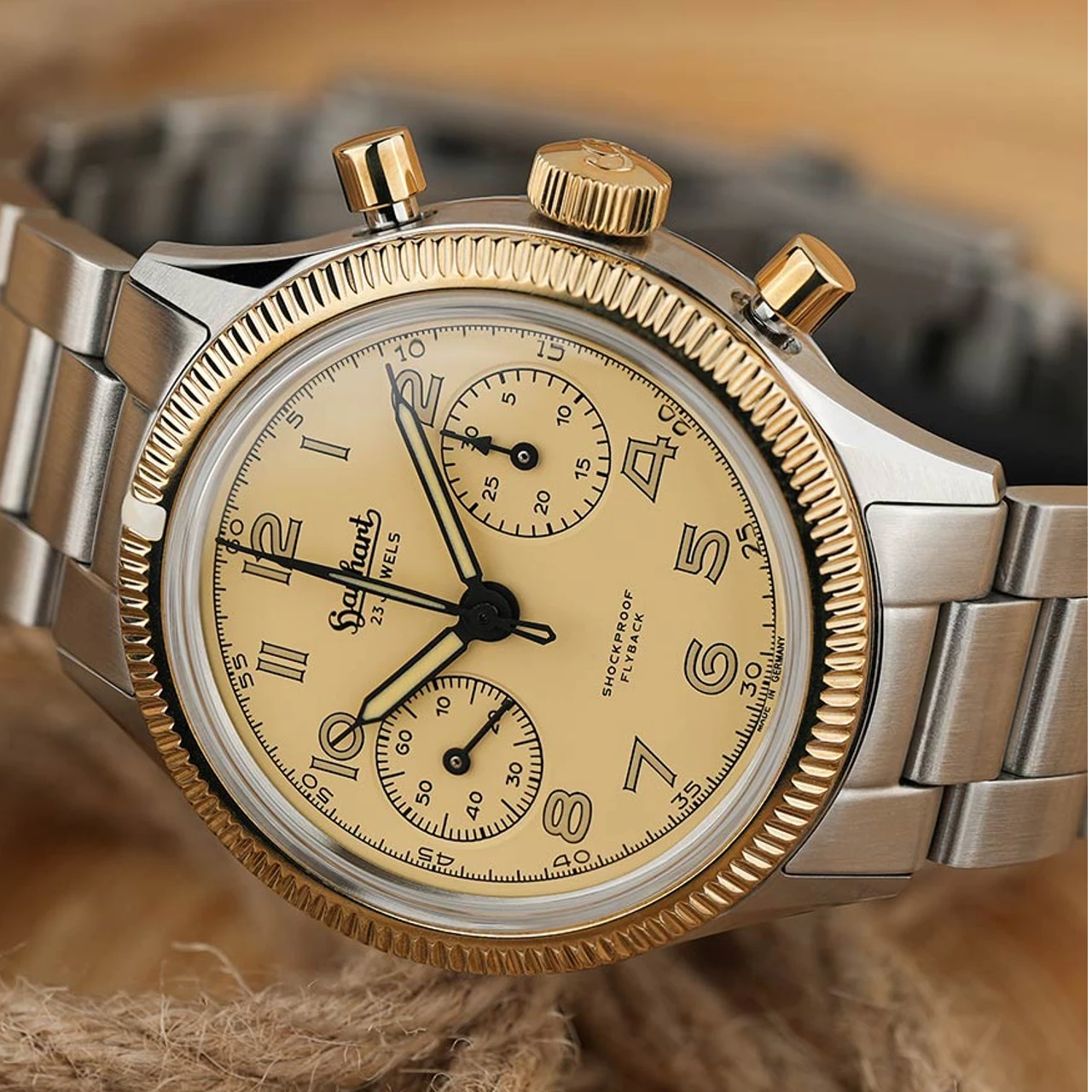
Perhaps the most entertaining aspect of the Panna is that its appearance at the time of purchase will not necessarily be its appearance five years later.
Hanhart uses aluminium bronze, specifically the alloy CuAl10Ni5Fe4, for the bezel, crown and pushers. This is a strong, corrosion-resistant material, but it still develops a natural patina through contact with oxygen, moisture and the surrounding environment. The resulting changes are influenced by how frequently the watch is worn, the climate in which it is used and how it is maintained.
For some collectors, patina is an inconvenience. For others, it is precisely the reason to own a bronze watch. The gradual darkening of the metal, variations in surface colour and subtle differences between individual components are part of its appeal. It introduces an element of unpredictability into an industry that ordinarily places considerable importance on absolute consistency.
Imagine two examples of the Panna purchased on the same day. One spends most of its time in a collection and is worn occasionally, while the other becomes a daily companion in the humid Australian climate. In time, the two watches could develop noticeably different appearances despite leaving Hanhart’s manufacture with identical finishes.
That makes the decision to produce only 100 pieces a little more interesting. Each watch is already individually numbered, but its developing patina gives it another, less formal means of identification.
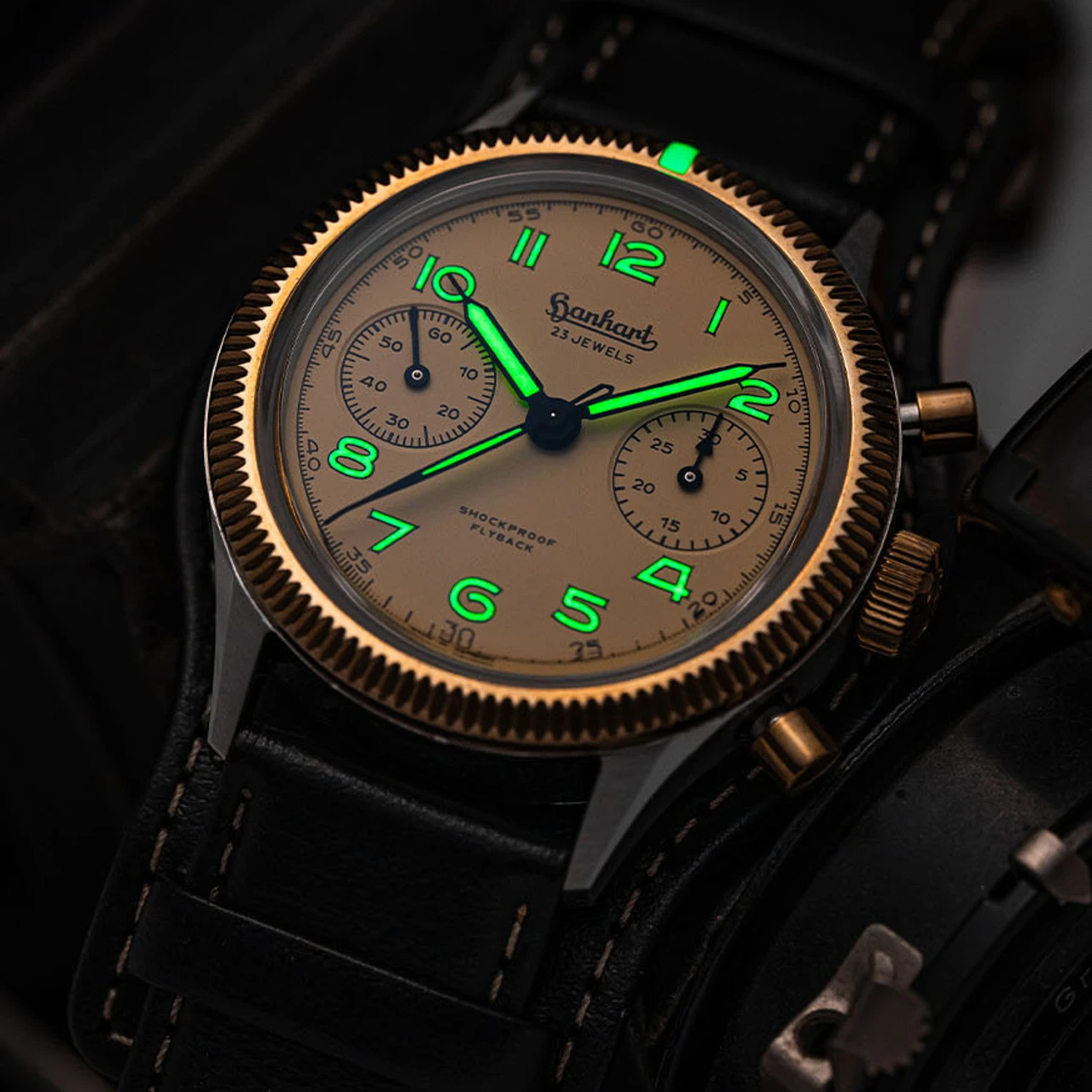
Artificially aged luminous material remains a surprisingly divisive subject among watch enthusiasts. Some appreciate the visual warmth it brings to a dial, while others would prefer manufacturers to use contemporary white luminous compounds rather than imitate the appearance of decades-old watches.
On the Panna, however, the use of Light Old Radium Super-LumiNova makes considerable aesthetic sense. Bright white numerals and hands would have interrupted the relationship between the cream dial and bronze case components. The warmer luminous material allows those elements to sit more comfortably together.
It is worth noting that Light Old Radium refers to the colour of the modern luminous compound, not the use of radioactive radium paint. The numerals, hands and rotating bezel insert all benefit from the material, maintaining the night-time functionality expected of a pilot’s chronograph.
The dial itself remains reassuringly uncomplicated. Hanhart has retained its historic logo and traditional bicompax configuration, with a running small seconds display and a 30-minute chronograph counter. There is no date aperture competing for space, no unnecessary text and no additional complication introduced purely to differentiate the limited edition. The visual interest comes from the execution of the existing design rather than the addition of new elements.
Even without the unusual exterior, the Panna would be a mechanically interesting chronograph. Its Sellita AMT5100 MB calibre is a manually wound movement with 23 jewels, a frequency of 4 Hz and a power reserve of 58 hours. More importantly, it incorporates a flyback mechanism.
For anyone unfamiliar with the complication, a standard chronograph must be stopped, reset and restarted to begin recording a new interval. A flyback chronograph allows those actions to be performed in a single operation while the chronograph is running. Pressing the appropriate pusher sends the chronograph hand back to zero and immediately begins timing again.
Its origins are closely associated with aviation, where consecutive timing operations once had genuine navigational applications. Today, the complication is unlikely to be called upon for its original purpose by most owners, but that does not diminish its mechanical appeal.
There is something wonderfully excessive about the amount of mechanical engineering required to perform an operation that a digital stopwatch handles without hesitation. The coordination of small mechanical components, the instantaneous return of the chronograph hand and the immediate resumption of timing are all reminders of why mechanical complications remain so fascinating.
Hanhart’s decision to use a sapphire exhibition caseback is therefore particularly welcome. A solid caseback might have been more historically accurate, but the opportunity to observe the manually wound movement is arguably more valuable to a modern collector. Without an automatic winding rotor obstructing the view, the movement can be appreciated more directly.
The 58-hour power reserve is also a useful improvement over the shorter running times associated with many traditional hand-wound chronographs. Manual winding still demands a degree of involvement from the owner, but that is hardly an objection for the audience Hanhart is targeting with this release.
Chronographs have a habit of growing unnecessarily large. Sometimes this is dictated by the movement, but in other cases it appears to be driven by the assumption that a sporting watch should have a substantial presence on the wrist.
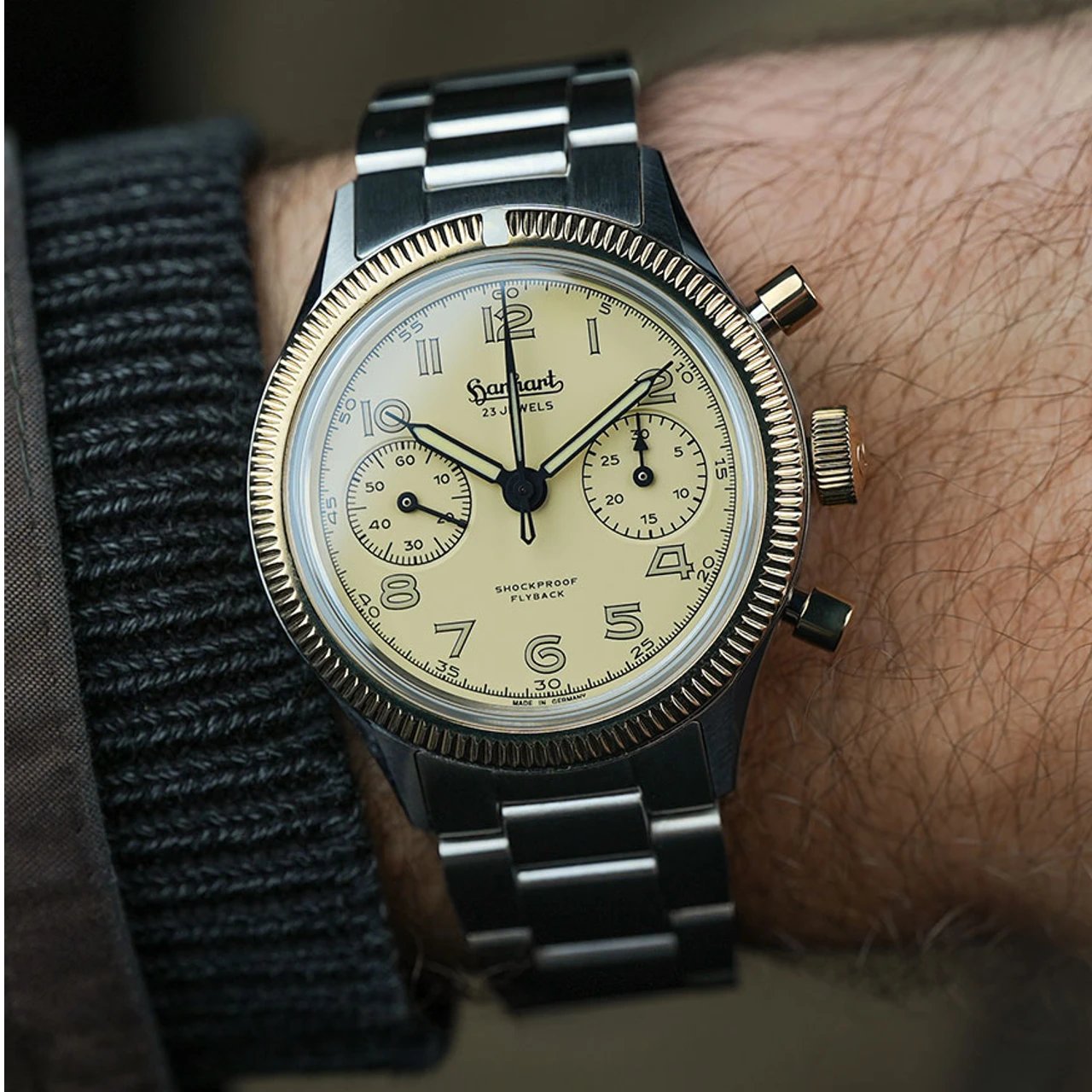
The Panna makes a strong argument for the opposite approach. Its 39 mm diameter and 46 mm lug-to-lug measurement preserve the compact footprint of the historical 417. These dimensions are particularly well suited to a design with such a prominent bezel and clearly defined dial.
At 13.3 mm thick, including the high-domed spherical crystal, it is certainly not an ultra-thin chronograph. However, the case itself measures 11.55 mm without the crystal, and the pronounced dome contributes significantly to the vintage silhouette. Flattening the crystal simply to achieve a more impressive measurement on a specification sheet would arguably have been a mistake.
Modern water resistance of 10 bar is another welcome inclusion. Vintage chronographs can require a degree of caution during everyday activities, whereas the Panna offers the reassurance of contemporary construction without sacrificing its historical appearance.
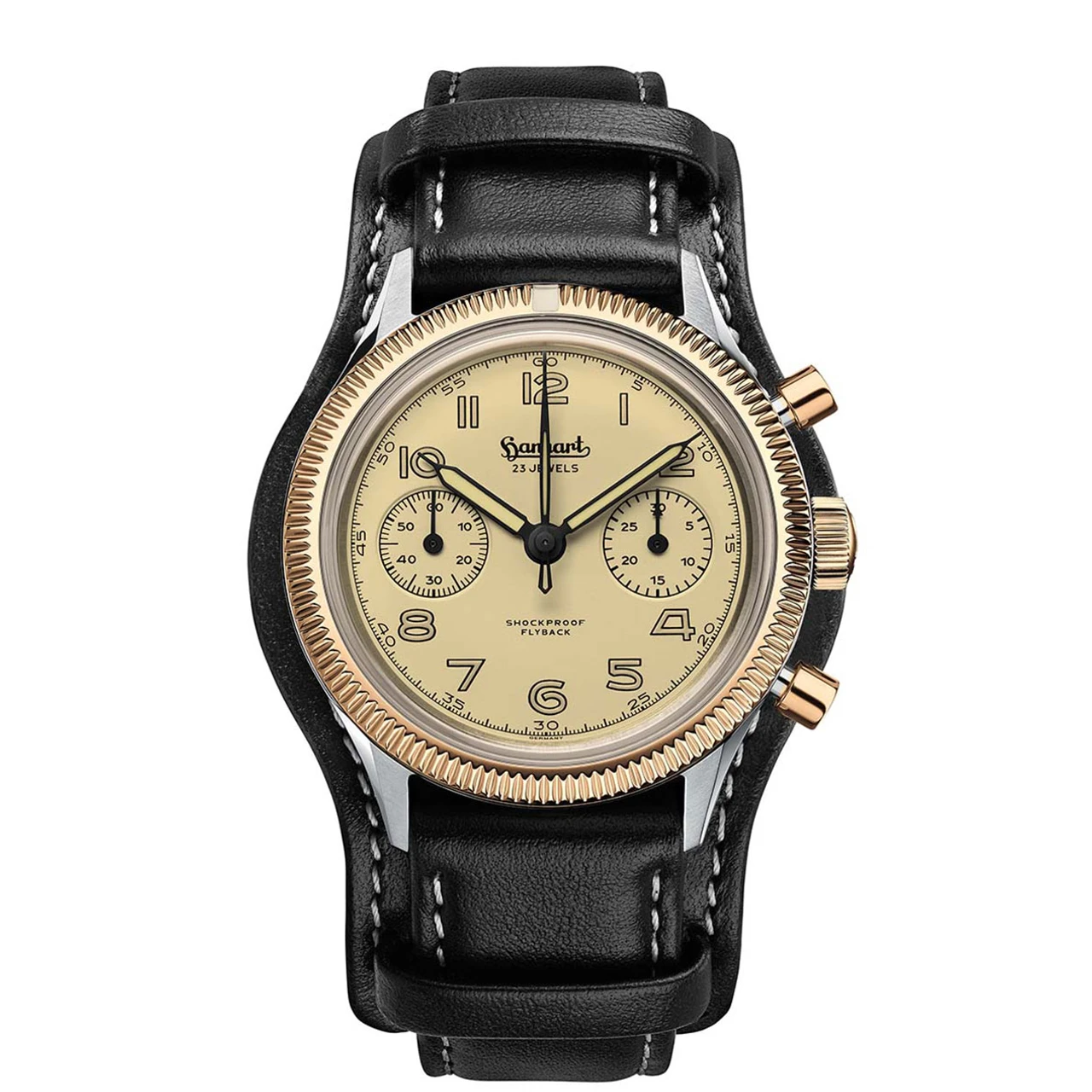
The choice between the black calfskin bund strap and stainless steel bracelet is more consequential on this particular model than it might initially appear.
The leather strap, with its contrasting white stitching and Alcantara lining, emphasises the aviation connection. It introduces a darker element beneath the cream dial and helps the bronze components stand out. The additional bund backing gives the watch a more traditional pilot’s chronograph appearance, although some wearers may prefer the less substantial profile of a conventional leather strap.
The stainless steel bracelet takes the design in another direction. It increases the presence of the cooler steel tones, making the bronze bezel and controls more visually distinct. The result is arguably less military in character and closer to a vintage-inspired sporting chronograph.
The standard 20 mm lug width also opens up plenty of possibilities. A chocolate-brown leather strap or a lightly textured tan leather strap could work particularly well as the bronze develops its patina. The Panna seems especially well suited to experimentation with different strap combinations.
The involvement of Rob Nudds and Alon Ben Joseph is interesting because the finished product appears to respect what existing Hanhart enthusiasts value about the 417. There is no oversized case, conspicuous collaborative branding or additional complication competing with the original design. The changes are concentrated on the colours and materials, leaving the fundamentals of the watch intact.
That is a sensible approach when working with a design that already has a strong identity. A successful collaborative watch does not necessarily need to satisfy every existing customer of the brand. It can afford to be a little unconventional, particularly when production is restricted to 100 pieces.
The Panna will probably divide opinion more than a conventional black-dial 417, and that is no bad thing. Some enthusiasts will always favour the historical accuracy and straightforward appearance of the standard stainless steel model. Others will appreciate seeing Hanhart take a more imaginative approach to a familiar design without abandoning its mechanical or historical foundations.
Where the Panna Fits in a Collection
For someone purchasing their first Hanhart, the traditional black-dial 417 remains an obvious starting point. It captures the essence of the original chronograph and represents much of what the brand does particularly well. The Panna, on the other hand, makes an interesting proposition for a collector looking for something outside the conventional pilot’s watch aesthetic.
It is a watch that could sit comfortably alongside vintage chronographs, contemporary German mechanical watches and other pieces from specialist manufacturers. Its restrained dimensions prevent the bronze from becoming overly conspicuous, while the flyback movement ensures there is substance behind the unusual exterior.
Independent and specialist watchmaking is at its most interesting when manufacturers have the confidence to produce something that does not need to appeal to everyone. Hanhart could easily have released another variation of the black-dial 417, but the Panna offers a more interesting conversation about materials, ageing and the interpretation of historical designs.
Of the 100 examples produced, no two are likely to age in quite the same way. That may ultimately become the most appealing aspect of this release. The cream dial, flyback mechanism and historical proportions will remain constant, but the bronze will quietly record the passage of time in its own way. For a mechanical instrument built to measure time, there is something rather fitting about that.