Armin Strom Minute Repeater Resonance 12:59 First Edition – Pushing Two Disciplines Into One System
There are very few watches where the headline complication does not fully explain what is actually going on. The Armin Strom Minute Repeater Resonance 12:59 First Edition is one of those rare cases. On paper, it combines a minute repeater with a resonance regulating system. In reality, it forces two mechanically demanding, often conflicting systems to coexist within a single architecture – and does so in a way that feels resolved rather than compromised.
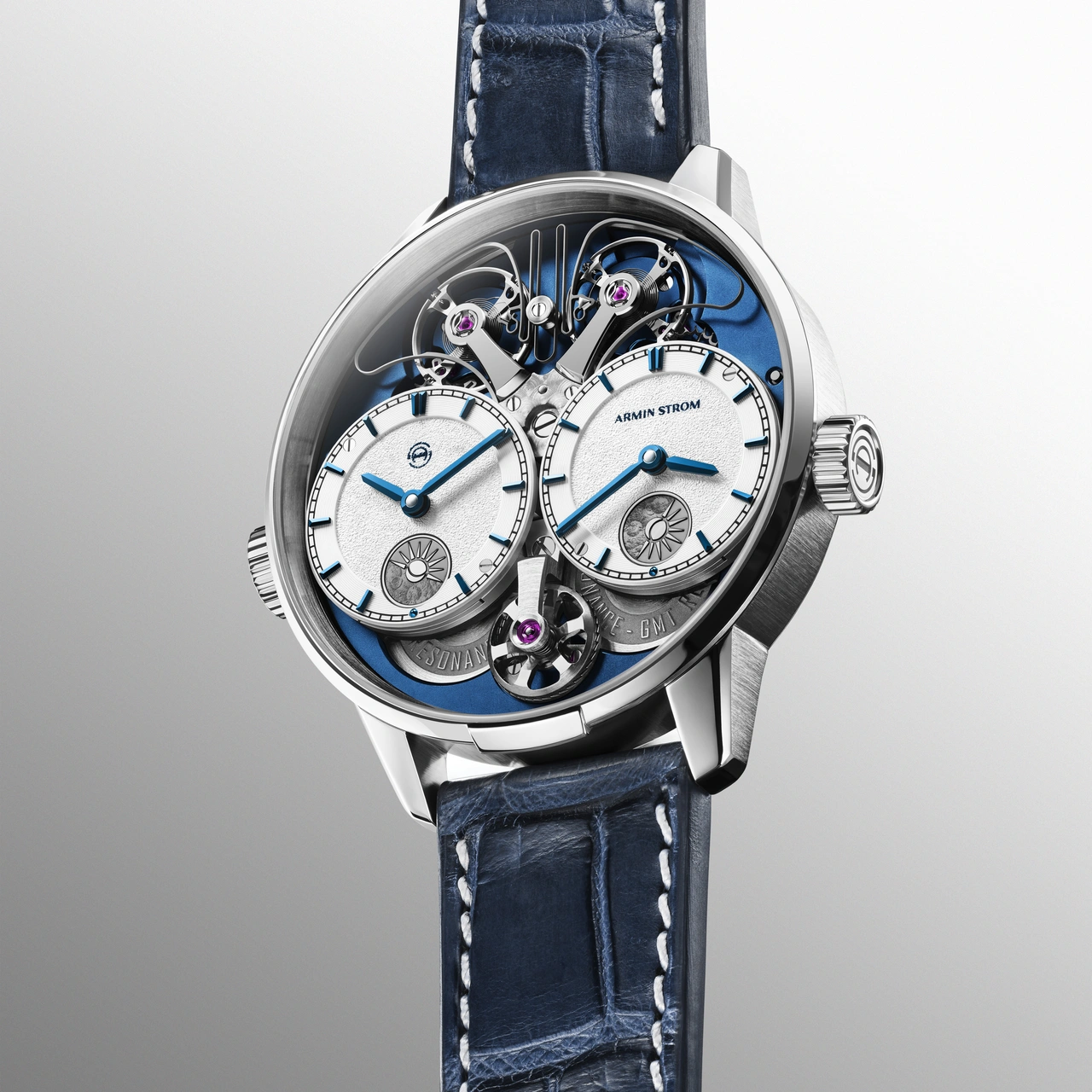
Armin Strom has spent over a decade refining resonance in a modern context. Unlike historical interpretations, which relied on proximity and chance, the brand’s patented resonance clutch actively links two balance systems, encouraging synchronisation in a controlled and repeatable way. That alone is already a complex proposition. Introducing a full Westminster minute repeater into that same movement is not just an addition of parts, but an entirely different layer of mechanical and spatial challenge.

Why This Combination Is So Difficult
Resonance thrives on stability. Two balance wheels, each with their own gear train and escapement, must oscillate in a consistent relationship. Any external disturbance can affect that equilibrium. A minute repeater, on the other hand, introduces controlled chaos – releasing stored energy through hammers striking gongs, creating vibration, acoustic resonance, and physical shock throughout the movement.
Bringing these two ideas together is not straightforward. The repeater cannot interfere with the regulating system, yet it must remain powerful enough to produce a clear and layered chime. This tension is what defines the ARR25 calibre. It is not simply a movement with two complications, but a system that has been designed from the ground up to manage both simultaneously.
The ARR25 – A Movement Built Around Balance
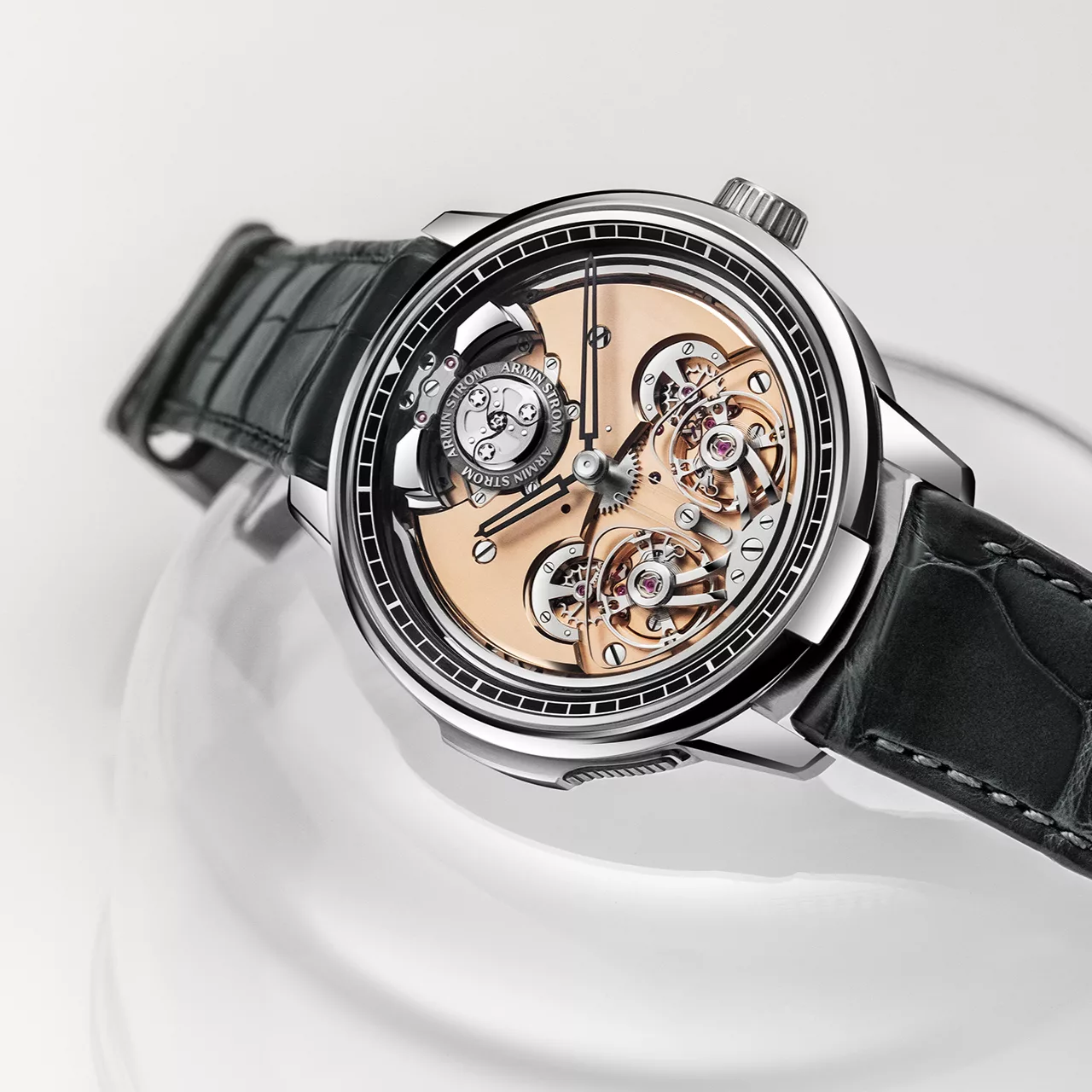
The architecture of the ARR25 makes this immediately clear. Two completely independent regulating systems sit on the dial side, each with its own barrel, gear train, escapement, and balance wheel. They are connected by Armin Strom’s resonance clutch spring, which physically links the oscillations of the two balances. Over time, these balances synchronise, reducing rate deviation and improving stability.
What is particularly interesting here is the placement and visibility of this system. The resonance clutch has been reoriented upward, making the interaction between the two balances more prominent. This is not just a visual decision. It reinforces the idea that resonance is not a hidden technical detail, but the core identity of the watch.
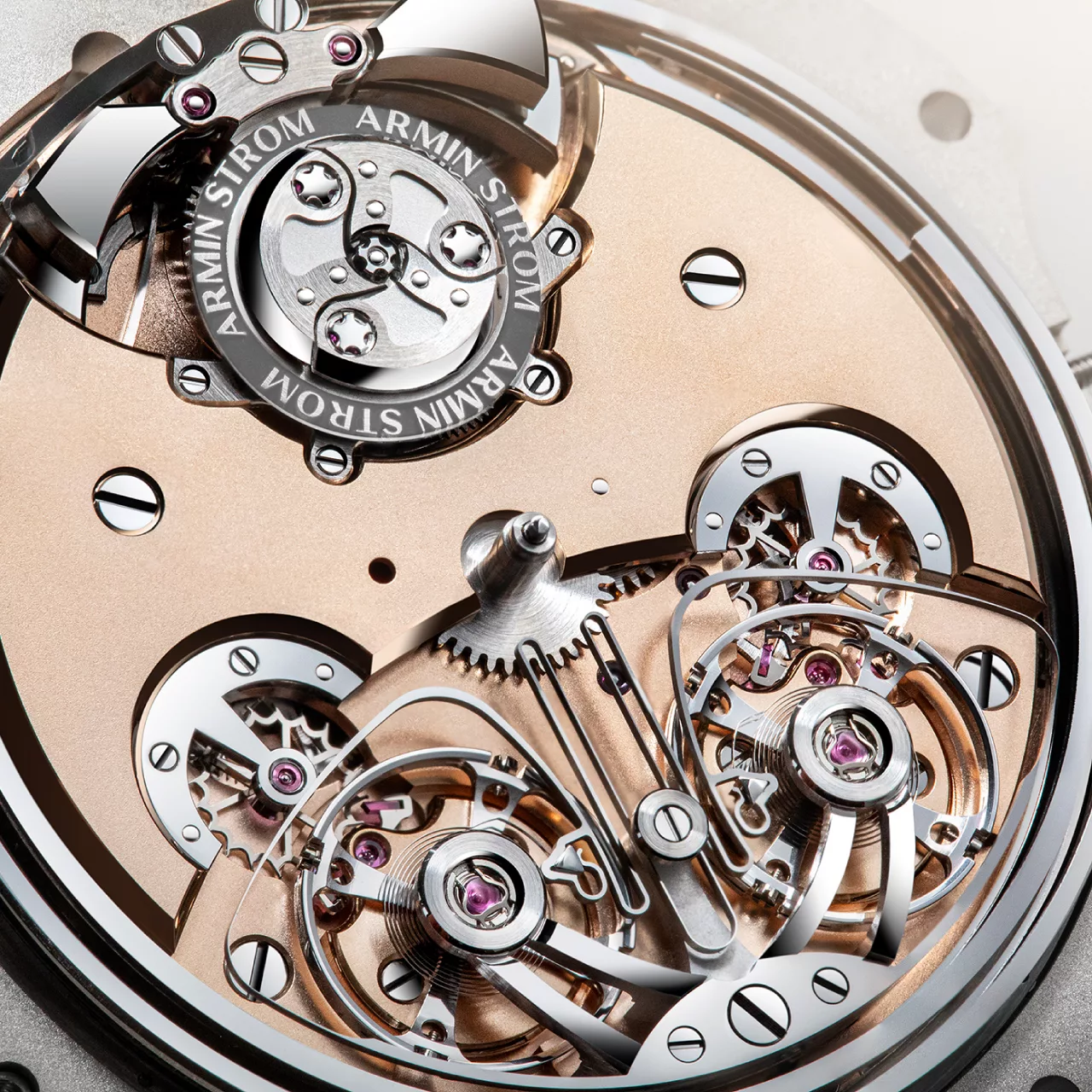
At the same time, the minute repeater system occupies significant space within the same movement. Four hammers and four gongs are arranged across the dial side, rather than hidden beneath it. This allows the wearer to see exactly how the sound is produced, from the lifting of the hammers to the release and strike.
Westminster Chime – More Than Just Sound
Most minute repeaters use two gongs to indicate hours, quarters, and minutes. The use of four hammers and four gongs allows this watch to replicate a Westminster chime sequence, which is significantly more complex. Instead of a simple indication, it produces a melodic progression, similar in structure to traditional clock towers.

This choice is not purely aesthetic. It increases the number of components, the space required within the case, and the precision needed in tuning. Each gong must be shaped, hardened, and adjusted to produce a consistent tone. The sequence must also remain clear and evenly spaced, which is where the flying governor becomes critical.
Positioned on the dial side, the flying governor regulates the speed of the chiming sequence. Its visibility is an important detail. Rather than hiding the regulation of sound, Armin Strom places it front and centre, turning it into both a functional and visual anchor during activation.
The 12:59 Function – Mechanical Theatre With Purpose
The most unusual aspect of this watch is the 12:59 striking mode. At first glance, it could be dismissed as a novelty, but it is more accurately a demonstration of mechanical capability. In this mode, the watch executes the longest possible sequence the repeater can produce – twelve hours, three quarters, and fourteen minutes.
This is not a trivial addition. It requires the repeater mechanism to operate at full capacity, delivering the maximum number of strikes in a single activation. The fact that this can be selected independently of the current time adds a layer of interaction that is rarely seen in traditional repeaters.

The switching between standard time indication and 12:59 mode is controlled via a column wheel. This is a detail often associated with chronographs, chosen here for its precision and reliability. It ensures that the transition between modes is exact, with a clear mechanical engagement rather than a simple toggle.
Case Proportions and Restraint
Given the level of mechanical density, the case dimensions are surprisingly restrained. At 42 mm in diameter and 11.70 mm in thickness, the watch avoids the bulk often associated with high-complication pieces. The use of titanium contributes to this balance, reducing weight while also influencing the acoustic properties of the case.

The design language reflects a shift toward refinement. Earlier Armin Strom pieces often emphasised technical exposure through sharper contrasts and more industrial forms. Here, the lines are softer, the composition more centred, and the overall presentation more controlled. The openworked layout remains, but it feels more deliberate, with each component given space to be understood.
Finishing – Contrast and Depth
Finishing plays a critical role in separating elements within such a complex display. The hammers, gongs, and resonance clutch are mirror-polished, allowing them to stand out against the frosted mainplate. Bridges are decorated with a mix of textures, while edges are hand-bevelled to create light transitions across surfaces.

The caseback reveals a different aesthetic, with Geneva stripes and circular graining providing a more traditional presentation. This duality between dial-side modernity and movement-side tradition is consistent with Armin Strom’s broader approach to watchmaking.
Final Thoughts
The Minute Repeater Resonance 12:59 First Edition is not a watch that exists to tick boxes of complications. It represents a deeper exploration of how different mechanical ideas can interact within a single system. Resonance and minute repeating are rarely discussed together, largely because of how difficult they are to combine.
What makes this watch compelling is not just that it achieves this combination, but that it does so with clarity. Each function is visible, understandable, and given space to operate without compromise. The addition of the 12:59 mode reinforces this idea, turning the repeater into something that can be engaged with beyond its traditional role.
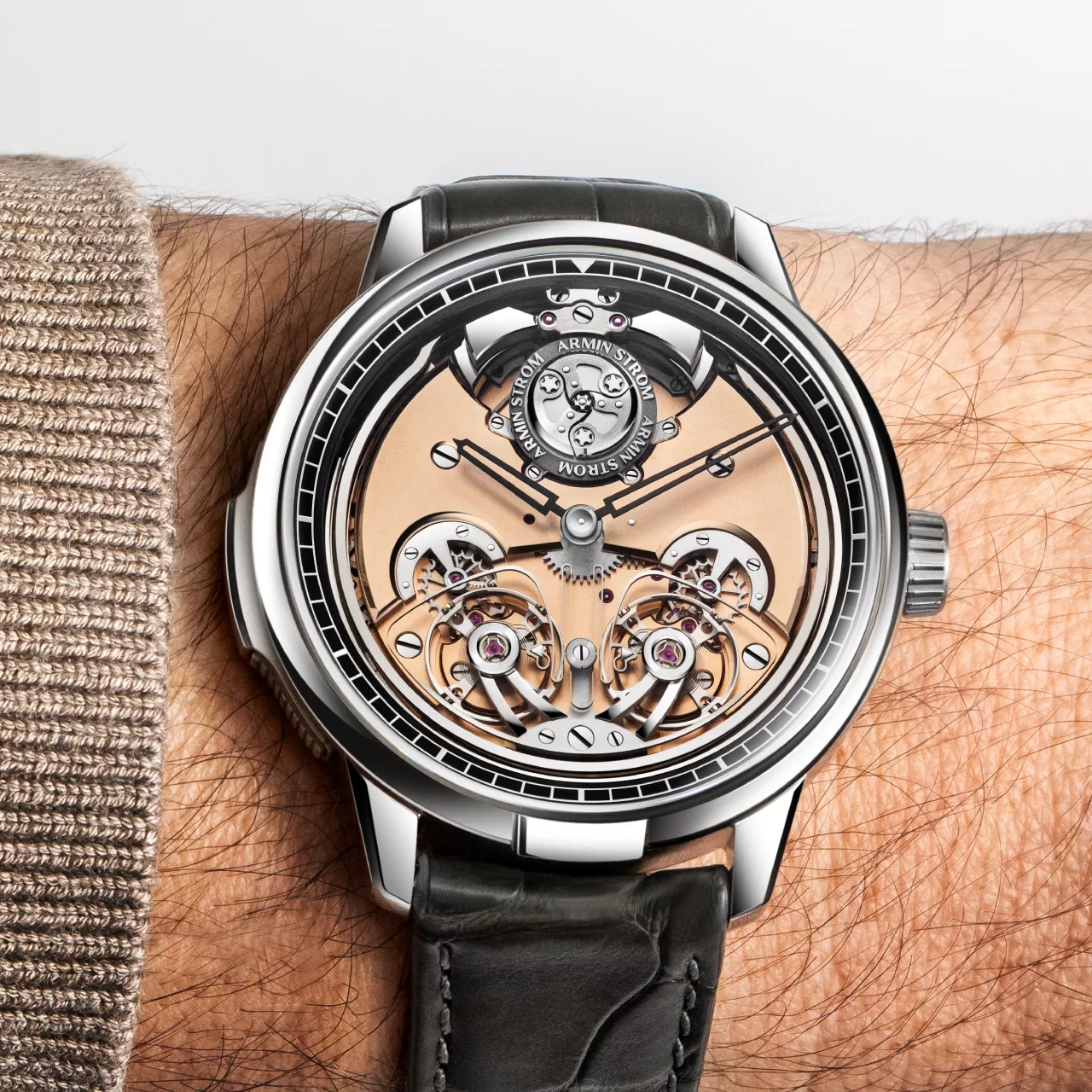
Limited to just 25 pieces, it will remain a rare object. More importantly, it stands as a reference point for what independent watchmaking can achieve when it focuses on solving problems rather than following convention.