The most interesting watches are often the ones that appear restrained at first glance. They do not demand attention with excessive colour, oversized bezels or decorative theatrics. Instead, they reward a slower, more analytical look. The Mühle-Glashütte 29er Big GMT belongs to that category.
On paper, it is straightforward: 42.4 mm stainless steel case, dual time function, automatic movement, 10 bar water resistance. But reducing the 29er Big GMT to its specifications misses the point. What makes this release significant is not the presence of a GMT complication, but how it has been integrated into an already established design language without disrupting its balance.
The 29er family has always been about clarity. Its nautical origins are not decorative references, but structural ones. Marine chronometers demanded legibility, stability and reliability above all else. The Big GMT inherits this philosophy and adapts it to modern global life.
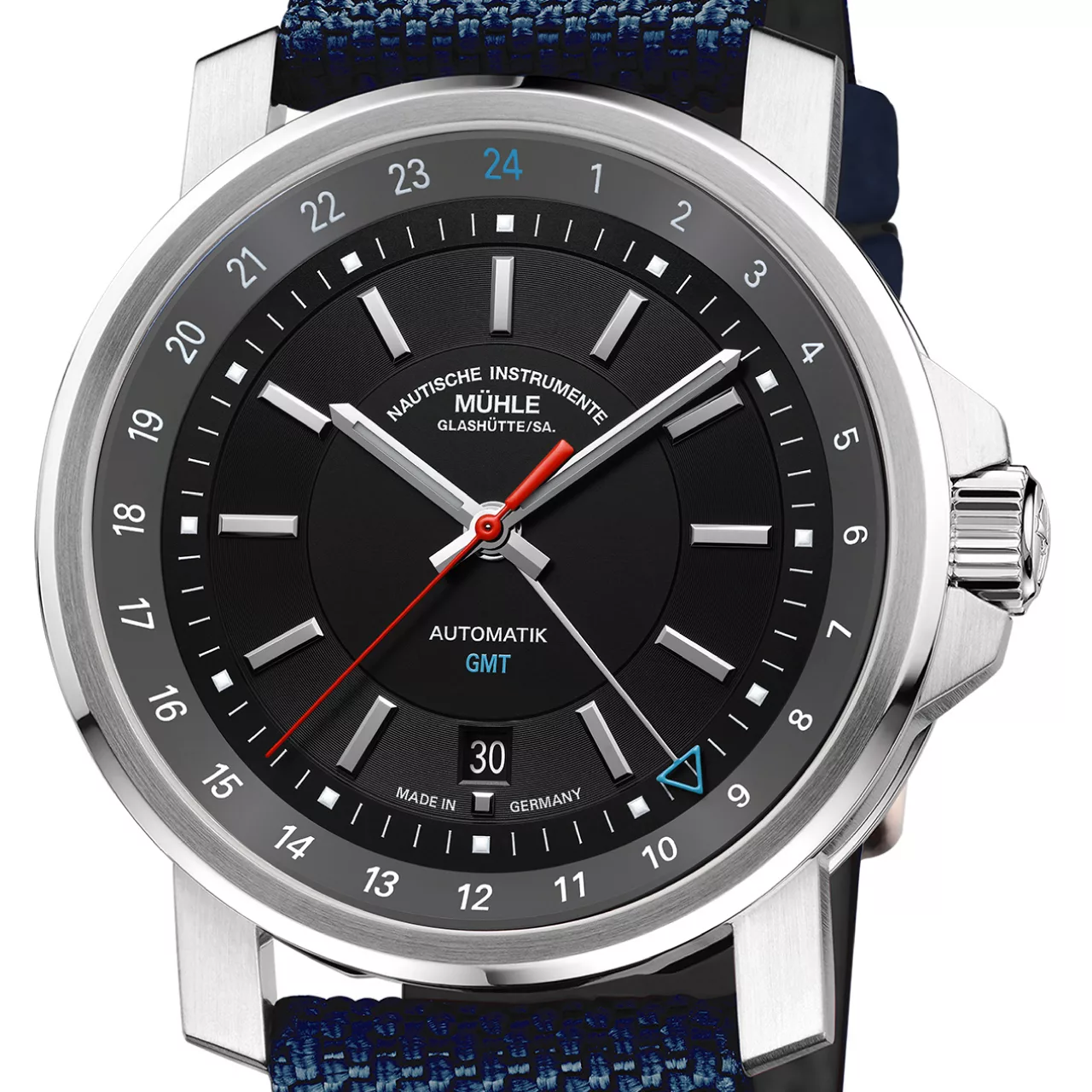
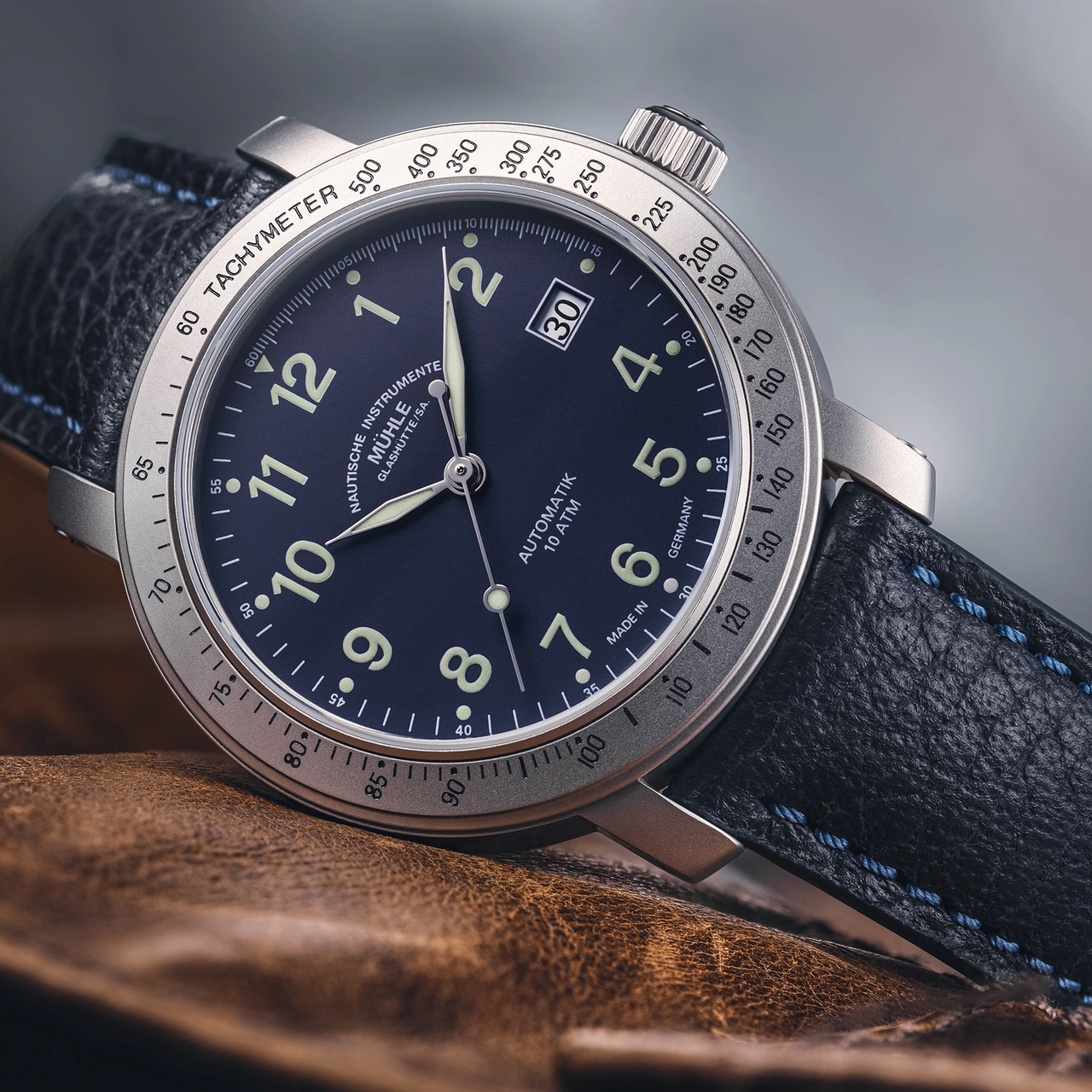
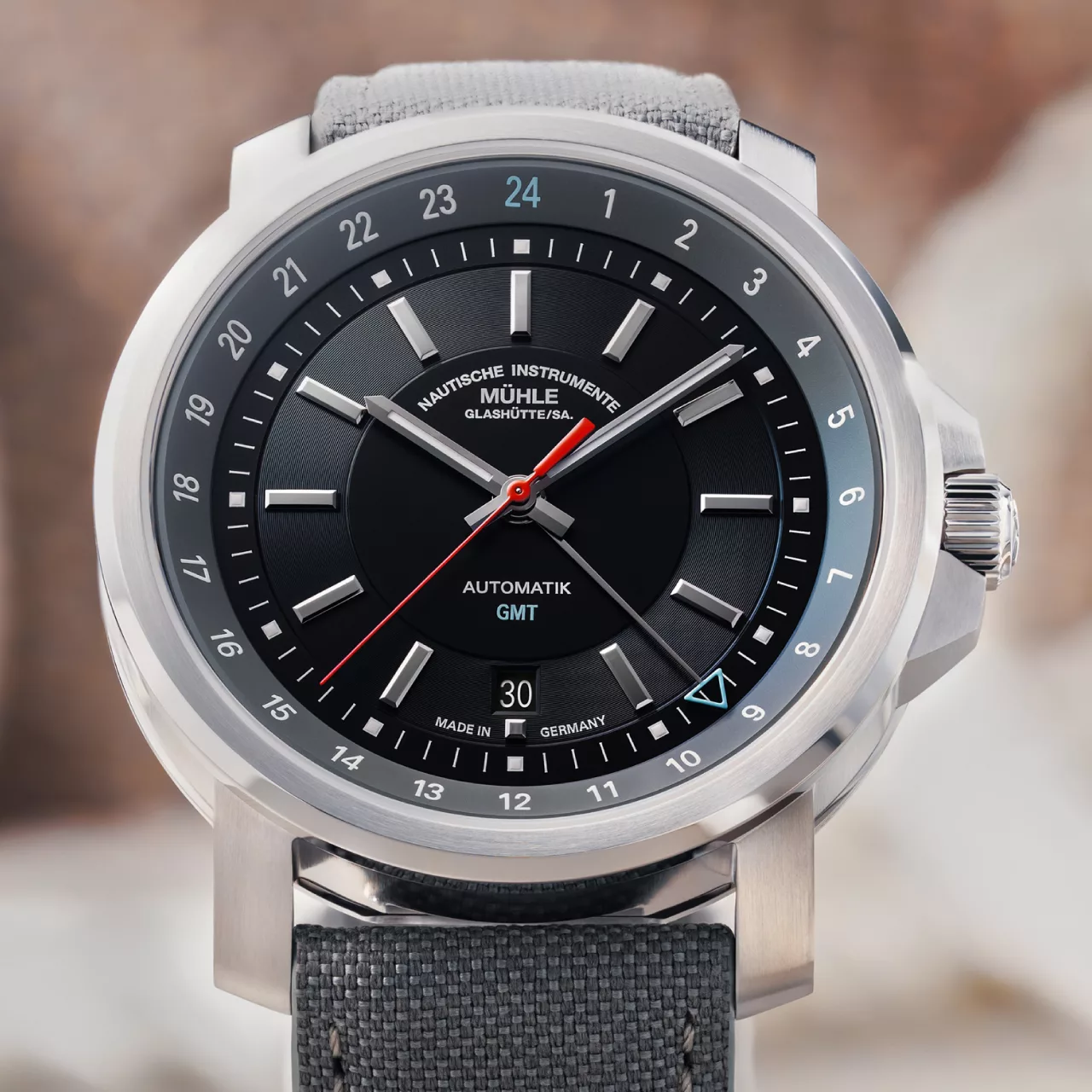
The dial layout reveals careful thinking about information hierarchy. The primary time remains dominant. Large applied indices, crisp white minute markers and generously proportioned hands establish the watch’s first priority: readability.
The GMT scale is positioned on the outer ring, a deliberate separation from the main time display. This is important. Many dual time watches blur the distinction between local and reference time, leading to visual congestion. Here, the second time zone is clearly secondary.
The light blue accent is restrained. It introduces contrast without shifting the emotional tone of the watch. Blue is used precisely where needed – highlighting the “24” on the scale and marking the triangular GMT hand tip. That triangular frame is an intelligent design decision. Because it is open rather than solid, it does not block the dial beneath it. The wearer reads both time zones without visual conflict.
The date window is subtly recessed, echoing the slightly lowered applied indices. This small dimensional shift creates depth without ornament. It is a quiet detail, yet one that reinforces the watch’s structured composition.
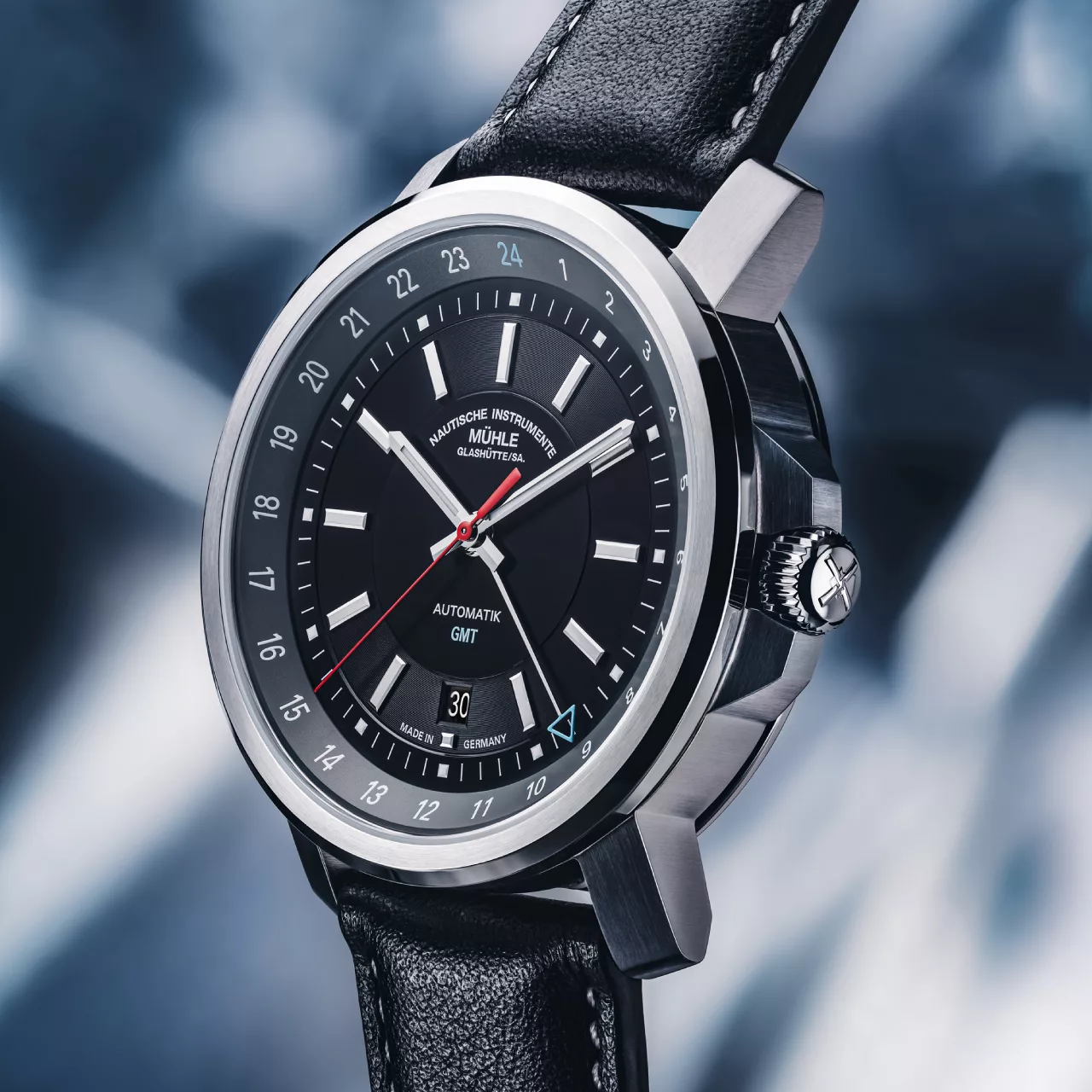
A diameter of 42.4 mm places the 29er Big GMT firmly in modern territory. It has presence. Yet its 10.3 mm thickness changes the conversation entirely.
In the current 29er Big family, this is one of the flattest models. That slim profile is not accidental. It is achieved through the use of the flatter Mühle-version SW 330-2 movement and a redesigned middle case segment. Engineering decisions at the movement level ripple outward to define the watch’s physical identity.
On the wrist, this proportion results in an interesting duality. The watch feels assertive when viewed head-on, yet refined in profile. It slides easily under a cuff, something many GMT watches in this size category fail to accomplish.
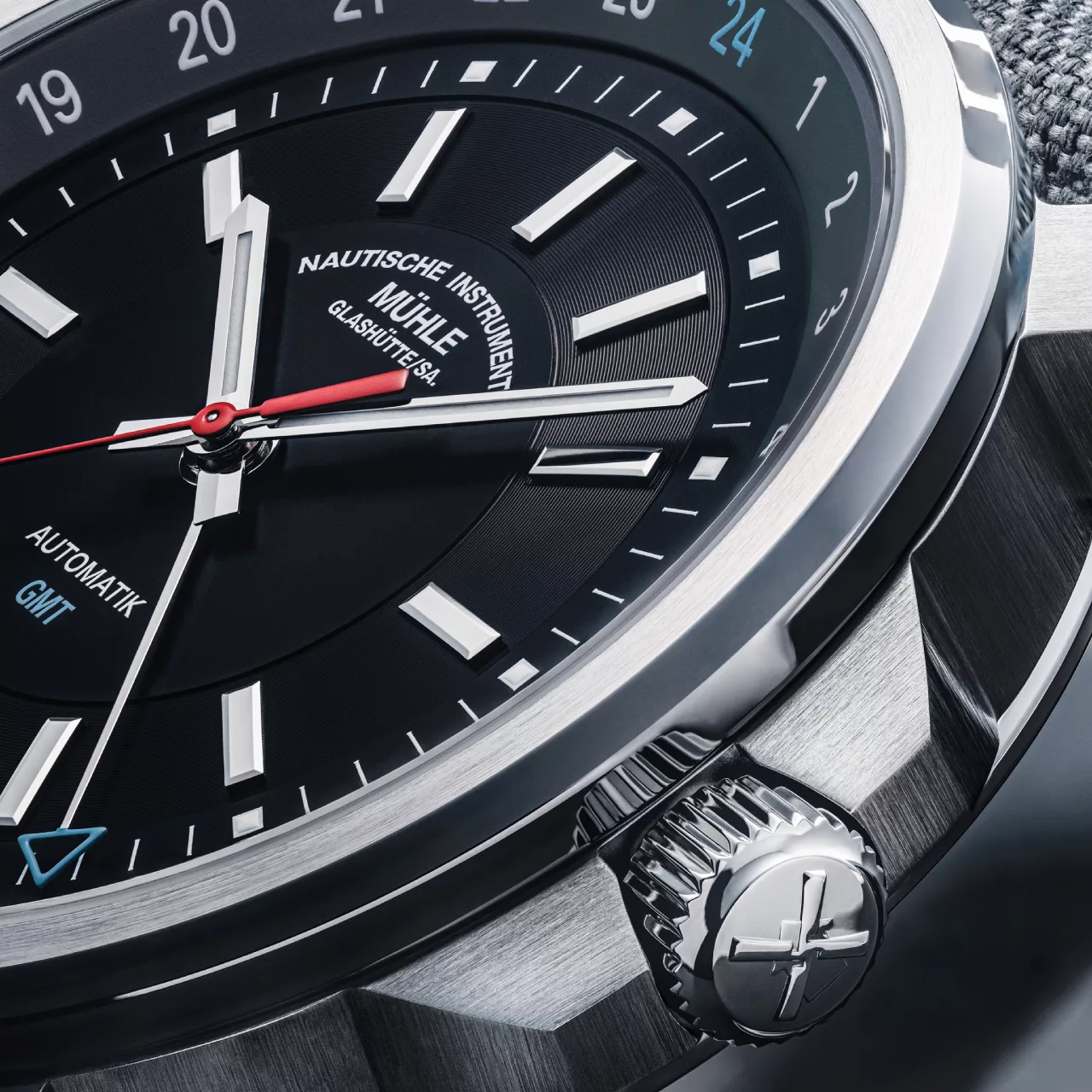
The finishing of the case reflects Mühle’s measured approach. Brushed surfaces dominate, controlling reflections and emphasising utility. Polished accents introduce contrast without turning the watch into jewellery. This is not a flamboyant GMT. It is disciplined.
Inside, the SW 330-2 automatic movement is modified to Mühle’s specification. The base calibre is well respected for its reliability and dual time capability, but what sets this execution apart is the regulation system.
The woodpecker neck fine regulation is not merely a brand signature. It is a mechanical philosophy. By reinforcing the regulator assembly, the system enhances shock resistance and long-term stability. In practical terms, this contributes to consistent timekeeping even under real-world conditions.
More significant, however, is the adjustment standard. Each movement is regulated in six positions to achieve a daily rate between 0 and +8 seconds. This is a deliberate choice. Rather than targeting symmetrical deviation, Mühle ensures the watch will not run slow. The wearer is never late because of the watch. It is a subtle but telling insight into the brand’s priorities.
The 56-hour power reserve is another quiet strength. It ensures practical autonomy without pushing the movement into extreme engineering territory that might compromise reliability.
Collectors will note the special-edition rotor fitted to all new Mühle models introduced in 2026. This rotor marks three decades of wristwatch production at Nautische Instrumente Mühle-Glashütte.
This anniversary matters. The company’s roots lie in marine chronometers and shipboard timekeeping instruments. Wristwatches came later. The commemorative rotor symbolises that transition from maritime precision instruments to contemporary wrist-worn mechanics.
Visible through the exhibition case back, the rotor becomes more than decoration. It situates the 29er Big GMT within a specific historical moment. For enthusiasts who value narrative continuity, this detail carries weight.

It is tempting to categorise the 29er Big GMT simply as a travel watch. And yes, it serves travellers well. But its broader appeal lies in how it expresses dual time functionality without visual excess.
Many GMT watches aim to communicate adventure. Bright bezels, bold typography and contrasting halves on rotating rings often dominate the aesthetic. The 29er Big GMT takes a different route. It integrates the complication into a clean, almost architectural design framework.
This approach will resonate strongly with enthusiasts who appreciate independent German watchmaking. There is a restraint here that feels mature. The watch does not attempt to reinvent the GMT concept. It refines it.
The 29er Big GMT is not chasing the tool watch extreme, nor is it attempting to compete with luxury sports icons. Instead, it occupies a thoughtful middle ground.
It is suited to professionals who move between time zones, but who prefer discretion over spectacle. It appeals to collectors who value regulation standards and movement integrity as much as dial aesthetics. It speaks to those who appreciate that engineering is often most impressive when it is understated.
In a market crowded with oversized, hyper-styled GMT watches, the Mühle-Glashütte 29er Big GMT feels composed. Its strength lies in proportion, disciplined execution and a clear hierarchy of information.
Final Thoughts?
The 29er Big GMT does not rely on novelty to justify its existence. Its significance lies in integration. The dual time function fits naturally within the 29er design language. The slim case profile demonstrates thoughtful mechanical selection. The woodpecker neck regulation reinforces the brand’s maritime precision heritage. The anniversary rotor anchors it in a meaningful milestone year.
Taken together, these elements form a watch that rewards close inspection. It is measured rather than dramatic, precise rather than experimental.
In the world of independent German watchmaking, that kind of discipline carries enduring appeal.