The Moritz Grossmann Backpage Tremblage Blue is the kind of anniversary watch that understands the weight of the occasion it represents. Created for the 200th birthday of Carl Moritz Grossmann, born on 27 March 1826, this special edition does more than place a date on a case back or introduce a commemorative dial colour. It uses the anniversary as an opportunity to reflect on what made Grossmann such an important figure in the first place: technical invention, devotion to craft, and a serious belief that watchmaking should continue to move forward.
Carl Moritz Grossmann was one of the defining personalities of Glashütte watchmaking. He was a master watchmaker, scientist, author, and founder of the German Watchmaking School in Glashütte. His influence helped shape not only the mechanical standards of the region, but also its educational and cultural foundation. For a modern manufactory carrying his name, a 200th birthday tribute needs to be more than ornamental. The Backpage Tremblage Blue succeeds because it feels directly connected to that spirit of intelligent watchmaking.
This is not a watch that looks backwards in a simple nostalgic way. Instead, it takes traditional elements of German high watchmaking and repositions them through a distinctly modern concept. The result is a platinum limited edition that places the movement at the front of the watch, allowing the visual beauty normally seen through the case back to become the main dial-side attraction.
The Backpage idea, made even more expressive
The Backpage concept is one of the most fascinating ideas in Moritz Grossmann’s modern catalogue. In a conventional mechanical watch, the most beautiful movement components are usually hidden on the reverse side. The owner may admire them when the watch is removed from the wrist, but they are not part of the normal experience of reading the time. With the Backpage architecture, Moritz Grossmann changes that relationship.
The calibre 107.0 is built as a mirror-image movement, meaning that the components normally seen on the back can be viewed from the dial side. This is not merely an open-worked watch or a decorative skeleton. It is a more considered architectural idea. The movement is not stripped away for visual drama. It is reconstructed so that its most refined mechanical side becomes the face of the watch.
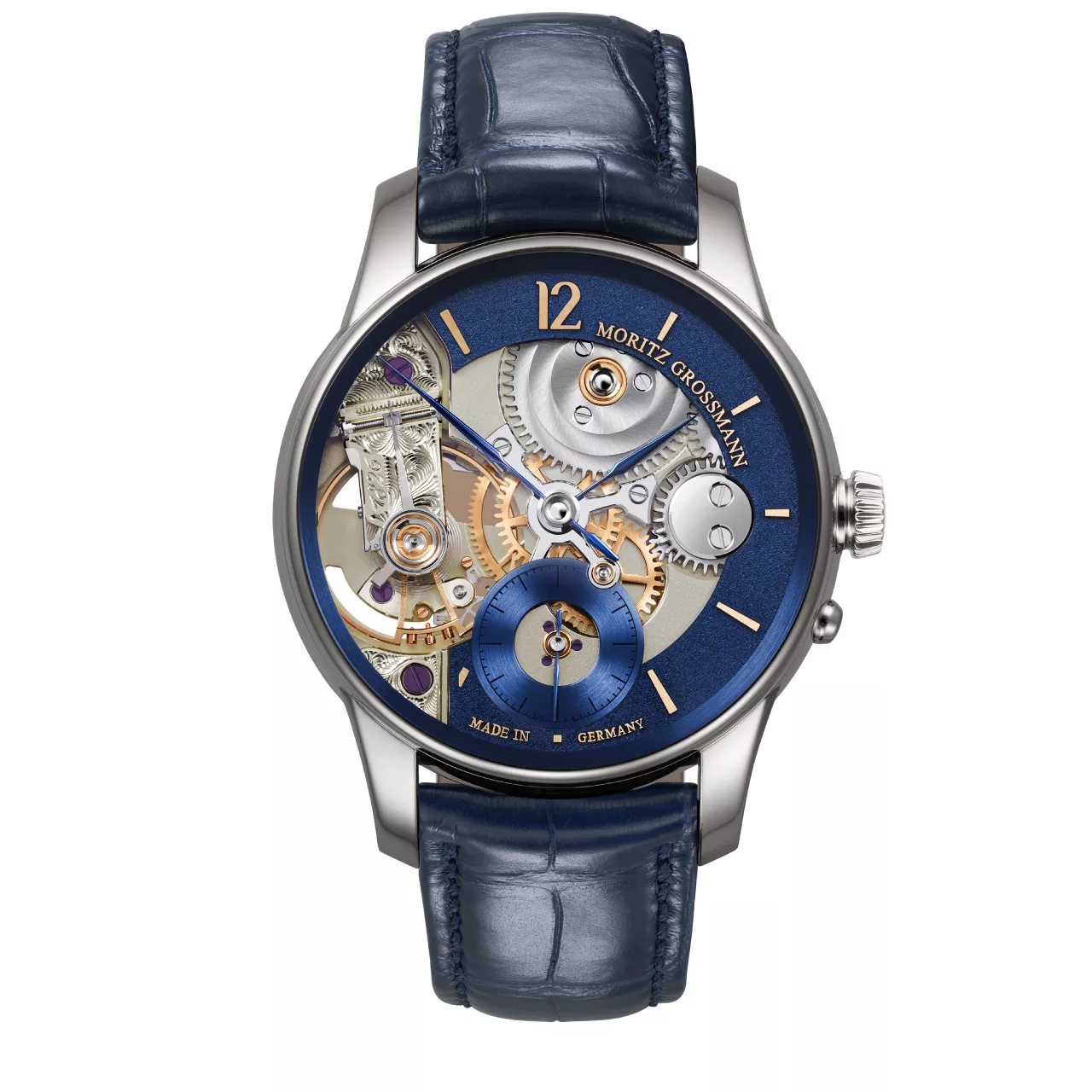
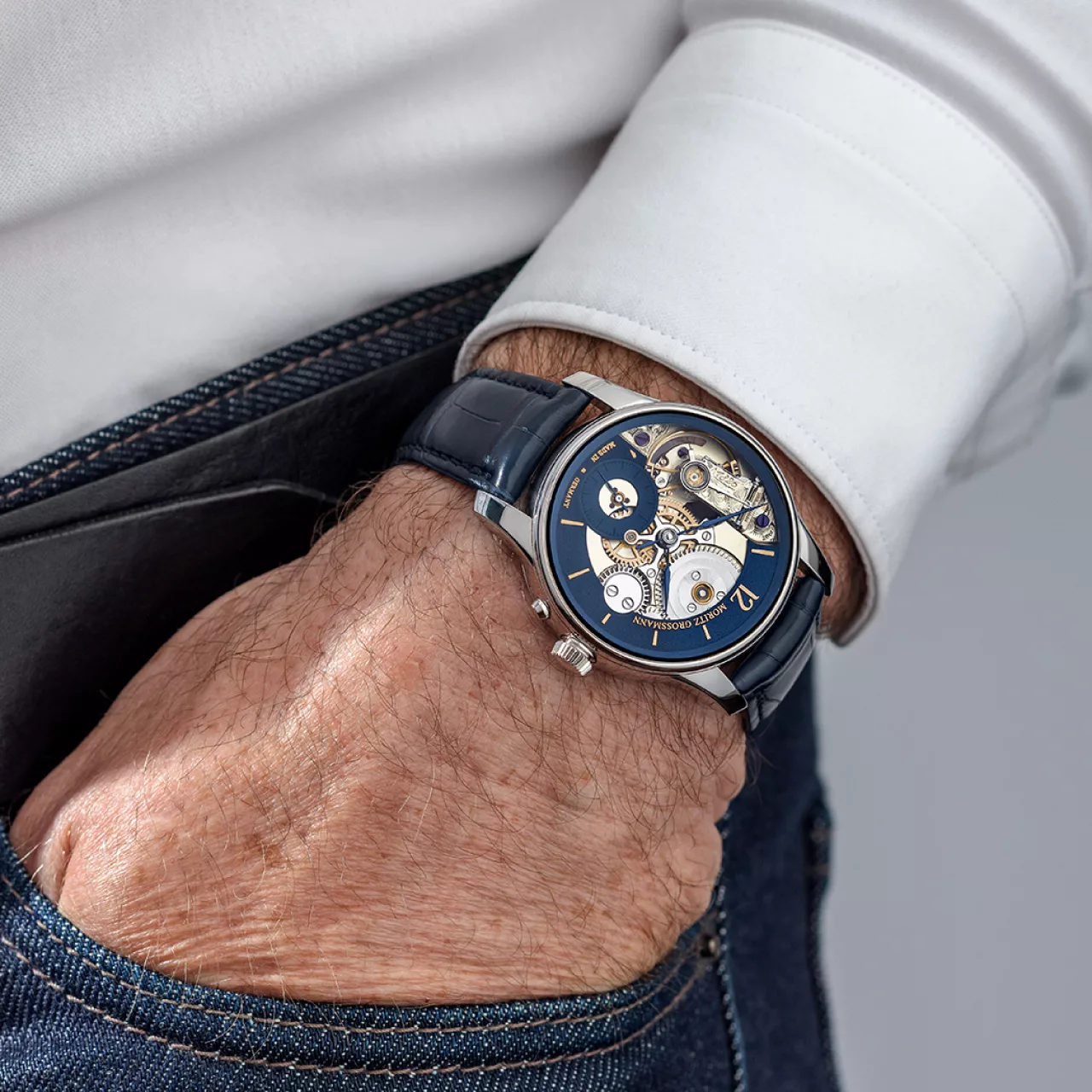
That distinction gives the Backpage Tremblage Blue a different personality from many exposed-movement watches. It is technically expressive, but not chaotic. It reveals, but it does not overstate. The large dial-side cut-out provides a generous view of the Grossmann balance, hand-engraved balance cock, gold chatons, polished screws, bevelled wheels, and three-band snailing on the ratchet wheel. Every visible component feels deliberate.
Calibre 107.0 and the craft of mechanical reversal
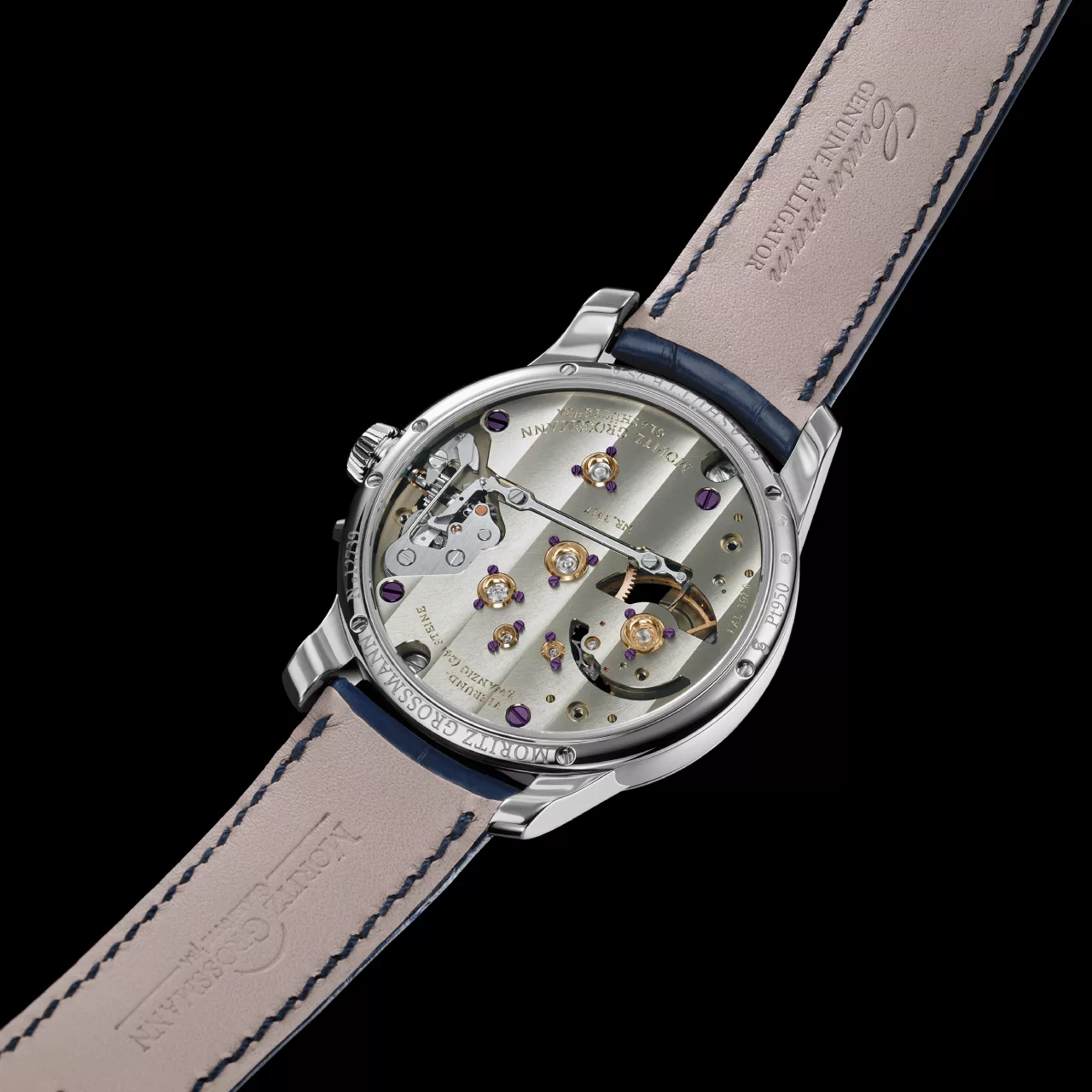
At the heart of the watch is the manually wound Moritz Grossmann manufactory calibre 107.0. It is regulated in five positions and made from 230 parts. While it draws from the foundation of the calibre 100.1, the 107.0 has been reworked in a way that demands genuine movement engineering. To achieve the mirrored construction, Moritz Grossmann added an additional wheel between the crown wheel and ratchet wheel. This reverses the drive train in relation to the rotation of the mainspring barrel.
The mirrored logic also extends to the escapement and oscillation system, including the coiling direction of the balance spring. In other words, the movement is not simply arranged differently for display. Its technical system has been redesigned so it can function properly in this reversed architecture.
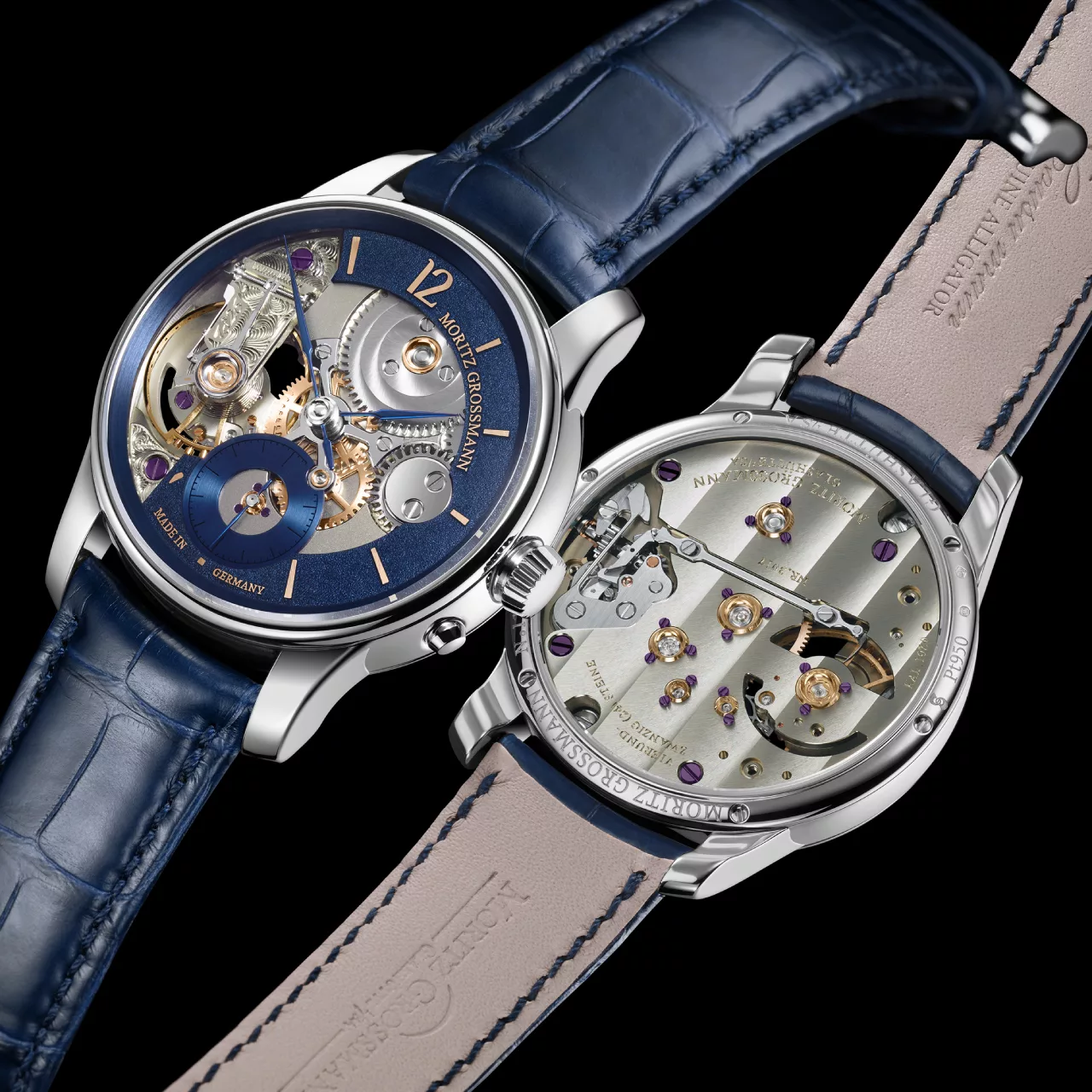
The movement includes 24 jewels and 11 gold chatons, seven of which are screwed chatons. It has a 42-hour power reserve when fully wound, a lever escapement, and a shock-absorbed Grossmann balance measuring 14.2 mm in diameter. The balance is fitted with four inertia screws and two poising screws, while the Nivarox 1 balance spring features a No. 80 Breguet terminal curve with Gustav Gerstenberger geometry.
These are details that matter to serious collectors. They speak to a level of watchmaking that values adjustment, architecture, serviceability, and long-term mechanical integrity. The calibre beats at 18,000 semi-oscillations per hour, giving the movement a traditional rhythm that suits the character of the watch.
The blue meteor tremblage dial
The blue dial section gives this model its distinctive identity. Moritz Grossmann describes the colour as “blue meteor”, a fitting name for a surface that feels vivid but not loud. It brings a cool, almost celestial quality to the watch, contrasting beautifully with the warmth of the gold-plated wheels, gold chatons, and untreated German silver movement components.
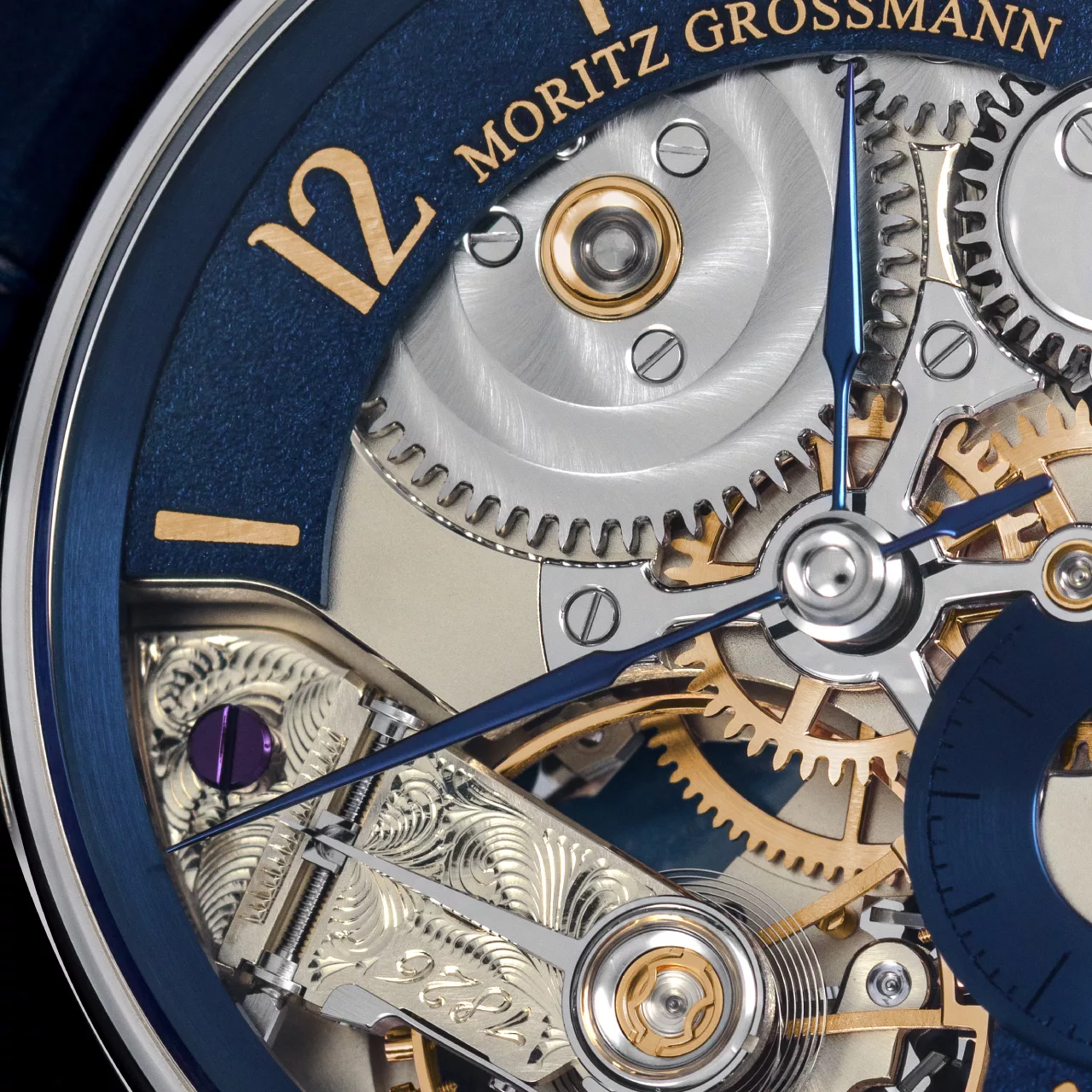
The tremblage engraving is especially important. This traditional technique is performed by hand, with the engraver guiding a cutter in tiny back-and-forth movements across the surface. The process creates a textured, matte finish that has a living quality under light. It does not behave like a flat lacquer or a simple galvanic dial finish. It has grain, depth, and the unmistakable irregularity of handwork.
In the Blue edition, the tremblage surface acts as both dial and frame. It provides colour and structure, while allowing the movement to dominate the visual field. The circulating minute scale and the hour display from 11 to 5 o’clock maintain legibility without interrupting the view of the calibre. This balance between display and restraint is one of the watch’s most impressive achievements.
Hands, case, and finishing details
The hands are manually crafted from steel and annealed to a blue hue. Moritz Grossmann is known for its hands, and this detail should not be overlooked. In many watches, hands are treated as functional necessities. At Grossmann, they are miniature works of craft in their own right. Their colour is not applied as a coating, but achieved through careful heat treatment, giving them a direct relationship to traditional watchmaking methods.
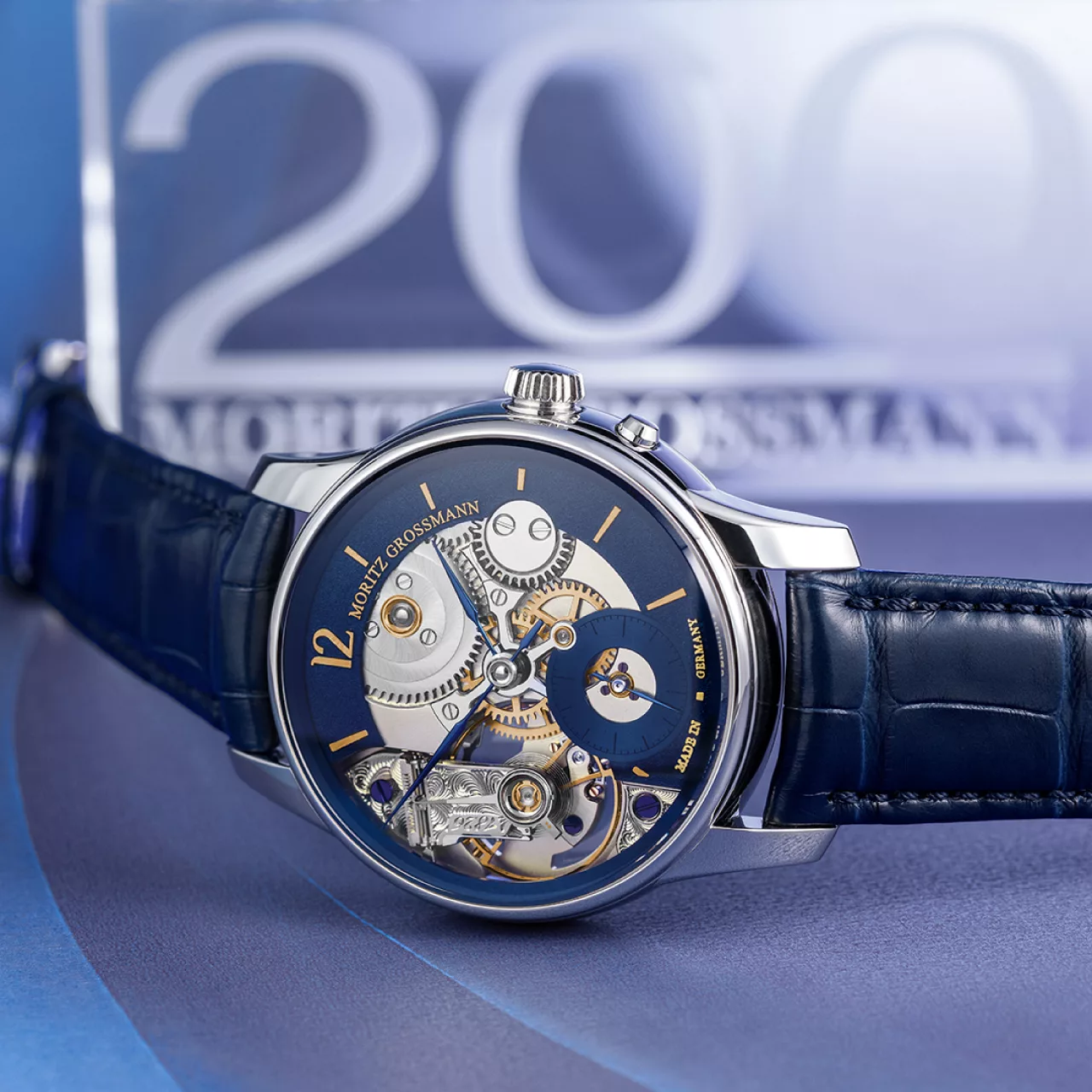
The case is made from platinum, measuring 41.0 mm in diameter and 11.35 mm in height. Platinum is a natural fit for this anniversary edition. It gives the watch physical substance and quiet rarity, while avoiding any unnecessary visual flamboyance. The size also suits the purpose of the watch. A smaller case would not give the movement the same visual space, while a larger one could compromise the refinement of the overall design.
On the balance cock, Moritz Grossmann includes a special “1826” engraving, referencing the founder’s birth year. This is the kind of commemorative detail that feels properly judged. It is meaningful, but not dominant. It rewards close inspection and sits within the movement rather than being treated as a surface-level anniversary badge.
A collector’s perspective
The Backpage Tremblage Blue is limited to twelve pieces, and that number alone places it in rare territory. Yet its collector appeal is not based purely on scarcity. What makes the watch important is the way it combines several of Moritz Grossmann’s strongest qualities in one piece: traditional German movement architecture, uncompromising finishing, hand-crafted hands, visible mechanics, precious metal casework, and a meaningful anniversary context.
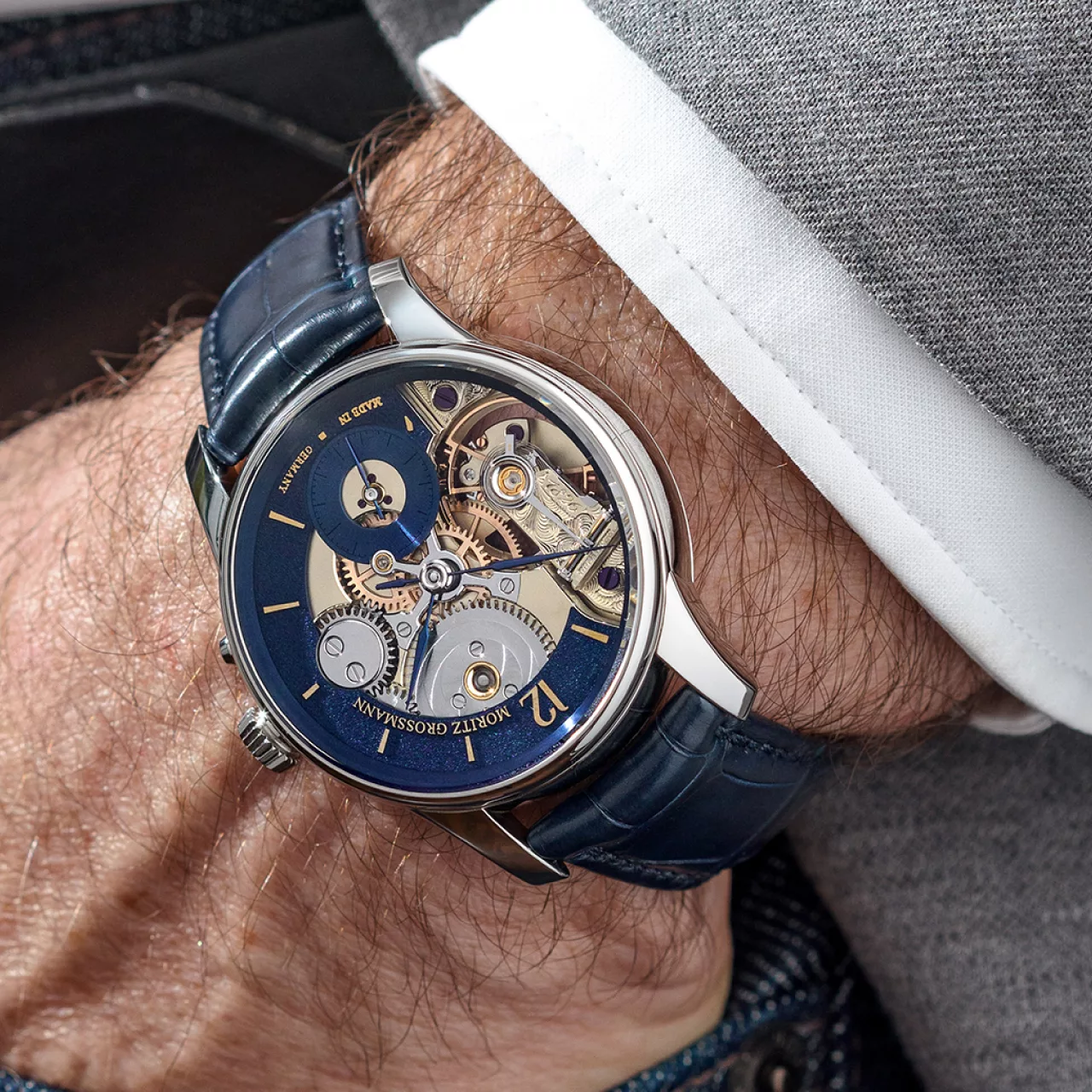
The Blue edition may be the more immediately striking of the two Backpage Tremblage anniversary variants. The blue meteor tremblage surface gives the watch clarity, coolness, and visual energy. It feels technical and refined, but also contemporary. It is a watch that could only come from a brand with deep historical roots and the confidence to reinterpret them rather than simply repeat them.
For collectors of independent watchmaking, this model represents something increasingly rare: a watch where the main attraction is not a complication in the usual sense, but the architecture and finishing of the movement itself. The complication, in a way, is the act of reversal. The beauty lies in making the movement visible without reducing it to spectacle.
Final thoughts
The Moritz Grossmann Backpage Tremblage Blue is a remarkable anniversary watch because it feels worthy of the person it honours. It is thoughtful, technically demanding, visually distinctive, and finished with the kind of care that defines the best of Glashütte watchmaking.
It does not rely on nostalgia alone. Instead, it celebrates Moritz Grossmann’s legacy by continuing the tradition of intelligent mechanical development. The mirrored calibre 107.0, blue meteor tremblage dial, platinum case, hand-crafted annealed blue hands, and “1826” engraving all serve the same purpose: to create a watch that respects history while remaining vividly alive in the present.
Limited to only twelve pieces, the Backpage Tremblage Blue is not simply a beautiful watch. It is a mechanical tribute, a collector’s object, and a reminder that the most compelling anniversary editions are those that add something meaningful to the story rather than merely marking the passing of time.